

You might be trying to build simple Spanish sentences but feel unsure about small connecting words.
If you’ve ever searched for how to say with in spanish, you’re in the right place.
Learning short words like this can feel confusing at first, especially when they change how a whole sentence sounds.
But don’t worry; this guide will help you understand it easily so you can speak more naturally and confidently in everyday conversations.
The Main Word for “With” in Spanish
Con – The Most Common Translation
The Spanish word for “with” is con.
- Meaning: With
- Usage: Everyday conversations
- Type: Preposition
Example:
- Voy con mi amigo.
(I go with my friend.) - Quiero café con leche.
(I want coffee with milk.)
“Con” is one of the most important and frequently used words in Spanish.
Pronunciation Made Easy
Pronouncing “con” is simple.
- Sounds like: “kohn”
- Short and clear sound
- No silent letters
Practice saying it out loud to feel comfortable using it.
Using “Con” in Sentences
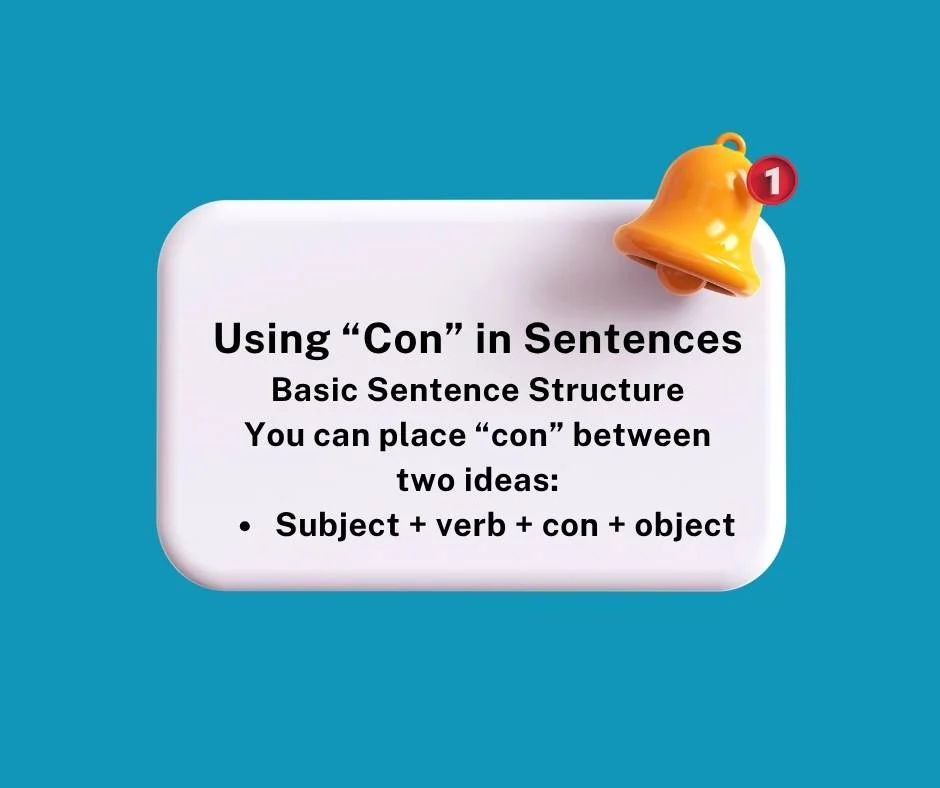
Knowing how to say with in Spanish becomes easier when you use it in real sentences.
Basic Sentence Structure
You can place “con” between two ideas:
- Subject + verb + con + object
Example:
- Vivo con mi familia.
(I live with my family.)
Talking About People
Use “con” when mentioning who you are with.
- Salgo con mis amigos.
(I go out with my friends.) - Trabajo con ella.
(I work with her.)
Talking About Things
You can also use it for objects.
- Pan con queso
(Bread with cheese) - Agua con limón
(Water with lemon)
This shows how flexible “con” is in daily use.
How to say without in spanish
The Spanish word for “without” is sin. You use sin when you want to say that something is missing or not included. It is one of the most common Spanish prepositions and works in many everyday conversations.
- Sin means “without” in Spanish.
- Use sin before a noun or pronoun.
- Say sin azúcar for “without sugar.”
- Say sin leche for “without milk.”
- Use sin dinero for “without money.”
- Say sin problema for “without a problem.”
- Sin never changes its spelling.
- It is easy to remember because it always means “without.”
- Native Spanish speakers use sin every day.
- Learning sin helps you make simple and useful sentences.
With in spanish duolingo
If you are learning Spanish on Duolingo, the word for “with” is con. It is one of the first prepositions beginners learn because it appears in many common phrases and daily conversations.
- Con means “with” in Spanish.
- Use con to show that people or things are together.
- Say con amigos for “with friends.”
- Say con café for “with coffee.”
- Duolingo teaches con in beginner lessons.
- Con stays the same in every sentence.
- It is useful for speaking naturally.
- You will hear con in everyday Spanish.
- Practice using con in short sentences.
- Learning con builds a strong Spanish foundation.
When to use con” in Spanish
You use con in Spanish whenever you want to express “with.” It connects people, objects, or actions and is an essential part of everyday communication.
- Use con to mean “with.”
- Say con mi familia for “with my family.”
- Use it to describe company or companionship.
- Use it to mention tools or objects.
- Say con amor for “with love.”
- Use con in simple conversations.
- It works with people and things.
- Native speakers use con very often.
- It makes sentences clear and natural.
- Practice con to improve your Spanish.
How to say want’ in Spanish

The most common way to say “want” in Spanish is querer. You change the verb depending on the person who is speaking, but querer is the base form you will see in dictionaries and language lessons.
- Querer means “to want.”
- Say quiero for “I want.”
- Say quieres for “you want.”
- Use querer in daily conversations.
- It is one of the most common Spanish verbs.
- You can use it for things or actions.
- It also expresses wishes and desires.
- Learn its basic forms early.
- Practice it with simple examples.
- Querer helps you communicate naturally.
Sugar in Spanish
The Spanish word for “sugar” is azúcar. You will often hear it in restaurants, cafés, grocery stores, and everyday conversations.
- Azúcar means “sugar.”
- Say sin azúcar for “without sugar.”
- Say con azúcar for “with sugar.”
- It is common in food vocabulary.
- You will see azúcar on product labels.
- The word is easy to recognize.
- It appears in many beginner lessons.
- Practice saying it with drinks.
- Native speakers use it every day.
- Learning azúcar expands your food vocabulary.
Milk in Spanish

The Spanish word for “milk” is leche. It is one of the first food-related words many Spanish learners memorize because it appears in daily life.
- Leche means “milk.”
- Say leche fría for “cold milk.”
- Say con leche for “with milk.”
- Use it in cafés and restaurants.
- It is a common household word.
- You will hear it often in conversations.
- It is easy to pronounce with practice.
- Learn it with other food words.
- It appears in beginner Spanish lessons.
- Knowing leche helps with daily communication.
What is ice in Spanish
The Spanish word for “ice” is hielo. It is commonly used when talking about cold drinks, weather, or frozen objects.
- Hielo means “ice.”
- Say con hielo for “with ice.”
- Use it when ordering cold drinks.
- It is common in travel conversations.
- You will hear it in restaurants.
- The word is useful year-round.
- Practice saying hielo aloud.
- Learn it with drink-related vocabulary.
- Native speakers use it frequently.
- Knowing hielo improves practical Spanish.
Young in Spanish
The most common Spanish word for “young” is joven. You can use it to describe a young person or someone who is not old.
- Joven means “young.”
- Use it for both people and age descriptions.
- Say una persona joven for “a young person.”
- It is common in everyday speech.
- The word works for males and females.
- You will find it in beginner lessons.
- It is useful in conversations about people.
- Practice using joven in simple sentences.
- Native speakers use it regularly.
- Learning joven helps you describe people naturally.
Special Forms with Pronouns
When using “con” with certain pronouns, the form changes slightly.
Conmigo – With Me
- Con + mí → conmigo
Example:
- Ven conmigo.
(Come with me.)
Contigo – With You (Informal)
- Con + ti → contigo
Example:
- Voy contigo.
(I go with you.)
Consigo – With Himself/Herself
- Con + sí → consigo
Example:
- Lleva el libro consigo.
(He carries the book with him.)
These special forms are important to remember because they don’t follow the usual pattern.
Using “Con” in Everyday Situations
Learning how to say with in Spanish is easier when you see it in real life.
At a Restaurant
- Quiero pizza con queso extra.
(I want pizza with extra cheese.)
Talking About Activities
- Juego fútbol con mis amigos.
(I play soccer with my friends.)
Describing Possession
- Ella viene con su perro.
(She comes with her dog.)
Making Plans
- Voy al cine con mi familia.
(I go to the cinema with my family.)
These examples show how often “con” appears in daily conversations.
Common Expressions with “Con”
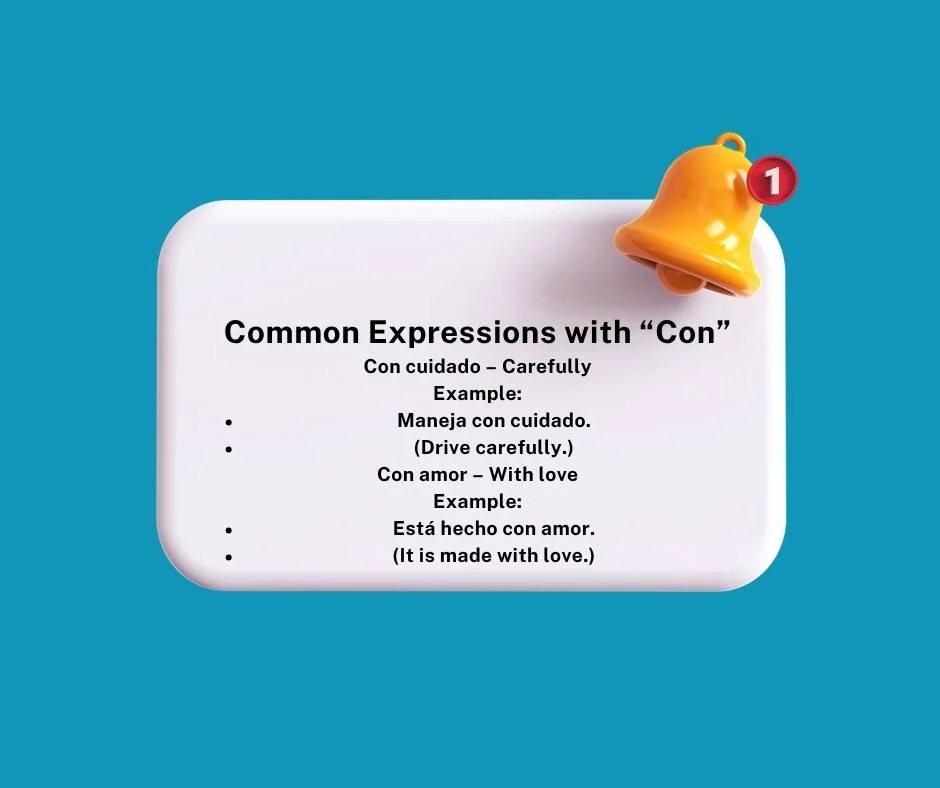
Spanish has many expressions using this word.
Con cuidado – Carefully
Example:
- Maneja con cuidado.
(Drive carefully.)
Con amor – With love
Example:
- Está hecho con amor.
(It is made with love.)
Con ganas – With enthusiasm
Example:
- Trabaja con ganas.
(Work with enthusiasm.)
These expressions help you sound more natural and fluent.
When “With” Is Not Translated as “Con”
Sometimes, English and Spanish don’t match exactly.
Using “De” Instead of “Con”
In some cases, Spanish uses “de.”
Example:
- Un hombre de negocios
(A man of business, not “with business”)
Using “En” for Certain Contexts
Sometimes “with” becomes “en.”
Example:
- Es bueno en matemáticas
(He is good at math, not “with math”)
Context Matters
Spanish often changes based on meaning.
- Don’t translate word-for-word
- Focus on understanding the sentence
Learning these differences will improve your accuracy.
Advanced Uses of “Con”
Once you know the basics, you can explore deeper uses.
Expressing Means or Tools
Use “con” to show how something is done.
- Corto con un cuchillo.
(I cut with a knife.)
Showing Company
Use it to show who you are with.
- Estoy con mi hermana.
(I am with my sister.)
Expressing Conditions
“Con” can describe conditions.
- Con tiempo, todo es posible.
(With time, everything is possible.)
These advanced uses help you sound more fluent.
Common Mistakes to Avoid
When learning how to say with in Spanish, beginners often make these mistakes.
Direct Translation Errors
Not every “with” translates to “con.”
- Always check the context
Forgetting Special Forms
- Don’t say “con mí”
- Correct: conmigo
Overusing “Con”
Sometimes another preposition fits better.
- Learn alternatives like “de” and “en”
Misplacing the Word
Make sure “con” is in the right position.
- Correct: Voy con él
- Not: Voy él con
Avoiding these mistakes will improve your fluency quickly.
Tips to Practice and Remember
Building confidence takes regular practice.
Use It in Daily Sentences
Talk about your routine.
- Vivo con mi familia
- Estudio con amigos
Practice Speaking Out Loud
Say sentences clearly.
- Repeat simple phrases
- Focus on pronunciation
Watch Spanish Content
Listen to how native speakers use “con.”
- Movies
- Videos
- Conversations
Write Short Examples
Writing helps memory.
- Create your own sentences
- Practice different situations
These small habits will help you remember easily.
Real-Life Dialogue Examples
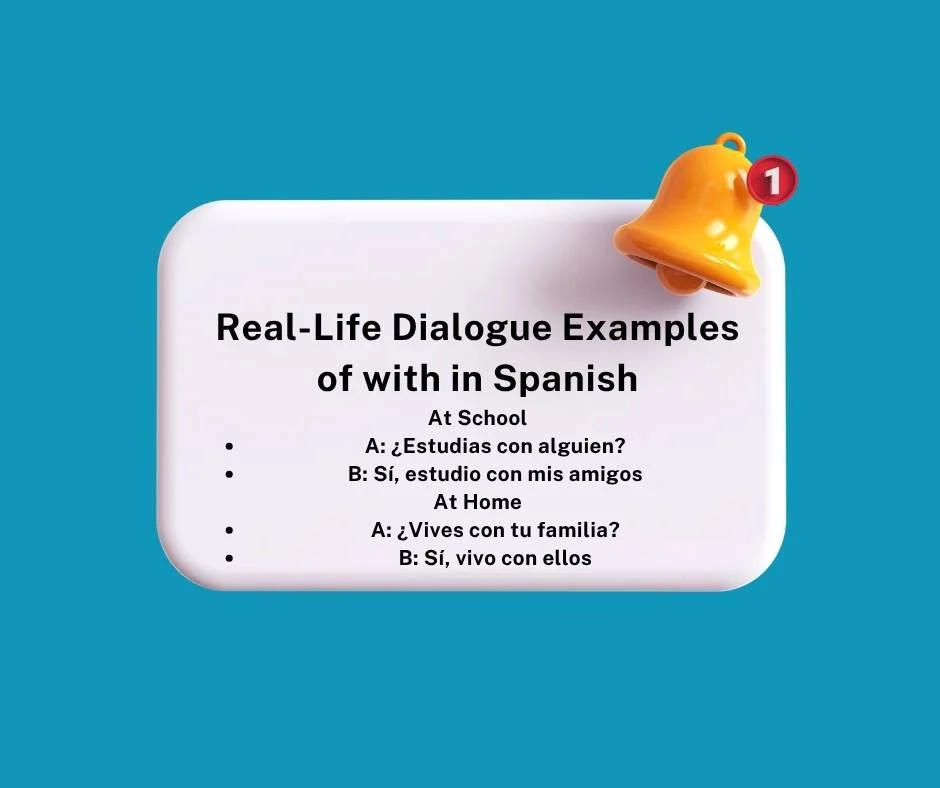
Using dialogues can improve your understanding.
Casual Conversation
- A: ¿Con quién vas?
- B: Voy con mi hermano
Planning an Event
- A: ¿Quieres venir conmigo?
- B: Sí, claro
At School
- A: ¿Estudias con alguien?
- B: Sí, estudio con mis amigos
At Home
- A: ¿Vives con tu familia?
- B: Sí, vivo con ellos
These examples show how natural and useful “con” is.
Frequently Asked Questions (FAQs)
What is the main word for how to say with in Spanish?
The main word is “con,” which is used in most everyday situations.
How do you say “with me” in Spanish?
You say “conmigo,” not “con mí.”
Can “with” always be translated as “con”?
No, sometimes Spanish uses other words like “de” or “en.”
What is “with you” in Spanish?
It is “contigo” in informal situations.
Why is “con” important when learning how to say with in Spanish?
Because it is used in many daily conversations and helps connect ideas clearly.
How to use con in Spanish?
Con means “with” in Spanish and is used to show companionship, possession, or the way something is done. For example, Voy con mi amigo means “I’m going with my friend,” and Café con leche means “coffee with milk.”
How do you say the word “with”?
The Spanish word for “with” is con. It is the standard and most common preposition used to connect people, objects, or ideas in everyday Spanish conversations.
How do you say “with or without” in Spanish?
The phrase “with or without” is translated as con o sin in Spanish. It is commonly used in daily speech, such as con o sin azúcar (“with or without sugar”) or con o sin permiso (“with or without permission”).
Is “con” the only word for “with” in Spanish?
Con is the main Spanish word that means “with.” However, depending on the sentence, Spanish may use different expressions instead of a direct translation, but con is the correct choice for most situations.
What is “te tengo”?
Te tengo literally means “I have you.” Depending on the context, it can also mean “I’ve got you,” “I found you,” or “I’m here for you,” making it a flexible expression in everyday Spanish.
What does el con mean?
El con is not commonly used as a standalone phrase in Spanish. The word con means “with,” while el is the masculine article meaning “the.” Together, they usually appear only as part of a larger sentence rather than having a separate meaning.
Conclusion
Learning how to say with in Spanish is a simple but powerful step in your language journey.
The word “con” appears in everyday conversations, expressions, and sentences.
By practicing regularly and understanding its different uses, you’ll be able to speak more naturally and confidently in Spanish.
Also Check These Posts:
How to Say Uranus the Easy Way with Clear Sound Breakdown
How To Say Your Welcome in German Explained Clearly With Practical Examples
How to Say Cute in Japanese Perfectly for Travel, Anime and Daily Talk

Darcy Lynn
Darcy Lynn has always been fascinated by the colors and stories of life. Her journey with writing began in childhood, and today she takes readers into new worlds through her stories. For her, every word is a way to explore new experiences and emotions. Darcy loves exploring stories across different cultures and languages, which also reflects in her unique writing style. She believes that a good story touches every heart and sparks deeper thinking. Alongside writing, she enjoys connecting directly with her readers and understanding their feelings.
Books:
-
Whispers Across Worlds
-
Echoes of Tomorrow