

How to say me in French is one of the first small but important steps when learning everyday conversation in a new language.
If you are just starting with French, understanding how pronouns work will help you speak more naturally and confidently.
In this guide, you will learn how “me” is used in different situations in the French language, along with easy examples, rules, and common mistakes to avoid.
Understanding “Me” in French
Before translating directly, it is important to understand that English and French do not always match word-for-word. The word “me” changes depending on how it is used in a sentence.
In French, “me” can appear in different forms such as:
- me
- moi
- m’ (short form before vowels)
These forms are not interchangeable randomly; they depend on grammar rules.
In simple terms:
- “me” is used inside a sentence (before verbs)
- “moi” is used for emphasis or alone
For example:
- He sees me → Il me voit
- Give it to me → Donne-le-moi
- Me too → Moi aussi
So, instead of one fixed translation, French uses different versions depending on meaning.
Basic Meaning of “Me” in French
The simplest answer to how to say me in French is:
- me (used as a direct or indirect object)
- moi (used for emphasis or standalone usage)
Easy breakdown:
- Me → me / m’
- Used before verbs
- Example: Il me parle (He talks to me)
- Moi → me (emphasis)
- Used after prepositions or for stress
- Example: C’est moi (It’s me)
Quick examples:
- She loves me → Elle m’aime
- They call me → Ils m’appellent
- This is for me → C’est pour moi
At this stage, the key idea is simple: “me” in French is not always one fixed word.
Difference Between “Me” and “Moi”
One of the most confusing parts for beginners is understanding when to use “me” and when to use “moi.”
“Me” (unstressed form)
- Used before verbs
- Always attached to action
Examples:
- He helps me → Il me aide
- She sees me → Elle me voit
“Moi” (stressed form)
- Used for emphasis
- Used after prepositions like “for,” “with,” “to”
Examples:
- It is for me → C’est pour moi
- Come with me → Viens avec moi
- Me too → Moi aussi
Simple trick:
- If the word comes BEFORE the verb → use “me”
- If it comes AFTER a preposition or alone → use “moi”
How “Me” Works in Sentences
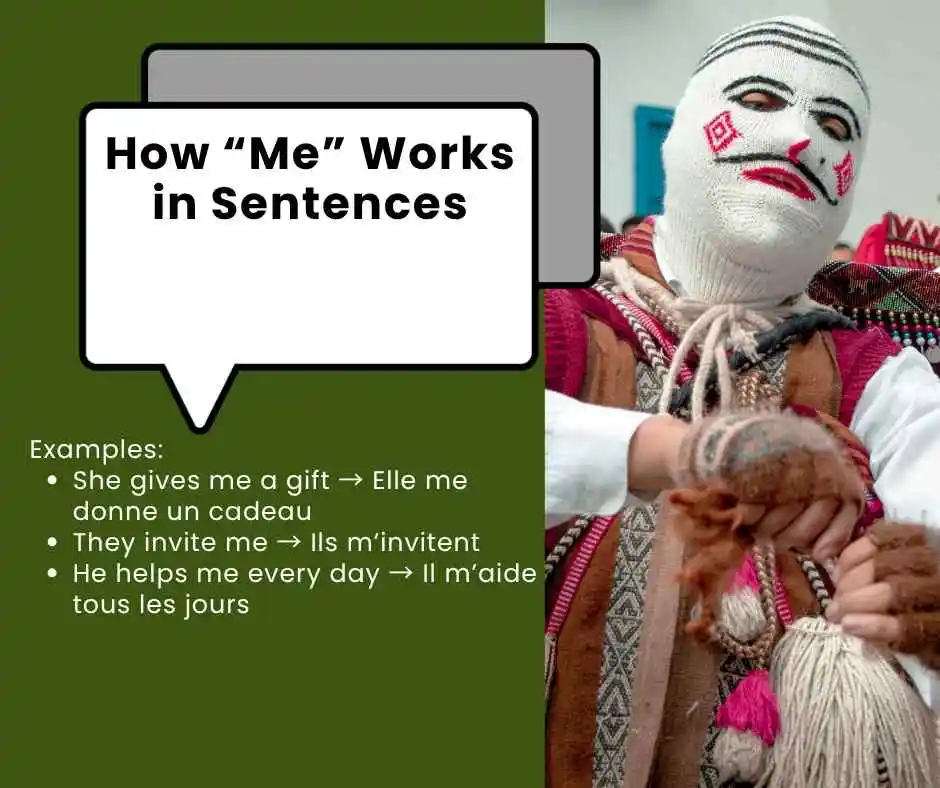
In French sentences, word order is very important. Unlike English, pronouns usually come before the verb.
Basic structure:
Subject + me + verb + rest of sentence
Examples:
- She gives me a gift → Elle me donne un cadeau
- They invite me → Ils m’invitent
- He helps me every day → Il m’aide tous les jours
With negation:
- She does not see me → Elle ne me voit pas
- They do not call me → Ils ne m’appellent pas
Notice how “me” stays in the same position even when the sentence is negative.
Object Pronouns in French Explained Simply
To fully understand how to say me in French, you need to know about object pronouns.
Object pronouns replace nouns to avoid repetition.
Instead of saying:
- John helps John’s friend
French uses pronouns:
- John helps him → Jean l’aide
Types of object pronouns:
- me (me)
- te (you – informal)
- le / la (him / her / it)
- nous (us)
- vous (you – formal/plural)
- les (them)
Example with “me”:
- He sees me → Il me voit
- They know me → Ils me connaissent
This system makes French sentences smoother and more natural.
Reflexive Verbs and “Me”
Another important part of learning how to say me in French is reflexive verbs.
Reflexive verbs are actions you do to yourself.
In French, “me” becomes part of the verb structure.
Examples:
- I wash myself → Je me lave
- I wake myself up → Je me réveille
- I prepare myself → Je me prépare
Key structure:
Subject + me + reflexive verb
These verbs are very common in daily French conversation, especially for routines.
Common Mistakes Learners Make
When learning how to say me in French, beginners often make simple but important mistakes.
Mistake 1: Using “moi” everywhere
Wrong: Il moi voit
Correct: Il me voit
Mistake 2: Wrong placement
Wrong: Il voit me
Correct: Il me voit
Mistake 3: Mixing “me” and “moi”
Wrong: Donne me ça
Correct: Donne-moi ça
Mistake 4: Forgetting contraction
Before vowels, “me” becomes “m’”
- Il m’aime (He loves me)
Easy tip:
If the sentence sounds awkward, check pronoun placement first.
Real-Life Conversation Examples
To understand better, let’s look at real-life usage of how to say me in French in daily situations.
At school:
- Teacher helps me → Le professeur m’aide
- They teach me French → Ils m’enseignent le français
At home:
- My mother calls me → Ma mère m’appelle
- My brother sees me → Mon frère me voit
With friends:
- Call me later → Appelle-moi plus tard
- Don’t forget me → Ne m’oublie pas
Social situations:
- They invite me to the party → Ils m’invitent à la fête
- She remembers me → Elle se souvient de moi
These examples show how flexible the word “me” becomes in real conversations.
Advanced Understanding for Better Fluency
Once you understand the basics, you can move to slightly advanced usage.
Double object pronouns:
- He gives it to me → Il me le donne
- She sends it to me → Elle me l’envoie
Word order rule:
In advanced sentences, object pronouns still come before the verb cluster.
Formal vs informal:
- Informal: Tu me parles
- Formal: Vous me parlez
Even in formal speech, “me” stays the same, but sentence structure changes slightly.
Quick Summary Table
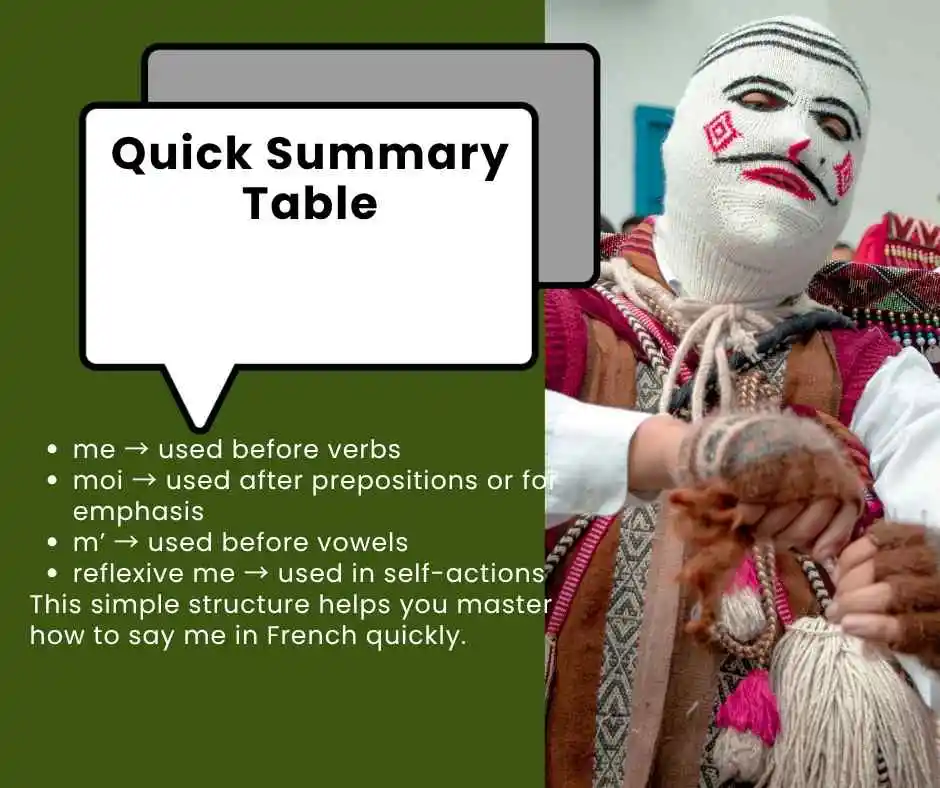
- me → used before verbs
- moi → used after prepositions or for emphasis
- m’ → used before vowels
- reflexive me → used in self-actions
This simple structure helps you master how to say me in French quickly.
Frequently Asked Questions
What is the easiest way to say me in French?
The easiest way is “me” when it is before a verb and “moi” when used for emphasis or after prepositions.
When should I use “me” in French sentences?
Use “me” when it comes before the verb, such as in “Il me voit” (He sees me).
What is the difference between “me” and “moi” in French?
“Me” is used inside sentences before verbs, while “moi” is used for emphasis or after prepositions like “for me.”
Can “me” change in French grammar?
Yes, it can become “m’” before vowels and changes depending on sentence structure.
Is “me” used in everyday French conversations?
Yes, “me” is very common in daily speaking, especially in greetings, actions, and reflexive verbs.
Conclusion
Learning how to say me in French is a small but powerful step toward speaking the language naturally. Once you understand when to use “me,” “moi,” and “m’,” your sentences become clearer and more fluent. With practice and real-life examples, you can quickly build confidence in everyday communication using simple French structures.
Also Check These Posts:
How to Say Happy Thanksgiving with Heart in 2026
How to Say 17 in Spanish Without Mistakes
Learn How to Say You’re Welcome in Italian and Impress Everyone

Darcy Lynn
Darcy Lynn has always been fascinated by the colors and stories of life. Her journey with writing began in childhood, and today she takes readers into new worlds through her stories. For her, every word is a way to explore new experiences and emotions. Darcy loves exploring stories across different cultures and languages, which also reflects in her unique writing style. She believes that a good story touches every heart and sparks deeper thinking. Alongside writing, she enjoys connecting directly with her readers and understanding their feelings.
Books:
-
Whispers Across Worlds
-
Echoes of Tomorrow