

You might be trying to talk about family in Spanish and feeling unsure about the right word to use.
If you’ve ever searched for how to say son in spanish, you’re in the right place.
Learning family-related words can feel a little confusing at first, especially when you want to speak correctly and confidently.
But don’t worry;this guide will make it simple so you can use it naturally in real conversations with ease.
The Basic Word for Son in Spanish
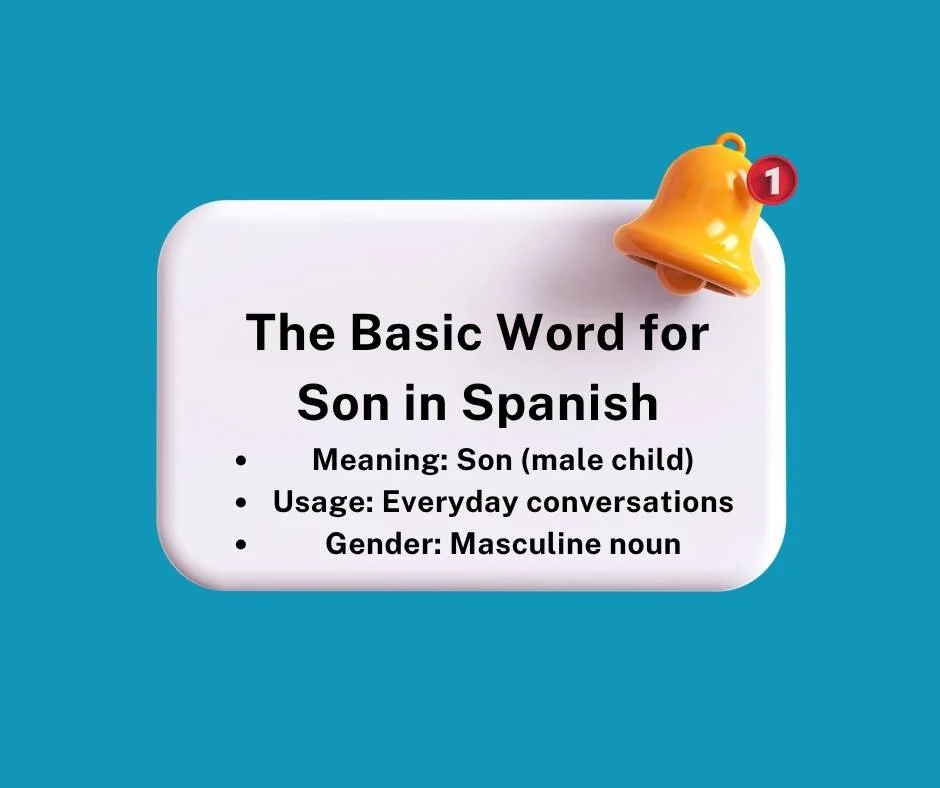
Hijo – The Most Common Translation
The Spanish word for “son” is hijo (pronounced: ee-ho).
- Meaning: Son (male child)
- Usage: Everyday conversations
- Gender: Masculine noun
Example:
- Tengo un hijo.
(I have a son.) - Mi hijo estudia en la escuela.
(My son studies at school.)
This is the most important word to remember when learning how to say son in Spanish.
How to say my son in Spanish
- Mi hijo is the correct way to say “my son” in Spanish.
- People use mi hijo when talking about their own son in daily conversations.
- The word mi means my, and hijo means son.
- Parents often use this phrase with love, pride, and affection.
- You can say Mi hijo está aquí, which means My son is here.
- Spanish speakers use this expression in both formal and informal situations.
- The pronunciation sounds like mee EE-ho.
- In some regions, parents also use mi hijo as a warm nickname.
- This phrase works for children of any age.
- Learning mi hijo helps you communicate naturally in Spanish.
How to say son in spanish slang
- The standard Spanish word for son is hijo.
- Some families lovingly shorten it to mijo, which comes from mi hijo.
- Mijo sounds warm, friendly, and caring.
- Parents, grandparents, and relatives often use mijo in casual conversations.
- The slang term shows affection instead of replacing the actual meaning of son.
- You will hear mijo more often in Mexico and many Latin American countries.
- Friends may also use mijo in a kind and supportive way.
- The exact slang can change from one Spanish-speaking country to another.
- It is best to use hijo in formal situations.
- Learning both hijo and mijo helps you understand everyday Spanish.
How to say son in spanish to a girl
- The Spanish word for son is always hijo.
- If you speak to a girl, the word son does not change.
- You can say Tengo un hijo, meaning I have a son, no matter who listens.
- If you talk about a girl, you would use hija, which means daughter.
- Spanish changes words based on meaning, not on the listener.
- Hijo refers to a male child.
- Hija refers to a female child.
- Understanding this difference helps you avoid common mistakes.
- Native speakers use these words naturally in daily conversations.
- Practice both words to build confidence in Spanish.
My little son in spanish
- Mi hijito is a sweet way to say my little son in Spanish.
- You can also say mi hijo pequeño for a more direct meaning.
- Parents often use mi hijito with love and affection.
- The ending -ito adds warmth and tenderness.
- This expression sounds natural in family conversations.
- You may hear grandparents use it often with young children.
- Both phrases show care and closeness.
- Mi hijito works well for babies and young boys.
- Spanish speakers commonly use affectionate forms with family members.
- These expressions help your Spanish sound more natural.
How to say son in spanish funny
- The normal Spanish word for son is hijo.
- There is no official funny translation for the word itself.
- People sometimes jokingly say mijito in playful family moments.
- The humor usually comes from the situation, not the translation.
- Families often create their own funny nicknames.
- A playful tone makes the conversation sound more cheerful.
- Different countries may have different humorous expressions.
- Friends and relatives often use affectionate words with smiles.
- You should use hijo when you want the correct meaning.
- Funny nicknames work best with people you know well.
How to say daughter in Spanish
- Hija is the correct Spanish word for daughter.
- To say my daughter, use mi hija.
- Parents use this phrase every day in Spanish-speaking countries.
- The pronunciation sounds like EE-ha.
- Hija refers to a female child of any age.
- You can say Mi hija estudia mucho, meaning My daughter studies a lot.
- The word fits both formal and informal conversations.
- Families often use loving nicknames based on hija.
- Learning hija and hijo together makes Spanish easier.
- This word is common in everyday Spanish.
How to say my handsome son in Spanish
- Mi hijo guapo means my handsome son in Spanish.
- Parents often use this phrase to praise their son.
- Guapo means handsome or good-looking.
- The expression sounds warm and affectionate.
- You can also hear mi hermoso hijo, meaning my beautiful son.
- Both phrases express love and pride.
- Spanish speakers use these compliments naturally.
- The wording works in casual family conversations.
- These expressions fit both young boys and adult sons.
- Using kind words helps your Spanish sound friendly and natural.
How to say sun in spanish
- Sol is the Spanish word for sun.
- The pronunciation sounds similar to sohl.
- You can say El sol brilla, meaning The sun shines.
- Sol is different from son, which translates as hijo.
- Many beginners confuse sun and son because they sound alike in English.
- Spanish uses completely different words for these meanings.
- Sol appears in many everyday conversations.
- It also appears in songs, stories, and weather reports.
- Learning sol helps you avoid common translation mistakes.
- Remember that sol means the star in the sky, while hijo means a male child.
Understanding Pronunciation
Spanish pronunciation is simple once you learn the basics.
- The “h” in “hijo” is silent
- The “j” sounds like a soft “h” in English
- Pronounced as: ee-ho
Practicing pronunciation will help you sound more confident.
Using “Hijo” in Sentences
Learning how to use the word in context is key.
Simple Sentence Structure
Spanish sentences often follow this pattern:
- Subject + verb + object
Example:
- Mi hijo juega fútbol.
(My son plays soccer.)
Adding Descriptions
You can describe your son using adjectives.
- Mi hijo es inteligente.
(My son is smart.) - Mi hijo es alto.
(My son is tall.)
Talking About Age
- Mi hijo tiene diez años.
(My son is ten years old.)
These examples help you use the word naturally in daily speech.
Plural Form and Variations
Understanding plural and related forms is important.
Hijos – Sons or Children
The plural of “hijo” is hijos.
- Meaning: Sons or children (mixed group)
Example:
- Tengo dos hijos.
(I have two sons.) - Mis hijos están en casa.
(My children are at home.)
Hija – Daughter
For “daughter,” the word changes slightly.
- Hijo → Son
- Hija → Daughter
Example:
- Tengo un hijo y una hija.
(I have a son and a daughter.)
This shows how Spanish nouns change based on gender.
Formal and Informal Usage
Knowing when and how to use “hijo” correctly can improve your communication.
Everyday Conversations
Use “hijo” in casual situations:
- Talking with friends
- Sharing family details
- Introducing your child
Example:
- Este es mi hijo.
(This is my son.)
Emotional or Affectionate Use
In some cultures, “hijo” can also be used affectionately.
- Parents speaking to children
- Older people addressing younger ones
Example:
- Ven aquí, hijo.
(Come here, son.)
This adds warmth and emotional connection.
Common Expressions with “Hijo”
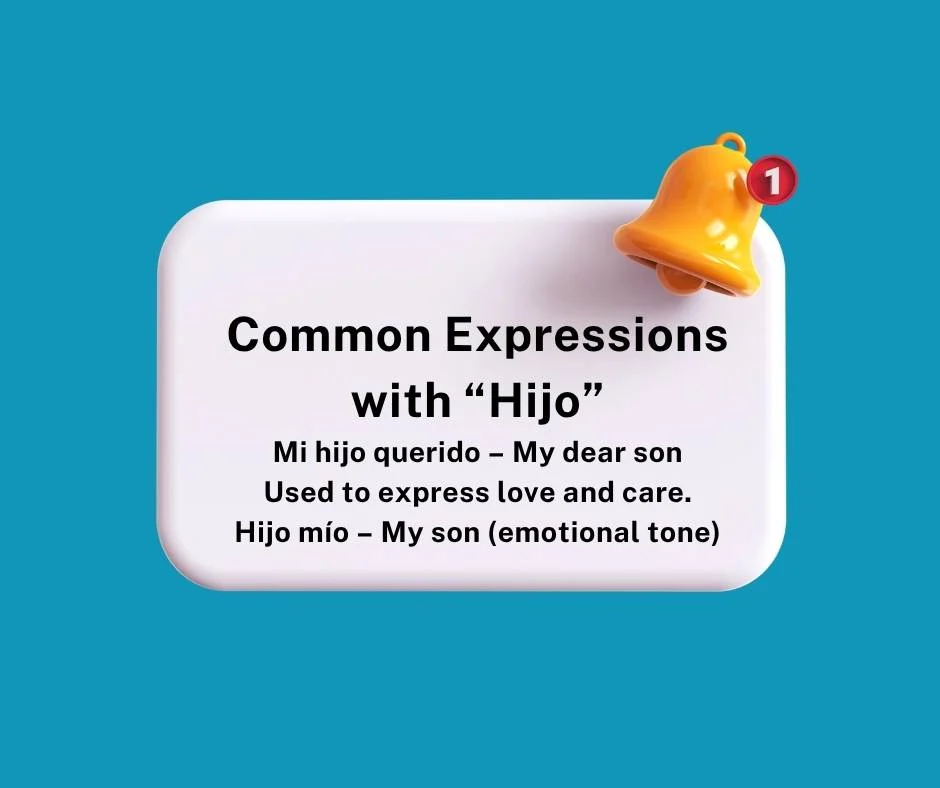
Spanish includes many expressions using this word.
Mi hijo querido – My dear son
Used to express love and care.
Hijo mío – My son (emotional tone)
Often used in serious or heartfelt moments.
Como un hijo – Like a son
Used when someone feels like family.
Example:
- Él es como un hijo para mí.
(He is like a son to me.)
These expressions help you speak more naturally and emotionally.
Real-Life Examples for Better Understanding
Let’s look at practical situations where you might use this word.
Introducing Family
- Este es mi hijo Carlos.
(This is my son Carlos.)
Talking About School
- Mi hijo estudia mucho.
(My son studies a lot.)
At the Doctor
- Mi hijo no se siente bien.
(My son doesn’t feel well.)
Casual Conversation
- Mi hijo ama los videojuegos.
(My son loves video games.)
These real-life examples make learning easier and more relatable.
Cultural Insights About Family Terms
Understanding culture adds depth to language learning.
Family Is Very Important
In Spanish-speaking cultures, family plays a central role.
- People often talk about family
- Strong emotional connections are common
Respect and Warmth
Words like “hijo” carry emotional meaning.
- Used with love and care
- Reflects close relationships
Learning how to say son in Spanish also helps you understand these cultural values.
Advanced Usage and Grammar Tips
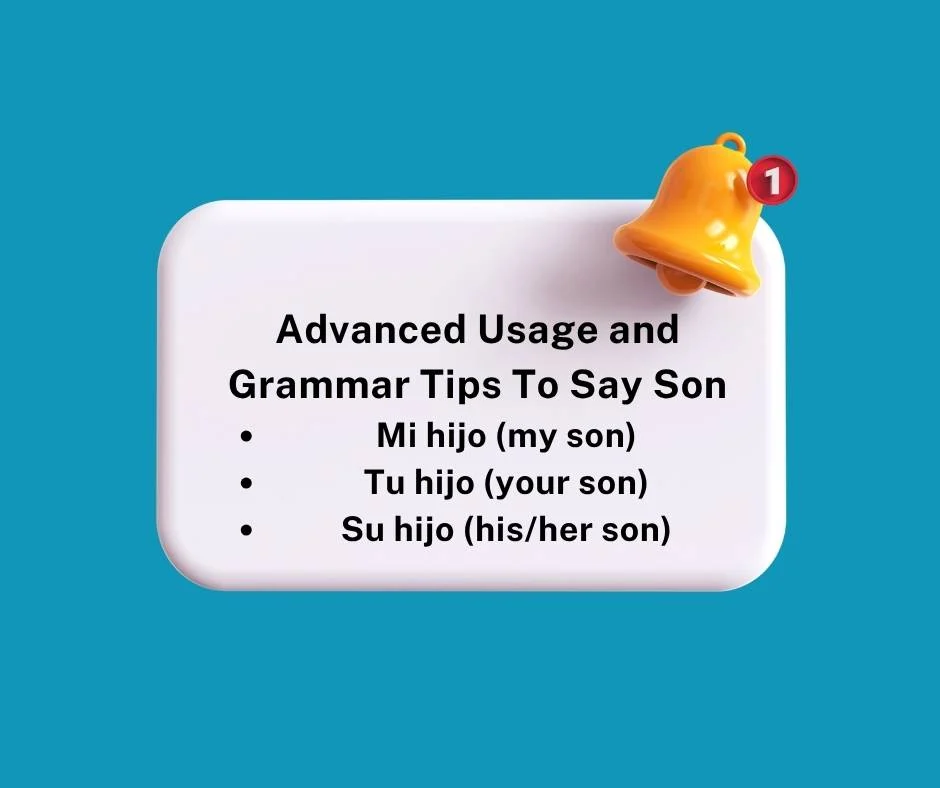
Once you know the basics, you can improve your skills further.
Using Possessive Words
Possessives make sentences clearer.
- Mi hijo (my son)
- Tu hijo (your son)
- Su hijo (his/her son)
Example:
- Su hijo es muy amable.
(His/Her son is very kind.)
Using Articles
Spanish uses articles before nouns.
- Un hijo (a son)
- El hijo (the son)
Example:
- El hijo de María es alto.
(Maria’s son is tall.)
Combining Sentences
You can create longer sentences easily.
- Mi hijo estudia y juega fútbol.
(My son studies and plays soccer.)
These tips will help you speak more fluently.
Common Mistakes to Avoid
When learning how to say son in Spanish, beginners often make simple mistakes.
Mispronouncing “Hijo”
- Don’t pronounce the “h”
- Focus on the “ee-ho” sound
Confusing Gender Forms
- Hijo = son
- Hija = daughter
Forgetting Plural Forms
- Hijo → Hijos
- Practice both forms regularly
Skipping Articles
Always include “un” or “el” when needed.
Avoiding these mistakes will improve your Spanish quickly.
Tips to Practice and Remember
Consistent practice makes learning easier.
Use It Daily
Talk about your family in Spanish.
- Create simple sentences
- Practice with friends or alone
Write Short Sentences
Writing helps memory.
- Mi hijo es amable
- Tengo un hijo
Listen to Native Speakers
Watch Spanish videos or shows.
- Notice how “hijo” is used
- Copy pronunciation and tone
Practice Speaking Out Loud
Speaking builds confidence.
- Repeat phrases daily
- Focus on clarity
These habits will help you remember the word naturally.
Frequently Asked Questions (FAQs)
What is the correct way for how to say son in Spanish?
The correct word is “hijo,” which means son in Spanish.
How do you pronounce “hijo” in Spanish?
It is pronounced as “ee-ho,” with a silent “h.”
What is the plural form when learning how to say son in Spanish?
The plural form is “hijos,” which can mean sons or children.
What is the difference between “hijo” and “hija”?
“Hijo” means son, while “hija” means daughter.
Can “hijo” be used in emotional expressions?
Yes, it is often used affectionately to show love and care.
Is son in Spanish mijo or hijo?
The standard Spanish word for son is hijo. Mijo is an affectionate nickname created from mi hijo (“my son”) and is commonly used by parents, especially in Mexico and other Latin American countries.
How do Mexicans say son?
Mexicans use hijo as the correct word for son. In everyday family conversations, they also lovingly say mijo to express affection and closeness.
What is the correct word for son in Spanish?
The correct Spanish word for son is hijo. It is the proper term used in dictionaries, schools, official writing, and everyday conversations across Spanish-speaking countries.
What is the slang word for son in Spanish?
A common informal term is mijo, which comes from mi hijo (“my son”). While it is not true slang, it is a warm and familiar way to address a son or even a younger person affectionately.
What do Mexicans call their sons?
Mexican parents often call their sons hijo or mijo, depending on the situation. Mijo is especially popular because it sounds caring, loving, and natural in daily speech.
What is “I love you son” in Spanish?
The most natural translation is “Te quiero, hijo.” For a stronger expression of love, you can also say “Te amo, hijo.” Both phrases are widely understood and commonly used in Spanish-speaking families.
Conclusion
Learning how to say son in Spanish is a simple yet meaningful step in your language journey.
The word “hijo” is easy to use and appears in everyday conversations, emotional expressions, and family discussions.
With practice and real-life usage, you’ll quickly feel confident using it naturally in your Spanish communication.
Also Check These Posts:
How to Say Uranus the Easy Way with Clear Sound Breakdown
How To Say Your Welcome in German Explained Clearly With Practical Examples
How to Say Cute in Japanese Perfectly for Travel, Anime and Daily Talk

Darcy Lynn
Darcy Lynn has always been fascinated by the colors and stories of life. Her journey with writing began in childhood, and today she takes readers into new worlds through her stories. For her, every word is a way to explore new experiences and emotions. Darcy loves exploring stories across different cultures and languages, which also reflects in her unique writing style. She believes that a good story touches every heart and sparks deeper thinking. Alongside writing, she enjoys connecting directly with her readers and understanding their feelings.
Books:
-
Whispers Across Worlds
-
Echoes of Tomorrow