

Learning how to say i want in spanish is an important step for anyone starting their Spanish journey. It helps you express desires, needs, and everyday choices in real conversations.
If you are ordering food, planning a trip, or talking with friends, this phrase will appear often in daily communication. In this guide, you will learn simple, natural ways to use it correctly and confidently.
Basic Translation of “I Want” in Spanish
The most common and direct way of saying “I want” in Spanish is “quiero.” It comes from the verb querer, which means “to want” or “to love” depending on context.
Quiero – The simplest form
“Quiero” is used in most everyday situations when expressing what you want.
Examples:
- Quiero agua. (I want water.)
- Quiero comer pizza. (I want to eat pizza.)
- Quiero descansar. (I want to rest.)
This is the first phrase learners usually remember because it is short, easy, and very common in daily speech.
How “Quiero” works in sentences
In Spanish, sentence structure is often flexible but usually follows:
Subject + Quiero + object/verb
Examples:
- Yo quiero un café. (I want a coffee.)
- Quiero aprender español. (I want to learn Spanish.)
Even if “yo” (I) is not always written, it is still understood in the sentence.
How to say i want in spanish to a woman
When you want to say “I want” to a woman in Spanish, the correct phrase depends on the situation and how respectful you want to sound. The basic expression is “Quiero”, which means “I want.” If you are speaking directly to a woman, you can say “Te quiero” when expressing affection or “Quiero…” followed by the thing you want.
Here are common examples:
- Quiero hablar contigo. (I want to talk to you.)
- Quiero ayudarte. (I want to help you.)
- Te quiero. (I love you/I care about you.)
- Quiero conocerte mejor. (I want to get to know you better.)
- Quiero invitarte a cenar. (I want to invite you to dinner.)
- Quiero escuchar tu opinión. (I want to hear your opinion.)
- Quiero pasar tiempo contigo. (I want to spend time with you.)
- Quiero verte otra vez. (I want to see you again.)
- Quiero hacerte una pregunta. (I want to ask you a question.)
- Quiero agradecerte por todo. (I want to thank you for everything.)
I want in spanish polite
If you want to sound polite in Spanish, avoid using “Quiero” in formal situations because it can sound direct. Instead, choose softer expressions that show respect and good manners.
Here are polite alternatives:
- Me gustaría… (I would like…)
- Quisiera… (I would like…)
- ¿Podría tener…? (Could I have…?)
- Me gustaría hacer una pregunta.
- Quisiera pedir ayuda.
- Me gustaría reservar una mesa.
- Quisiera hablar con usted.
- Me gustaría saber más.
- Quisiera comprar esto.
- Me gustaría un café, por favor.
These expressions work well in restaurants, hotels, stores, schools, and professional conversations.
I want in Spanish duolingo
If you are learning Spanish with Duolingo, you will often see “Quiero” as the translation for “I want.” It comes from the verb querer, one of the first verbs beginners learn.
Here are common Duolingo-style examples:
- Quiero agua. (I want water.)
- Quiero comer. (I want to eat.)
- Quiero dormir. (I want to sleep.)
- Quiero aprender español.
- Quiero un libro.
- Quiero una manzana.
- Quiero estudiar hoy.
- Quiero café.
- Quiero viajar a España.
- Quiero practicar más.
These simple sentences help learners remember the verb naturally.
How to say I would like in Spanish
The best way to say “I would like” in Spanish is “Me gustaría.” This expression sounds friendly, respectful, and natural in everyday conversations.
Here are useful examples:
- Me gustaría un café.
- Me gustaría ayudarte.
- Me gustaría aprender español.
- Me gustaría hacer una reserva.
- Me gustaría conocer más personas.
- Me gustaría visitar México.
- Me gustaría hacer una pregunta.
- Me gustaría ordenar comida.
- Me gustaría hablar con el gerente.
- Me gustaría saber el precio.
Spanish speakers often use this phrase because it sounds more polite than simply saying “Quiero.”
Do you want in Spanish
To ask “Do you want?” in Spanish, use the verb querer in question form. The exact wording changes depending on who you are speaking to.
Common examples include:
- ¿Quieres…? (Do you want? – informal)
- ¿Quiere…? (Do you want? – formal)
- ¿Quieres comer?
- ¿Quieres venir conmigo?
- ¿Quieres café?
- ¿Quiere ayuda?
- ¿Quieres salir hoy?
- ¿Quieres aprender español?
- ¿Quiere otra bebida?
- ¿Quieres ver una película?
These questions are common in daily conversations with friends, family, coworkers, and customers.
I want in mexican Spanish
In Mexican Spanish, “Quiero” is the standard way to say “I want.” People also use polite forms such as “Me gustaría” when speaking respectfully. The meaning stays the same, although local expressions and pronunciation may differ.
Here are common Mexican Spanish examples:
- Quiero tacos.
- Quiero un refresco.
- Quiero ir al mercado.
- Quiero hablar contigo.
- Quiero descansar.
- Quiero aprender más español.
- Quiero llegar temprano.
- Quiero un café.
- Quiero visitar Guadalajara.
- Quiero pasar tiempo con mi familia.
These examples reflect everyday conversations you may hear in Mexico.
I would want in Spanish
To express “I would want” in Spanish, speakers often use the conditional form “Querría.” It expresses a wish, preference, or hypothetical situation.
Here are common examples:
- Querría ayudarte.
- Querría aprender español.
- Querría visitar España algún día.
- Querría más información.
- Querría hablar con usted.
- Querría hacer una reserva.
- Querría un asiento junto a la ventana.
- Querría conocer tu opinión.
- Querría trabajar aquí.
- Querría intentarlo otra vez.
This form is useful in formal conversations and hypothetical situations.
I want in spanish slang
Spanish slang changes from one country to another, but people often replace formal expressions with casual phrases when talking to friends. These alternatives sound more relaxed and natural in informal conversations.
Common slang-style expressions include:
- Quiero eso.
- Lo quiero ya.
- Quiero uno.
- Quiero más.
- Quiero salir.
- Quiero ir.
- Quiero probarlo.
- Quiero verlo.
- Quiero todo.
- Lo quiero.
Remember that slang varies across Spain, Mexico, Argentina, Colombia, and other Spanish-speaking countries, so the exact wording may change depending on the region.
Different Ways to Express Desire in Spanish
Spanish offers several ways to express “I want,” depending on tone, politeness, and context. Using different phrases helps you sound more natural and fluent.
Quisiera – A polite way to say “I want”
“Quisiera” comes from querer and is used to sound polite or respectful.
Examples:
- Quisiera un vaso de agua. (I would like a glass of water.)
- Quisiera hablar contigo. (I would like to talk with you.)
This is commonly used in restaurants, shops, and formal situations.
Me gustaría – A softer expression
“Me gustaría” means “I would like” and is more gentle than “quiero.”
Examples:
- Me gustaría viajar a España. (I would like to travel to Spain.)
- Me gustaría aprender música. (I would like to learn music.)
This phrase is perfect for polite conversations and professional settings.
Tengo ganas de – Expressing feeling or desire
This phrase means “I feel like” or “I want to (in the moment).”
Examples:
- Tengo ganas de comer helado. (I feel like eating ice cream.)
- Tengo ganas de dormir. (I feel like sleeping.)
It is very natural in spoken Spanish and often used in casual conversations.
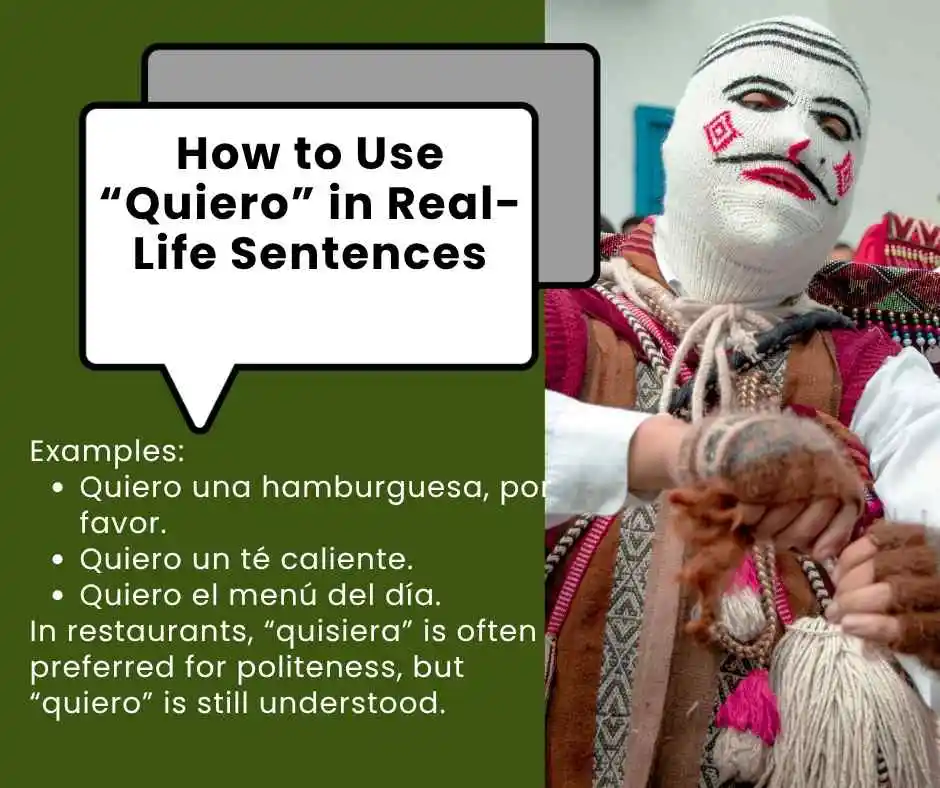
How to Use “Quiero” in Real-Life Sentences
Understanding vocabulary is not enough; you also need to see how it works in real situations.
Food and restaurant situations
One of the most common uses of “quiero” is ordering food.
Examples:
- Quiero una hamburguesa, por favor.
- Quiero un té caliente.
- Quiero el menú del día.
In restaurants, “quisiera” is often preferred for politeness, but “quiero” is still understood.
Travel and shopping situations
When traveling, you will use “quiero” to ask for things or express needs.
Examples:
- Quiero un billete a Madrid.
- Quiero reservar una habitación.
- Quiero comprar este bolso.
Daily life examples
You can also use it in everyday conversations.
Examples:
- Quiero ir al parque.
- Quiero ver esa película.
- Quiero hablar contigo más tarde.
These simple sentences help you communicate clearly in Spanish-speaking environments.
Polite vs Direct Expressions in Spanish
Knowing when to be direct or polite is very important in Spanish communication.
When to use “Quiero”
“Quiero” is direct and strong. It is used when:
- Talking with friends or family
- Expressing strong desire
- Casual conversations
Examples:
- Quiero dormir ahora.
- Quiero salir con mis amigos.
When to use “Quisiera” or “Me gustaría”
These are more polite and respectful.
Use them when:
- Talking to strangers
- Ordering in restaurants
- Speaking in formal situations
Examples:
- Quisiera una mesa para dos.
- Me gustaría una cita con el doctor.
Using polite forms makes your Spanish sound more natural and respectful.
Common Mistakes Learners Make
Many beginners make simple mistakes when learning how to say i want in spanish, but they are easy to fix.
Overusing “Quiero”
Some learners use “quiero” in every situation, which can sound too direct.
Instead of always saying:
- Quiero agua.
Try sometimes: - Me gustaría agua.
Grammar confusion
Another common mistake is incorrect sentence structure.
Wrong:
- Quiero a comer pizza.
Correct:
- Quiero comer pizza.
Remember, “quiero” is followed directly by a noun or verb without extra words.
Mixing formal and informal language
Using “quiero” in formal situations can sometimes sound rude.
Better alternatives:
- Quisiera ayuda, por favor.
- Me gustaría información.
Useful Vocabulary with “I Want” Expressions
To improve your Spanish, combine “quiero” with useful vocabulary.
Common nouns you can use
- Agua (water)
- Comida (food)
- Café (coffee)
- Trabajo (work)
- Casa (house)
Common verbs used with “quiero”
- Quiero aprender (I want to learn)
- Quiero viajar (I want to travel)
- Quiero estudiar (I want to study)
- Quiero descansar (I want to rest)
Everyday combinations
- Quiero café caliente.
- Quiero aprender español rápido.
- Quiero viajar a Europa.
These combinations help you speak more naturally in real conversations.
Practice Conversations
Practicing real dialogues is the best way to remember how to use “quiero.”
Conversation 1: At a café
A: ¿Qué quieres pedir?
B: Quiero un café y un croissant.
Conversation 2: At a shop
A: ¿En qué puedo ayudarte?
B: Quiero comprar una camiseta.
Conversation 3: Talking with a friend
A: ¿Qué haces hoy?
B: Quiero ver una película en casa.
These examples show how naturally the phrase is used in daily life.
Tips to Sound Natural in Spanish
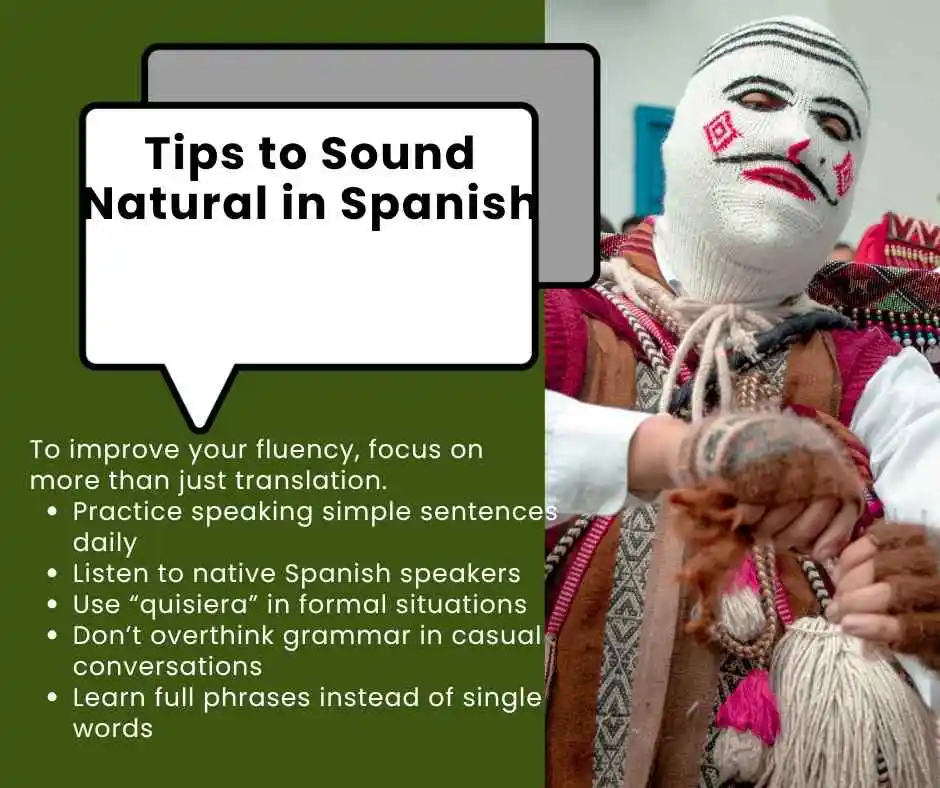
To improve your fluency, focus on more than just translation.
- Practice speaking simple sentences daily
- Listen to native Spanish speakers
- Use “quisiera” in formal situations
- Don’t overthink grammar in casual conversations
- Learn full phrases instead of single words
With practice, your use of how to say i want in spanish will become automatic and natural.
Frequently Asked Questions
What is the easiest way for how to say i want in spanish?
The easiest way is “quiero,” which is used in most everyday situations.
Is “quiero” polite in Spanish?
It can sound direct, so in formal situations “quisiera” or “me gustaría” is more polite.
Can I always use “quiero” for how to say i want in spanish?
Yes, but using polite forms makes your Spanish sound more natural and respectful.
What is the difference between “quiero” and “me gustaría”?
“Quiero” is direct, while “me gustaría” is softer and more polite.
How do I practice how to say i want in spanish in daily life?
Use simple sentences like “quiero comer,” “quiero viajar,” or “me gustaría aprender.”
Does quiero mean I want?
Yes. Quiero means “I want” in Spanish. It is the first-person singular form of the verb querer, so it expresses something that you want, desire, or would like.
What to say instead of “yo quiero”?
In most conversations, you can simply say “quiero” because the word yo (I) is usually understood from the verb. For a more polite tone, you can also use expressions like “me gustaría” (“I would like”).
How do you say “I want” in Spanish politely?
A polite way to say “I want” in Spanish is “me gustaría”, which means “I would like.” It sounds more respectful and is commonly used when making requests or ordering food.
How do you say I want in Spanish?
The most common way to say “I want” in Spanish is “quiero.” If you want to emphasize the subject, you can say “yo quiero,” but in everyday Spanish, “quiero” is usually enough.
What does “yo quiero” mean?
“Yo quiero” means “I want” in English. The word yo means “I,” and quiero means “want,” making it a direct way to express a desire or preference.
Why do people say “como se dice”?
People say “¿Cómo se dice?” when they want to ask “How do you say…?” in Spanish. It is a common phrase used when learning the language or asking for the Spanish word or expression for something.
Conclusion
Understanding how to say i want in spanish is essential for everyday communication. From “quiero” to more polite forms like “quisiera” and “me gustaría,” each expression helps you speak more naturally in different situations. With practice and real-life usage, you will quickly become more confident in Spanish conversations.
Also Check These Posts:
How to Say Happy Thanksgiving with Heart in 2026
How to Say 17 in Spanish Without Mistakes
Learn How to Say You’re Welcome in Italian and Impress Everyone

Daniel Carter
Hi, I’m Daniel Carter, a passionate storyteller and lifelong explorer of languages and cultures. Writing has always been my way of connecting with the world, sharing stories that inspire, educate, and entertain. I love diving into the nuances of communication and finding beauty in the words we use every day. Over the years, I’ve dedicated myself to crafting stories that resonate across borders and languages. When I’m not writing, you’ll usually find me exploring new places or learning something new about the world around me. My goal is to create stories that make readers think, smile, and sometimes even dream.
Books:
-
Whispers Across Borders
-
The Language of Hearts