
You might be trying to describe small amounts or simple ideas in Spanish but feel unsure where to start.
If you’ve ever searched for how to say a little in spanish, you’re in the right place.
Learning short and useful words like this can feel tricky at first, especially when you’re just beginning your language journey.
But don’t worry; this guide will help you understand it easily so you can use it naturally in everyday conversations with confidence.
The Most Common Way to Say “A Little” in Spanish
Un poco – The Basic and Versatile Option
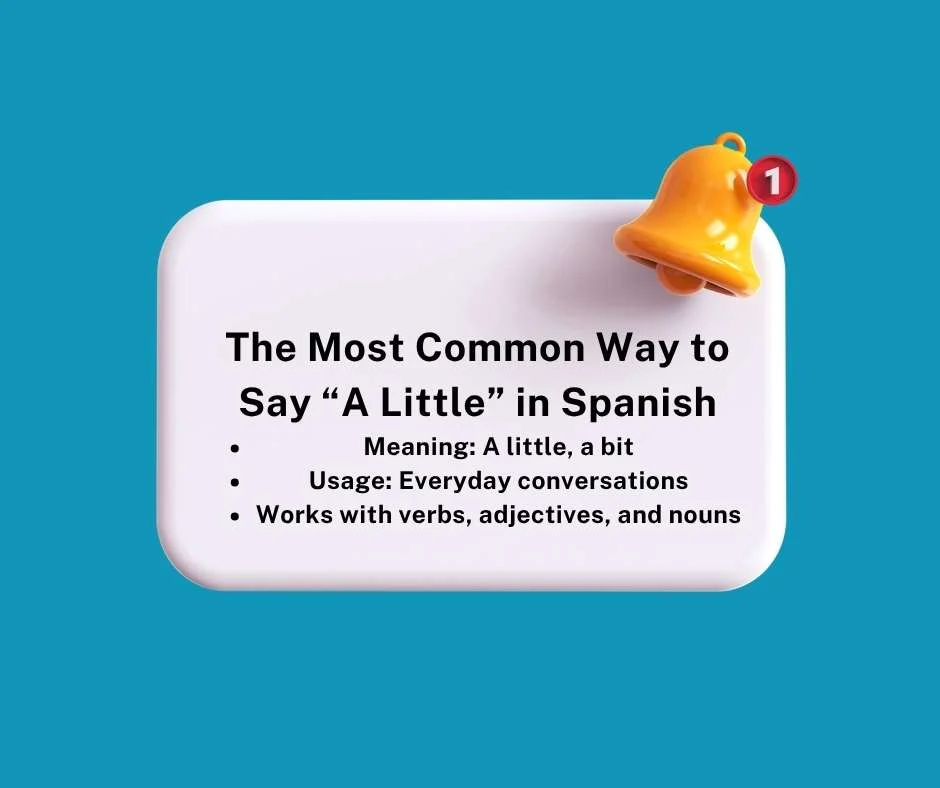
The most common way to say “a little” in Spanish is un poco.
- Meaning: A little, a bit
- Usage: Everyday conversations
- Works with verbs, adjectives, and nouns
Example:
- Hablo un poco de español.
(I speak a little Spanish.) - Quiero un poco de agua.
(I want a little water.)
This is the first phrase you should learn when understanding how to say a little in Spanish.
How to Use “Un poco” Naturally
You can place it in different parts of a sentence.
- Before nouns: un poco de + noun
- After verbs: verb + un poco
Example:
- Necesito un poco de ayuda.
(I need a little help.) - Estoy un poco cansado.
(I am a little tired.)
Another Common Option You Should Know
Poco – A Shorter Form
“Poco” is a shorter version that also means “little.”
- Meaning: Little / few
- Usage: More direct and flexible
Example:
- Tengo poco tiempo.
(I have little time.) - Como poco.
(I eat little.)
Difference Between “Un poco” and “Poco”
Understanding the difference is important.
- Un poco → A little (neutral or positive tone)
- Poco → Little (often sounds more negative or limited)
Example:
- Tengo un poco de dinero. (I have a little money.)
- Tengo poco dinero. (I have little money.)
This subtle difference helps you express meaning more clearly.
How to say a little in spanish audio
If you want to learn how to say “a little” in Spanish with the correct pronunciation, the most common word is un poco (oon POH-koh). It means “a little” or “a bit” and works in everyday conversations. Listening to native audio helps you copy the correct pronunciation, rhythm, and accent. Practice saying it several times until it sounds natural. You can also hear un poquito, which means “just a little” and sounds more friendly and affectionate.
- Un poco means “a little.”
- Un poquito means “a tiny little bit.”
- Listen to native pronunciation whenever possible.
- Repeat the phrase aloud several times.
- Focus on the stress in POH of poco.
- Use it in daily conversations.
- Practice with short Spanish sentences.
- Compare your pronunciation with native speakers.
- Speak slowly before increasing speed.
- Regular practice improves confidence.
A little in Spanish poquito
Poquito is a very common Spanish word that means “a little” or “a tiny bit.” It comes from poco, but adding -ito makes it sound smaller, warmer, or more affectionate. Native speakers often use poquito in casual conversations when talking about small amounts of food, time, or effort. It is friendly, natural, and easy to remember.
- Poquito means “a tiny little amount.”
- It is more informal than un poco.
- People use it in everyday speech.
- It can describe food, time, or quantity.
- It sounds warm and friendly.
- It is common across many Spanish-speaking countries.
- You can hear it in conversations and songs.
- Children often learn this word early.
- It helps conversations sound more natural.
- It is one of the most useful beginner vocabulary words.
How to say a little in spanish slang
In Spanish slang, people often keep things casual by saying un poquito, poqui, or other local expressions depending on the country. The exact slang changes from one region to another, but un poquito is widely understood almost everywhere. Using friendly expressions helps your Spanish sound more natural without becoming confusing.
- Un poquito is a casual choice.
- Some regions shorten it to poqui.
- Slang varies by country.
- Use local expressions only when you understand them.
- Friendly language sounds more natural.
- Beginners should learn standard Spanish first.
- Listen to native conversations for examples.
- Context helps you choose the right phrase.
- Casual speech is common among friends.
- Practice with simple everyday situations.
How to say very little in Spanish
To say “very little” in Spanish, the most common expression is muy poco. It describes a very small amount of something, such as time, money, food, or effort. You may also hear muy poquito, which sounds even softer and more affectionate in casual speech.
- Muy poco means “very little.”
- Muy poquito sounds more friendly.
- Use it for small amounts.
- It works in daily conversations.
- It is easy for beginners to remember.
- It can describe many different situations.
- Native speakers use it often.
- It sounds natural in spoken Spanish.
- Practice saying both expressions.
- Learn them with simple example sentences.
Pocito in Spanish
Many learners search for Pocito in Spanish, but the correct spelling is usually poquito. The word poquito means “a little” or “a tiny bit.” The spelling pocito is often a typing mistake or a misunderstanding of pronunciation. Learning the correct spelling helps you communicate more clearly.
- Poquito is the correct word.
- It means “a tiny little bit.”
- Pocito is usually a misspelling.
- Correct spelling improves communication.
- Native speakers commonly use poquito.
- It appears in everyday conversations.
- It is useful for beginners.
- Practice writing the word correctly.
- Listen to its pronunciation often.
- Remember the ending -quito.
Just a little bit in Spanish
The phrase “just a little bit” in Spanish is commonly translated as solo un poquito or solo un poco. Both expressions are polite and natural. They are useful when talking about food, drinks, time, or asking someone to do something in a small amount.
- Solo un poquito means “just a little bit.”
- Solo un poco is also correct.
- Both expressions sound natural.
- They fit many everyday situations.
- Use them politely in conversations.
- They are easy to remember.
- Native speakers understand both forms.
- They work in spoken and written Spanish.
- Practice them with common phrases.
- They help conversations sound friendly.
A little in spanish feminine

The meaning of “a little” does not change, but Spanish adjectives and some expressions change to match feminine nouns. For example, poquita is the feminine form of poquito. Native speakers use it naturally when describing feminine nouns.
- Poquita is the feminine form.
- It matches feminine nouns.
- Poquito is the masculine form.
- Gender agreement is important in Spanish.
- Learn both forms together.
- Practice with simple examples.
- Native speakers use the correct form automatically.
- It makes your Spanish sound accurate.
- Beginners should pay attention to noun gender.
- Regular practice builds confidence.
A little bit in Spanish google translate
Google Translate often translates “a little bit” as un poco or un poquito. Both translations are correct, but the best choice depends on the context. Un poco is more neutral, while un poquito sounds warmer and more conversational. Learning when to use each expression helps you speak more naturally.
- Un poco is the standard translation.
- Un poquito sounds friendlier.
- Context decides the best choice.
- Translation tools provide helpful guidance.
- Always check example sentences.
- Listen to native pronunciation.
- Practice using both expressions.
- Compare formal and casual situations.
- Build vocabulary through real conversations.
- Use translations as a learning tool, not your only resource.
Using “A Little” in Different Situations
Learning how to say a little in Spanish becomes easier when you see it in real-life situations.
Talking About Skills
- Hablo un poco de inglés.
(I speak a little English.) - Entiendo un poco.
(I understand a little.)
Ordering Food and Drinks
- Quiero un poco de café.
(I want a little coffee.) - Solo un poco de azúcar, por favor.
(Just a little sugar, please.)
Expressing Feelings
- Estoy un poco triste.
(I feel a little sad.) - Estoy un poco ocupado.
(I am a little busy.)
Talking About Time or Quantity
- Tengo un poco de tiempo.
(I have a little time.) - Necesito un poco más.
(I need a little more.)
These examples show how useful and flexible this phrase is.
Grammar Tips for Using “A Little”
Understanding grammar will help you use these phrases correctly.
Using “De” After “Un poco”
When followed by a noun, you must add “de.”
- Un poco de + noun
Example:
- Un poco de agua
- Un poco de comida
Agreement with Adjectives
When used with adjectives, no “de” is needed.
- Estoy un poco cansado
- Es un poco difícil
Plural Forms
“Poco” can change form based on number and gender.
- Poco (masculine singular)
- Poca (feminine singular)
- Pocos (masculine plural)
- Pocas (feminine plural)
Example:
- Poca agua (little water)
- Pocos amigos (few friends)
These grammar rules help you build accurate sentences.
Other Ways to Say “A Little” in Spanish
Expanding your vocabulary will make your Spanish sound more natural.
Un poquito – A Very Small Amount
This is a softer, more affectionate version.
- Meaning: A tiny bit
- Usage: Casual and friendly
Example:
- Dame un poquito de agua.
(Give me a tiny bit of water.)
Algo – Some / A Little
This word can also express a small amount.
- Meaning: Some, a little
Example:
- Quiero algo de comer.
(I want something to eat.)
Un tanto – Somewhat
This is slightly more formal.
- Meaning: Somewhat, a little
Example:
- Es un tanto complicado.
(It is somewhat complicated.)
These alternatives help you vary your speech.
Real-Life Conversations Using “A Little”
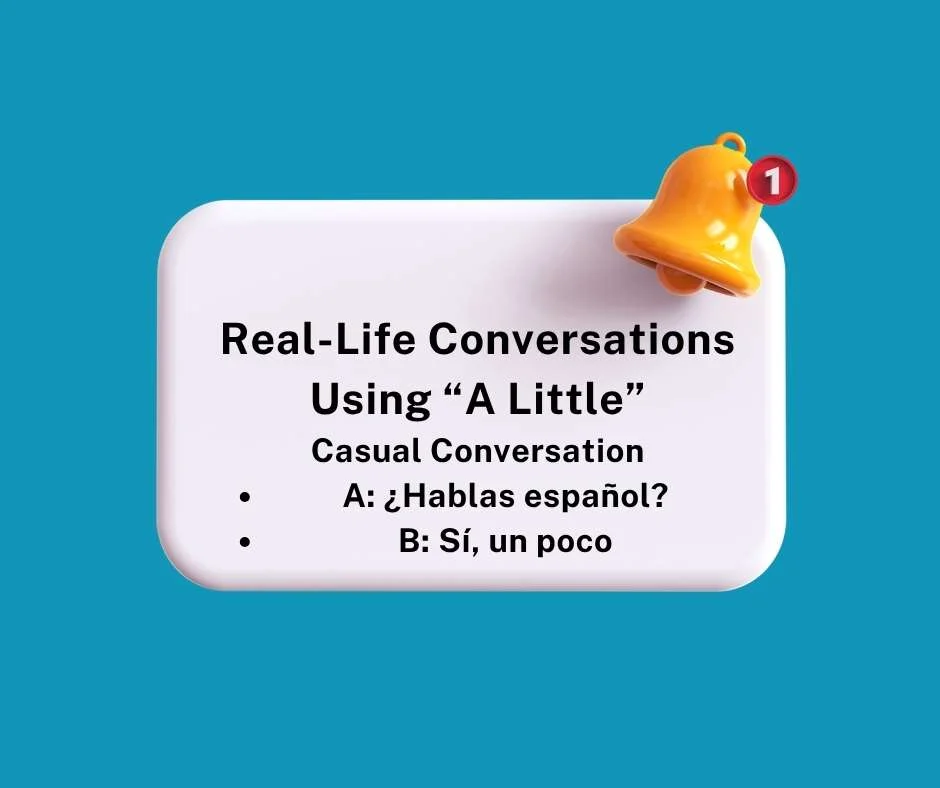
Practicing dialogues can improve your confidence.
Casual Conversation
- A: ¿Hablas español?
- B: Sí, un poco
At a Restaurant
- A: ¿Quieres más azúcar?
- B: Solo un poco, gracias
Talking About Feelings
- A: ¿Cómo estás?
- B: Estoy un poco cansado
Making Plans
- A: ¿Tienes tiempo?
- B: Sí, tengo un poco
These conversations show how natural and common the phrase is.
Common Mistakes to Avoid
When learning how to say a little in Spanish, beginners often make these mistakes.
Forgetting “De”
- Incorrect: un poco agua
- Correct: un poco de agua
Confusing “Poco” and “Un poco”
- “Poco” can sound negative
- “Un poco” sounds more neutral
Overusing One Phrase
Using only “un poco” can sound repetitive.
- Try alternatives like “un poquito”
Ignoring Gender Agreement
- Use “poca” for feminine nouns
- Example: poca comida
Avoiding these mistakes will improve your fluency quickly.
Tips to Practice and Remember
Building confidence takes regular practice.
Use It Daily
Talk about your routine.
- Tengo un poco de tiempo
- Estoy un poco ocupado
Practice Speaking
Say sentences out loud.
- Repeat simple phrases
- Focus on pronunciation
Listen to Native Speakers
Watch Spanish content.
- Notice how they use “un poco”
- Copy their tone and rhythm
Write Your Own Examples
Create simple sentences.
- Helps improve memory
- Makes learning easier
These habits will help you remember naturally.
Advanced Usage for Better Fluency
Once you know the basics, you can improve further.
Combining with Comparisons
- Un poco más (a little more)
- Un poco menos (a little less)
Example:
- Quiero un poco más de comida
Using with Verbs
- Estudio un poco cada día
(I study a little every day)
Expressing Opinions
- Es un poco difícil
(It is a little difficult)
These advanced uses make your Spanish more expressive.
Frequently Asked Questions (FAQs)
What is the most common way for how to say a little in Spanish?
The most common phrase is “un poco,” which means a little or a bit.
What is the difference between “poco” and “un poco”?
“Un poco” means a little, while “poco” often means little or not much.
Do I need “de” after “un poco”?
Yes, when followed by a noun, you must use “un poco de.”
Can I use “un poquito” instead?
Yes, it means a tiny bit and sounds more casual and friendly.
How can I practice how to say a little in Spanish?
Practice daily, use it in sentences, and listen to native speakers.
Is it poquito or poco?
Both poco and poquito are correct, but they have different meanings. Poco means “a little,” while poquito means “a very little” or “just a tiny bit.” In everyday Mexican Spanish, poquito is often used to sound friendlier or more natural.
How do Mexicans say “a little bit”?
Mexicans commonly say poquito or un poquito when they mean “a little bit.” These expressions are widely used in casual conversations to describe a small amount of something.
How do you say “I speak a little Spanish but not much”?
A natural way to say it is: Hablo un poco de español, pero no mucho. This politely tells others that you know some Spanish but are not fluent.
What is the Spanish word for little?
The Spanish word for “little” is pequeño (for masculine nouns) or pequeña (for feminine nouns) when describing size. For small amounts, Spanish often uses poco, which means “a little.”
How do Mexicans say small?
Mexicans usually use pequeño or chico to say “small,” depending on the context. Both are common, although pequeño is the more standard and widely understood word.
How do you say just a little in Spanish?
A common way to say “just a little” is solo un poco or solo un poquito. Both expressions are natural in everyday Spanish, with un poquito sounding a bit warmer and more conversational.
Conclusion
Learning how to say a little in Spanish is a simple but powerful step in your language journey.
With phrases like “un poco,” “poco,” and “un poquito,” you can express yourself clearly in many situations.
Practice regularly, explore different forms, and soon you’ll use these expressions naturally and confidently.
Also Check These Posts:
How to Say With in Spanish Correctly with Simple Grammar Tips
How to Say Tinnitus Made Easy for Health and Vocabulary Learning
How to Say Motherfucker in Spanish: Meaning, Usage and Safer Alternatives

Darcy Lynn
Darcy Lynn has always been fascinated by the colors and stories of life. Her journey with writing began in childhood, and today she takes readers into new worlds through her stories. For her, every word is a way to explore new experiences and emotions. Darcy loves exploring stories across different cultures and languages, which also reflects in her unique writing style. She believes that a good story touches every heart and sparks deeper thinking. Alongside writing, she enjoys connecting directly with her readers and understanding their feelings.
Books:
-
Whispers Across Worlds
-
Echoes of Tomorrow