

If you are searching for how to say i miss you in french, you are probably trying to express your feelings in a beautiful and romantic language.
French is known for its charm, and learning this phrase can help you connect deeply with someone special. In this guide, you will learn simple and natural ways to say it correctly, along with real-life examples and useful variations.
Understanding this expression is important because it helps you communicate emotions in a meaningful and culturally correct way.
Why expressing emotions in French matters
French is often called the language of love, and emotions play a big role in it. When you learn how to express feelings like missing someone, you are not just translating words—you are sharing emotion in a more natural and heartfelt way.
In daily conversations, French speakers use emotional phrases often. Knowing them helps you:
- Connect better with French speakers
- Understand movies, songs, and messages
- Express feelings in a more romantic or friendly way
- Build stronger relationships
For example, in English you might simply say “I miss you,” but in French, the structure and emotion feel slightly deeper.
The correct way to say I miss you in French
The most important thing to understand is that the direct translation of “I miss you” does not work the same way in French.
The correct expression is:
“Tu me manques”
This literally translates to “You are missing from me,” but in natural English it means “I miss you.”
Breaking it down simply:
- Tu = You (informal)
- Me = To me
- Manques = Are missing
So instead of saying “I miss you,” French focuses on the person being missed.
This is one of the most important phrases to learn when studying emotional French expressions.
Understanding how the grammar works
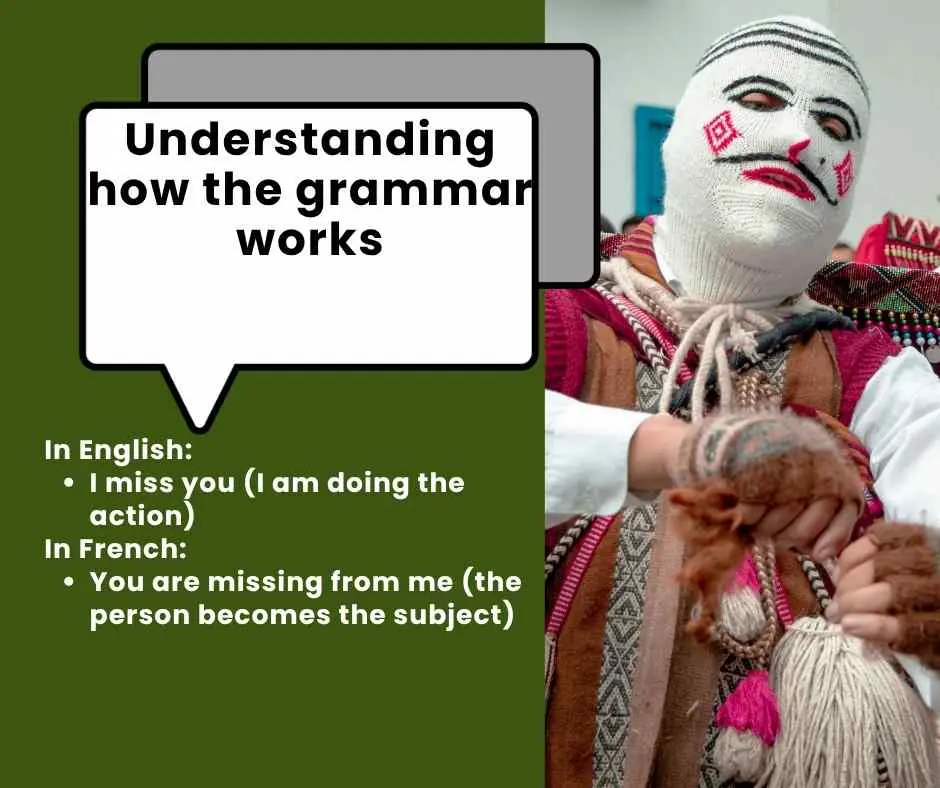
French grammar can feel confusing at first, especially with emotional sentences like this one. But once you understand it, everything becomes easier.
In English:
- I miss you (I am doing the action)
In French:
- You are missing from me (the person becomes the subject)
This structure shows that French expresses emotions differently. The focus is on the person you miss, not on the speaker.
Example:
- English: I miss my friend
- French: Mon ami me manque
This literally means “My friend is missing to me.”
Different ways to say I miss you in French
Even though “Tu me manques” is the most common phrase, there are other variations depending on the situation.
Romantic ways
If you want to sound more romantic or emotional, you can use:
- Tu me manques beaucoup → I miss you a lot
- Tu me manques tellement → I miss you so much
- Je pense à toi → I am thinking of you
These are often used in love messages or long-distance relationships.
Friendly expressions
For friends, you can keep it simple and casual:
- Tu me manques, mon ami(e) → I miss you, my friend
- Tu me manques déjà → I already miss you
- Ça fait longtemps que tu me manques → I have missed you for a long time
These expressions feel warm but not overly romantic.
Family expressions
When talking to family members, French becomes more emotional and soft:
- Tu me manques, maman → I miss you, mom
- Tu me manques, papa → I miss you, dad
- Vous me manquez → I miss you all (formal/plural)
Using “vous me manquez” is important when speaking politely or addressing multiple people.
Formal vs informal usage
French has two ways of saying “you”:
- Tu → Informal (friends, family, close people)
- Vous → Formal or plural
So depending on the situation, the phrase changes:
- Tu me manques → I miss you (informal)
- Vous me manquez → I miss you (formal or plural)
This is important when talking to teachers, elders, or people you don’t know well.
Common mistakes learners make
When beginners learn how to say how to say i miss you in french, they often make small mistakes. Here are the most common ones:
Saying “Je te manque” incorrectly
Many learners think “Je te manque” means “I miss you,” but it actually means:
- “You miss me”
So be careful with word order.
Translating word by word
Another mistake is trying to translate directly from English. French does not always follow English structure, especially with emotions.
Instead of thinking word by word, remember the full phrase:
- Tu me manques = I miss you
Using the wrong form of “you”
Using “tu” and “vous” incorrectly can change the meaning or tone of the sentence. Always choose based on relationship and formality.
Real-life examples in conversation
Understanding grammar is good, but seeing real conversations makes it easier.
Example 1 (Romantic chat)
A: Tu me manques
B: Moi aussi, je pense à toi
Example 2 (Friendship message)
A: Tu me manques déjà
B: On se voit bientôt
Example 3 (Family call)
A: Vous me manquez tous
B: Nous aussi, on pense à toi
These examples show how natural the phrase is in daily life.
Advanced and poetic ways to say I miss you
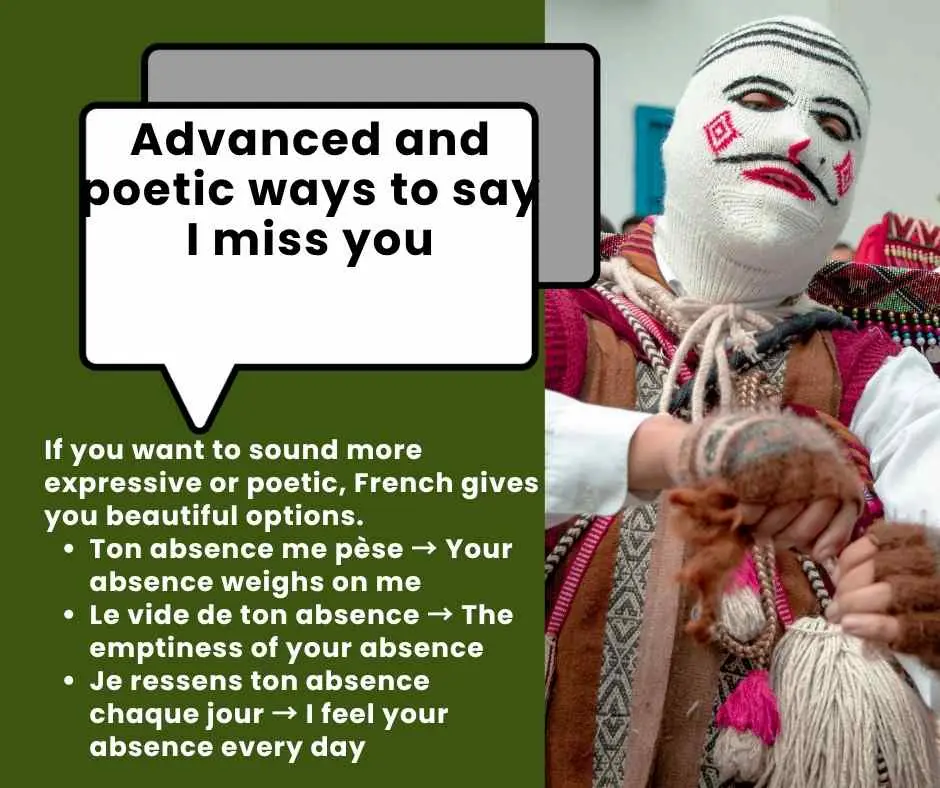
If you want to sound more expressive or poetic, French gives you beautiful options.
- Ton absence me pèse → Your absence weighs on me
- Le vide de ton absence → The emptiness of your absence
- Je ressens ton absence chaque jour → I feel your absence every day
- Sans toi, tout est différent → Without you, everything is different
These are often used in songs, poetry, or emotional messages.
Slang and casual expressions in French texting
In modern texting, French speakers often shorten or simplify expressions.
- T’me manques → Casual shorthand (informal texting)
- Jtm me manque → Very informal mix in chats
- Reviens vite → Come back soon
Young people often mix emotions with short phrases in messages.
Practical tips to remember the phrase easily
Learning a new language becomes easier with practice. Here are some simple tips:
- Repeat the phrase daily
- Write it in messages or notes
- Use it in real conversations
- Watch French movies or songs
- Practice with a friend or language partner
The more you use it, the more natural it becomes.
Why this phrase is so powerful
“Tu me manques” is more than just words. It carries emotion, connection, and care. In French culture, expressing feelings is important, and this phrase helps you show love and appreciation in a natural way.
Whether it is a friend, partner, or family member, saying it makes relationships stronger and more meaningful.
Frequently Asked Questions
What is the correct way to say how to say i miss you in french?
The correct phrase is “Tu me manques,” which means “I miss you.” It is the most natural and commonly used expression in French for showing that someone is missed.
Can I say Je te manque instead of Tu me manques?
No, “Je te manque” means “You miss me,” not “I miss you.” The correct form for expressing your feelings is “Tu me manques.”
Is Tu me manques romantic?
Yes, it can be romantic depending on context. It is often used between partners, but it can also be used with friends or family in a caring way.
What is the formal way to say I miss you in French?
The formal or plural version is “Vous me manquez.” It is used when speaking politely or addressing multiple people.
How do French people usually say they miss someone?
Most French speakers simply say “Tu me manques” in daily life. It is the most natural and widely used expression across all situations.
Conclusion
Learning how to say i miss you in french helps you express emotions in a meaningful and culturally correct way. The phrase “Tu me manques” may look simple, but it carries deep emotional value in French communication. Whether you use it in romantic, friendly, or family situations, it allows you to connect more closely with others and sound more natural in French conversations.
Also Check These Posts:
How to Say Hi in Swedish Correctly Every Time
How to Say Goodnight to Your Crush with Simple and Sweet Messages
How to Say Happy Birthday in Hawaiian | Fun and Easy Guide in 2026

Blake Kinslee
Hi! I’m Blake, a passionate writer who loves exploring the beauty of different languages and cultures through storytelling. Ever since I was young, I’ve been fascinated by how words can connect people across the world. Writing, for me, is not just a hobby—it’s a way to share ideas, emotions, and dreams with readers everywhere. When I’m not crafting stories, you’ll usually find me reading, traveling, or discovering new words in languages I’ve never spoken before. Every book I write is a journey, and I hope my readers feel that magic too.
Books:
-
Whispers Across Borders
-
The Language of Dreams