

If you are searching for how to say hungry in Spanish, you are already taking a great step toward learning real everyday communication.
Spanish is one of the most widely spoken languages in the world, and knowing simple words like hunger expressions can help you connect with people easily. In this guide, you will learn natural ways to express hunger in different situations in a simple and practical way.
Understanding this topic is important because hunger is something we talk about daily. Whether you are traveling, studying, or chatting with Spanish speakers, knowing the right phrase will make communication smoother and more confident.
The Basic Way to Say Hungry in Spanish
The most common and simple way to say hungry in Spanish is:
“Tengo hambre”
This is the phrase you will hear everywhere in Spanish-speaking countries. It literally translates to “I have hunger,” but in English, we say “I am hungry.”
Here is how it breaks down:
- Tengo = I have
- Hambre = hunger
So together, it means “I am hungry.”
Simple usage examples:
- Tengo hambre. (I am hungry.)
- Tengo mucha hambre. (I am very hungry.)
- Tengo hambre ahora. (I am hungry now.)
This phrase is used in both formal and informal situations, so it is very safe for beginners.
Common Everyday Expressions for Hunger
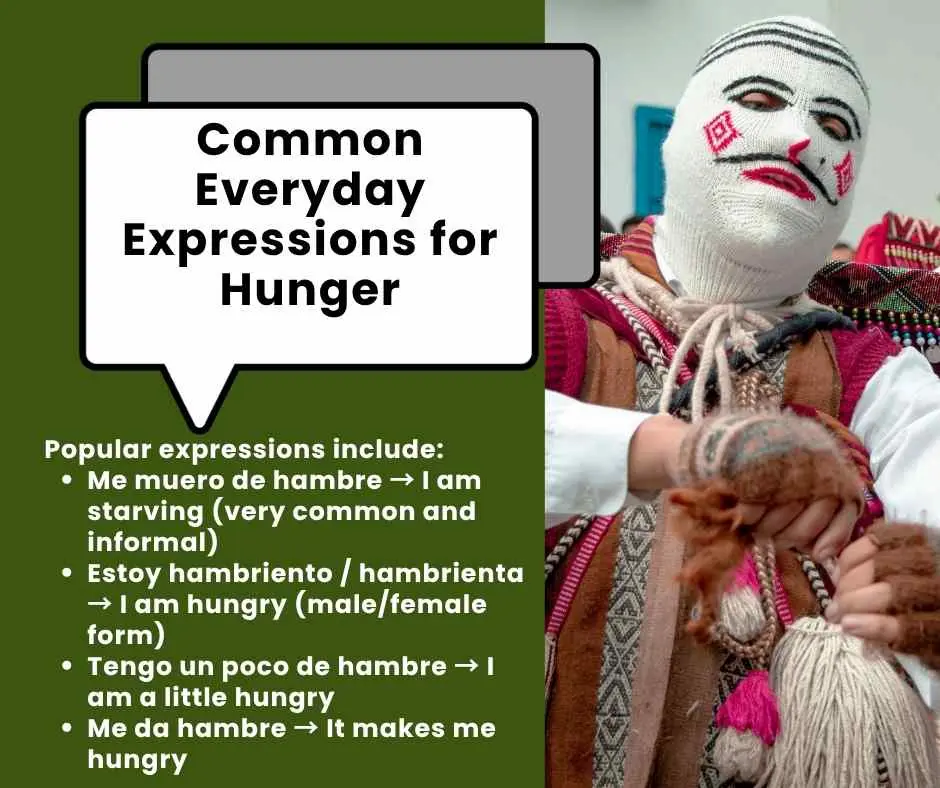
Besides the basic phrase, Spanish speakers use different natural expressions in daily life. Learning them helps you sound more fluent.
Popular expressions include:
- Me muero de hambre → I am starving (very common and informal)
- Estoy hambriento / hambrienta → I am hungry (male/female form)
- Tengo un poco de hambre → I am a little hungry
- Me da hambre → It makes me hungry
When to use them:
- Talking with friends → “Me muero de hambre”
- Neutral situations → “Tengo hambre”
- Describing feelings → “Estoy hambriento”
These variations make your Spanish more expressive and natural.
How Native Speakers Use It in Real Life
In real conversations, Spanish speakers often combine hunger phrases with actions or emotions. This makes speech sound more natural and flowing.
Real-life examples:
- After school:
“Tengo hambre, vamos a comer algo.”
(I am hungry, let’s eat something.) - At home:
“Me muero de hambre después del trabajo.”
(I am starving after work.) - With friends:
“¿Tienes hambre?”
(Are you hungry?)
Common question form:
- ¿Tienes hambre? = Are you hungry?
This is a very common question in families, restaurants, and social gatherings.
Pronunciation Guide Made Simple
Pronunciation is important when learning how to say hungry in Spanish, especially for beginners.
Key word pronunciation:
- Tengo → TEN-go
- Hambre → AHM-breh
Full phrase:
- Tengo hambre → TEN-go AHM-breh
Helpful tips:
- The “h” in “hambre” is silent
- Stress the first syllable in both words
- Speak slowly at first, then increase speed
Practicing out loud will help you sound more natural over time.
Slang and Informal Ways to Say Hungry
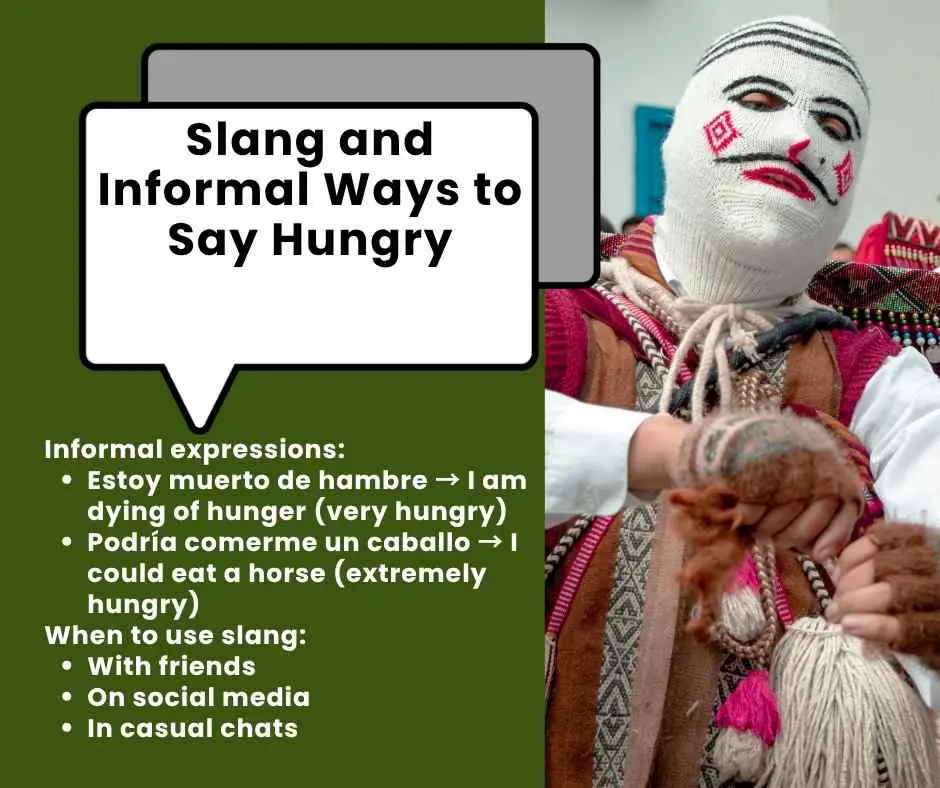
In casual conversations, Spanish speakers often use slang or relaxed expressions. These are not always used in formal situations, but they are very common among friends.
Informal expressions:
- Estoy muerto de hambre → I am dying of hunger (very hungry)
- Podría comerme un caballo → I could eat a horse (extremely hungry)
- Tengo un hambre que no puedo más → I am extremely hungry
- Ando con hambre → I’m feeling hungry
When to use slang:
- With friends
- On social media
- In casual chats
Avoid using these in formal meetings or professional conversations.
Polite and Formal Expressions
Sometimes you may want to sound more respectful, especially in formal settings like restaurants or meetings.
Polite ways include:
- Tengo hambre, por favor → I am hungry, please
- ¿Podría comer algo? → Could I eat something?
- Me gustaría comer ahora → I would like to eat now
These phrases are softer and more polite compared to slang or casual expressions.
When to use:
- Restaurants
- Formal conversations
- Meeting new people
Being polite always leaves a good impression in Spanish-speaking cultures.
Examples in Sentences
Understanding full sentences helps you remember vocabulary better. Here are some useful examples:
- Tengo hambre después de la escuela.
(I am hungry after school.) - ¿Tienes hambre o quieres esperar?
(Are you hungry or do you want to wait?) - Ella tiene hambre todos los días.
(She is hungry every day.) - Nosotros tenemos hambre ahora mismo.
(We are hungry right now.) - Me muero de hambre, necesito comer.
(I am starving, I need to eat.)
Practicing these sentences will help you use Spanish naturally in conversations.
Talking About Different Levels of Hunger
Spanish allows you to describe how hungry you feel in different ways.
Mild hunger:
- Tengo un poco de hambre → I am a little hungry
- Me da un poco de hambre → I feel a bit hungry
Normal hunger:
- Tengo hambre → I am hungry
Strong hunger:
- Tengo mucha hambre → I am very hungry
Extreme hunger:
- Me muero de hambre → I am starving
This makes your communication more precise and expressive.
Common Mistakes Learners Make
When learning how to say hungry in Spanish, beginners often make simple mistakes. Here are the most common ones:
Mistakes to avoid:
- Saying “Soy hambre” (incorrect)
- Forgetting “tengo” in basic sentence
- Pronouncing “hambre” with a strong “h” sound
- Mixing “estar” incorrectly in basic usage
Correct usage reminder:
- Always use “Tengo hambre” for “I am hungry”
Avoiding these mistakes will improve your Spanish quickly.
Quick Practice Phrases
Practice helps you remember better. Try saying these out loud:
- Tengo hambre ahora.
- Tengo mucha hambre hoy.
- ¿Tienes hambre?
- Me muero de hambre.
- Tengo un poco de hambre.
Repeat them daily to improve fluency and confidence.
Frequently Asked Questions
What is the most common way to say hungry in Spanish?
The most common way is “Tengo hambre,” which directly translates to “I am hungry” and is used in everyday conversations.
Can I say “Estoy hambre” in Spanish?
No, this is incorrect. The correct expression is “Tengo hambre,” not “Estoy hambre.”
How do you say very hungry in Spanish?
You can say “Tengo mucha hambre” or “Me muero de hambre” for stronger hunger.
Is “hambre” masculine or feminine in Spanish?
“Hambre” is a feminine noun, but it uses the article “el” in singular form due to pronunciation rules.
What does “¿Tienes hambre?” mean?
It means “Are you hungry?” and is commonly used when offering food or asking someone if they want to eat.
Conclusion
Learning how to say hungry in Spanish is a simple but powerful step in mastering everyday communication. The phrase “Tengo hambre” is the most important one, and from there, you can expand into slang, polite expressions, and natural conversations. With regular practice, you will sound more confident and fluent in real-life situations.
Also Check These Posts:
How to Say Hi in Swedish Correctly Every Time
How to Say Goodnight to Your Crush with Simple and Sweet Messages
How to Say Happy Birthday in Hawaiian | Fun and Easy Guide in 2026

Ethan Moore
Ethan Moore is a passionate storyteller and language enthusiast who believes that words have the power to bridge cultures. Ever since he was young, Ethan has been fascinated by how languages shape our thoughts and connect people from different corners of the world. Through his writing, he explores the beauty of communication and the subtle nuances that make each language unique. When he’s not writing, Ethan enjoys traveling, learning new languages, and diving into different cultures. His goal is to inspire readers to embrace diversity and appreciate the richness of global expression.
Books:
-
Whispers Across Tongues
-
The Language of Dreams