
If you’ve ever felt unsure about ordering a drink in another language, you’re not alone; you’re in the right place.
Learning how to say coffee in Spanish might seem like a small step, but it can make a big difference in real-life moments.
Imagine walking into a cozy café and confidently asking for your favorite drink without hesitation.
This simple word can open the door to real conversations and new experiences.
And don’t worry; I’ll guide you through it in the easiest, most friendly way possible.
The basic translation of coffee in Spanish
The Spanish word for coffee is:
- Coffee = Café
It’s simple, short, and easy to remember. The word “café” sounds very similar to the English word “coffee,” which makes it beginner-friendly.
How to pronounce café correctly
Here’s how you say it:
- Café → kah-FEH
Tips to pronounce it well:
- Stress the second syllable (FEH)
- Keep the “a” sound soft, like in “car”
- The “é” has a clear, strong sound
Practice saying it a few times out loud. It becomes natural quickly!
How to say coffee in spanish slang
In Spanish slang, people often say cafecito instead of just café. The word cafecito means “little coffee,” but it also shows warmth, kindness, and affection. Friends and family often use it when inviting someone for a relaxed coffee break or a friendly chat. In many Spanish-speaking countries, saying ¿Tomamos un cafecito? sounds more natural and welcoming than simply saying café.
- Cafecito feels as warm as a friendly hug.
- It spreads comfort like sunshine on a cool morning.
- The word sounds as inviting as an open door.
- Sharing a cafecito is like catching up with an old friend.
- It feels as cozy as a favorite blanket.
- The expression is like a smile in conversation.
- It brings people together as naturally as family dinners.
- The nickname sounds as sweet as homemade dessert.
- It creates connection like a bridge between friends.
- The phrase feels as comforting as a quiet weekend morning.
How to say coffee with milk in Spanish

The most common way to say coffee with milk in Spanish is café con leche. It is a popular drink across many Spanish-speaking countries and is often enjoyed at breakfast or during a relaxing break. If you order café con leche, people will immediately understand that you want coffee mixed with milk.
- Café con leche is as smooth as fresh cream.
- The flavor feels like a gentle morning breeze.
- It is as comforting as a homemade breakfast.
- The drink blends like two best friends together.
- It tastes as balanced as a perfect recipe.
- It feels like a peaceful start to the day.
- The combination is as classic as bread and butter.
- It is as satisfying as a warm meal.
- The aroma spreads like happiness through the kitchen.
- It feels as welcoming as a family gathering.
I would like a coffee in Spanish
If you want to politely order coffee, say Me gustaría un café. This phrase means “I would like a coffee” and is respectful in cafés, restaurants, and coffee shops. It sounds natural and is commonly used by both native speakers and language learners.
- The phrase is as polite as a kind greeting.
- It sounds like a respectful conversation.
- Speaking it feels as confident as knowing the way.
- The words flow like calm water.
- It is as useful as a travel map.
- The expression feels like opening a friendly conversation.
- It sounds as natural as saying hello.
- The sentence is like a key to easy ordering.
- It feels as simple as asking for help.
- The phrase works like a friendly smile abroad.
How to say coffee in French

The French word for coffee is café. It is pronounced differently from English but has the same meaning. Whether you are visiting France or learning French, saying café is the standard and correct way to ask for coffee.
- Café sounds as elegant as French music.
- The word feels like a stroll through Paris.
- It is as timeless as a classic painting.
- The pronunciation flows like soft poetry.
- The word feels as refined as fine art.
- It sounds like a relaxing afternoon in a café.
- Learning it is as easy as taking the first step.
- The expression feels as familiar as an old favorite.
- It is as memorable as a beautiful melody.
- The word fits like the final piece of a puzzle.
Coffee in spanish cafecito
Cafecito is an affectionate Spanish word for coffee. While it literally means “little coffee,” people often use it to express friendliness, comfort, or an invitation to spend time together. In many cultures, cafecito represents more than a drink—it represents connection.
- Cafecito feels as friendly as a neighbor’s wave.
- The word is like a warm invitation.
- It sounds as cheerful as morning laughter.
- Sharing one is like making a new memory.
- The expression feels as heartfelt as a thank-you.
- It is like comfort in a small cup.
- The nickname sounds as welcoming as home.
- It brings joy like good news from a friend.
- The word feels as gentle as a soft breeze.
- It creates warmth like a glowing fireplace.
Coffee in spanish duolingo
In Duolingo, the Spanish word for coffee is usually taught as café. As learners progress, they may also see phrases such as un café, café con leche, or cafecito. These examples help build everyday vocabulary for real conversations.
- Learning café is as easy as learning your name.
- The lesson feels like building one brick at a time.
- Each practice session is as rewarding as reaching a goal.
- New words stick like labels on a notebook.
- The vocabulary grows as steadily as a growing tree.
- The exercises feel like solving simple puzzles.
- Every lesson is as useful as daily practice.
- Remembering café is like recognizing a familiar face.
- Learning becomes as enjoyable as a favorite game.
- Progress feels like climbing one step at a time.
Coffee shop in Spanish
A coffee shop in Spanish is commonly called cafetería. It is a place where people enjoy coffee, snacks, desserts, and conversations. In many Spanish-speaking countries, cafeterías are popular meeting spots for friends, families, and coworkers.
- A cafetería feels as welcoming as your favorite place.
- It is like a second home for coffee lovers.
- The atmosphere is as relaxing as a quiet park.
- Walking in feels like joining good company.
- The aroma spreads as pleasantly as fresh flowers.
- The café buzzes like a happy neighborhood.
- It feels as peaceful as a slow morning.
- Every visit is like a small daily escape.
- The setting is as comfortable as an old chair.
- It creates memories like pages in a favorite book.
What is café in spanish color
In Spanish, café also means the color brown. The color gets its name from the rich brown shade of coffee beans. Depending on the region, people may also use marrón for brown, but café is widely understood when talking about color.
- The color café is as rich as roasted beans.
- It looks like freshly turned earth.
- The shade feels as natural as tree bark.
- It is as deep as dark chocolate.
- The color appears like autumn leaves.
- It feels as warm as wooden furniture.
- The tone is like a freshly brewed cup of coffee.
- It looks as earthy as mountain soil.
- The shade feels as classic as leather shoes.
- It is like nature wrapped in color.
Why learning how to say coffee in Spanish matters
You might wonder why such a small word is important. The truth is, “café” is used everywhere.
Everyday situations where you’ll use it
- Ordering drinks at a café or restaurant
- Talking to locals while traveling
- Asking for directions to a coffee shop
- Making small talk with Spanish speakers
Cultural importance of coffee
In many Spanish-speaking countries:
- Coffee is part of daily routines
- People meet over coffee to socialize
- It represents relaxation and conversation
So when you learn how to say coffee in Spanish, you’re also stepping into a cultural experience.
Common coffee-related words in Spanish
Once you know “café,” you can expand your vocabulary with related terms.
Types of coffee
- Café solo – Black coffee (like espresso)
- Café con leche – Coffee with milk
- Café americano – American-style coffee
- Café cortado – Coffee with a little milk
- Café descafeinado – Decaf coffee
Helpful vocabulary
- Azúcar – Sugar
- Leche – Milk
- Taza – Cup
- Caliente – Hot
- Frío – Cold
Example phrases
- Quiero un café. → I want a coffee
- ¿Tienes café? → Do you have coffee?
- Me gusta el café. → I like coffee
How to order coffee in Spanish like a local
Knowing the word is great, but using it in real life is even better.
Simple ordering phrases
- Un café, por favor – One coffee, please
- Quiero un café con leche – I want a coffee with milk
- ¿Me da un café? – Can you give me a coffee?
Polite expressions
- Por favor – Please
- Gracias – Thank you
- Buenos días – Good morning
Real-life example
Imagine you’re in a café:
- You say: “Un café con leche, por favor.”
- The waiter smiles and understands instantly
That’s the power of learning simple phrases!
Differences in coffee culture across Spanish-speaking countries
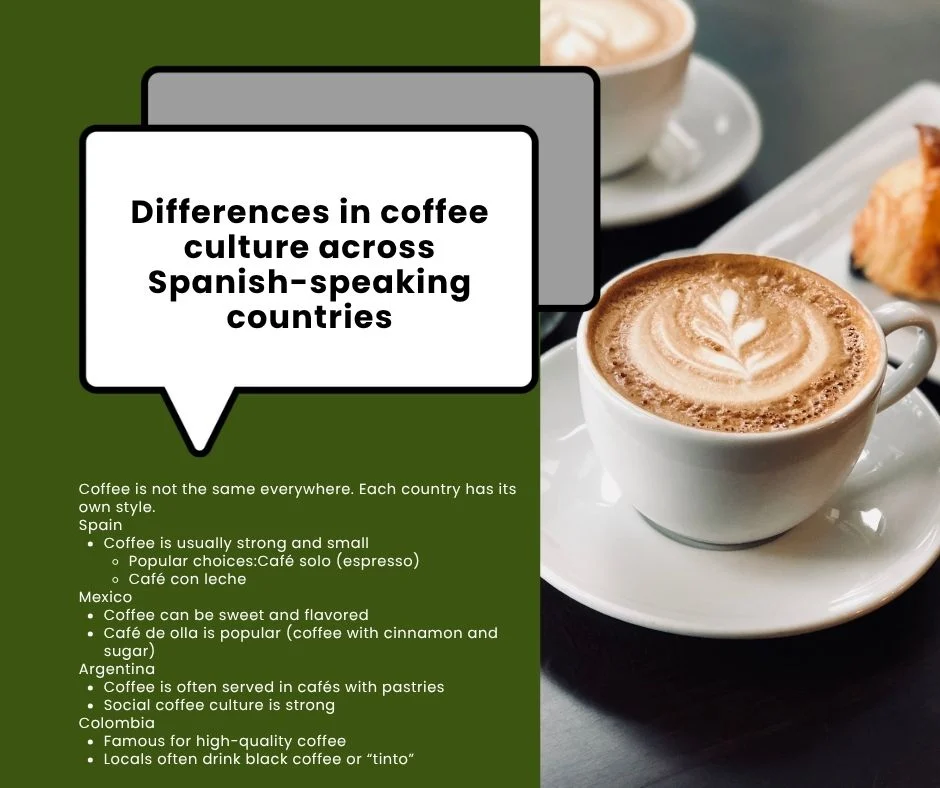
Coffee is not the same everywhere. Each country has its own style.
Spain
- Coffee is usually strong and small
- Popular choices:
- Café solo (espresso)
- Café con leche
Mexico
- Coffee can be sweet and flavored
- Café de olla is popular (coffee with cinnamon and sugar)
Argentina
- Coffee is often served in cafés with pastries
- Social coffee culture is strong
Colombia
- Famous for high-quality coffee
- Locals often drink black coffee or “tinto”
Why this matters
Even though “café” means coffee everywhere, how it’s served can change. Knowing this helps you order better and enjoy the experience more.
Easy tips to remember how to say coffee in Spanish
Learning new words can feel hard, but these tricks make it easier.
Use word association
- “Café” looks like “cafe” in English
- Think of a coffee shop sign
Practice daily
- Say “café” every morning
- Use it when drinking coffee
Label things
- Put a sticky note on your coffee cup: “café”
- Visual learning helps memory
Use it in sentences
Instead of memorizing the word alone, try:
- El café está caliente. (The coffee is hot)
Common mistakes beginners should avoid
Even simple words can be tricky at first.
Mispronouncing café
Wrong: CA-fee
Correct: kah-FEH
Forgetting the accent mark
- “Café” has an accent on é
- Without it, pronunciation may change
Using incorrect gender
- Coffee is masculine in Spanish
- Use: el café (not la café)
Overcomplicating
You don’t need long sentences. Keep it simple:
- Un café, por favor works perfectly
Expanding your Spanish beyond coffee
Once you learn “café,” you can build more vocabulary.
Drinks you might also like
- Té – Tea
- Jugo – Juice
- Agua – Water
- Chocolate caliente – Hot chocolate
Practice conversation
Try this simple dialogue:
- Person A: ¿Quieres café?
- Person B: Sí, quiero un café.
Build confidence step by step
Start with one word. Then:
- Add phrases
- Practice daily
- Speak without fear
Fun facts about the word café
Learning can be fun too!
- “Café” comes from Arabic origins
- It is used in many languages worldwide
- It can also mean “coffee shop” in some contexts
Example:
- Vamos al café → Let’s go to the café
Real-life scenarios to practice
At a restaurant
- Un café, por favor
At a friend’s house
- ¿Tienes café?
Traveling
- ¿Dónde puedo encontrar café? (Where can I find coffee?)
Morning routine
- Necesito café (I need coffee 😄)
Frequently Asked Questions (FAQs)
What is the correct way to say coffee in Spanish?
The correct word is café, and it is pronounced “kah-FEH.”
Is café the same in all Spanish-speaking countries?
Yes, “café” means coffee everywhere, but how it’s served may vary by country.
How do you order coffee in Spanish politely?
You can say, “Un café, por favor”, which means “One coffee, please.”
What does café con leche mean?
It means coffee with milk and is a very popular drink.
Is café masculine or feminine in Spanish?
“Café” is masculine, so you say el café, not la café.
How do Mexicans say coffee?
In Mexico, the most common word for coffee is café. It is used in everyday conversations, restaurants, and coffee shops, just like “coffee” is used in English.
How do I order coffee in Spanish?
A simple way to order coffee in Spanish is “Quiero un café, por favor.” It means “I would like a coffee, please.” This phrase is polite and commonly understood in Spanish-speaking countries.
What do Spanish people call coffee?
Spanish people call coffee café. Depending on the type of coffee, they may also use names like café con leche (coffee with milk) or café solo (espresso).
How do you say “I drink coffee” in Spanish?
You say “Yo bebo café” or simply “Bebo café.” Both mean “I drink coffee,” but the second version is more commonly used in everyday Spanish.
How do I say “Can I have a coffee please” in Spanish?
You can say “¿Me puede dar un café, por favor?” This means “Can I have a coffee, please?” It is a polite and natural phrase for ordering coffee in Spanish.
How do Mexicans say drink?
In Mexico, the verb beber means “to drink,” while tomar is more commonly used in everyday speech. For example, “Voy a tomar agua” means “I’m going to drink water.”
Conclusion
Now you know exactly how to say coffee in Spanish; café and how to use it in real-life situations.
This small word can make a big difference when traveling, ordering drinks, or connecting with others. Keep practicing daily, use simple phrases, and enjoy the process.
Learning Spanish starts with small steps, and “café” is a perfect one to begin with.
Also Check These Posts:
How to Say Name in Spanish with Confidence
How to Say Happy Hanukkah in Hebrew Like a Native Speaker
How to Say Ass in Spanish: Friendly Guide You Can Trust

Blake Kinslee
Hi! I’m Blake, a passionate writer who loves exploring the beauty of different languages and cultures through storytelling. Ever since I was young, I’ve been fascinated by how words can connect people across the world. Writing, for me, is not just a hobby—it’s a way to share ideas, emotions, and dreams with readers everywhere. When I’m not crafting stories, you’ll usually find me reading, traveling, or discovering new words in languages I’ve never spoken before. Every book I write is a journey, and I hope my readers feel that magic too.
Books:
-
Whispers Across Borders
-
The Language of Dreams