

Learning how to say man in Spanish is useful for travel, conversations, school, and daily communication.
Spanish is one of the most widely spoken languages in the world, so understanding common words can make speaking easier and more enjoyable.
Whether you are a beginner or improving your language skills, knowing the correct Spanish words for “man” helps you communicate naturally and confidently.
The Basic Word for Man in Spanish
The most common way to say “man” in Spanish is:
Hombre
The pronunciation sounds like:
OHM-breh
The “h” in Spanish is silent, so you do not pronounce it like the English “h.”
Simple Pronunciation Guide
Here is an easy breakdown:
- “Hom” sounds similar to “ohm”
- “bre” sounds like “breh”
Together:
- Hombre = OHM-breh
Example Sentences
Here are some simple examples:
- “Ese hombre es amable.”
- That man is kind.
- “El hombre está caminando.”
- The man is walking.
- “Un hombre habló conmigo.”
- A man spoke with me.
These examples help beginners understand how the word is used in everyday Spanish conversations.
Why Learning Basic Spanish Words Matters
Learning common Spanish vocabulary builds confidence and improves communication skills. Words like “man,” “woman,” “friend,” and “family” are used regularly in conversations.
Knowing how to say man in Spanish can help you:
- Understand movies and songs
- Communicate while traveling
- Speak with Spanish-speaking friends
- Improve school language assignments
- Build stronger vocabulary foundations
Small vocabulary improvements can create big language progress over time.
How to say man in spanish slang
In Spanish slang, there is no single word that means “man” everywhere because every Spanish-speaking country has its own informal expressions. Common slang words include tío (Spain), güey (Mexico), tipo, pana, compa, and bro, depending on the region. These words are often used between friends in casual conversations. If you are learning Spanish, remember that slang changes by country, so always match the word to the place where you are speaking.
- Tío – A common slang word for “man” in Spain.
- Güey – A casual way to say “man” or “dude” in Mexico.
- Tipo – Means “guy” or “man” in many Spanish-speaking countries.
- Compa – A friendly word for a close friend or buddy.
- Pana – Popular in several Latin American countries for a friend.
- Bro – An English borrowing often used by younger speakers.
- Carnal – Informal slang for a close friend in Mexico.
- Parcero – A Colombian slang word for a buddy or friend.
- Chavo – Refers to a young man in some regions.
- Cuate – A friendly Mexican term for a close male friend.
How to say woman in Spanish
The most common way to say woman in Spanish is mujer. This is the standard word used in everyday conversations, writing, and formal situations. Depending on the context, Spanish also has other words that describe a woman based on age, relationship, or level of formality. Learning the correct word helps you communicate naturally and respectfully.
- Mujer – The standard Spanish word for woman.
- Señora – A respectful way to address an adult woman.
- Dama – Means lady in a polite or formal context.
- Chica – Refers to a young woman or girl.
- Muchacha – Means young woman in many countries.
- Señorita – Used for a young or unmarried woman.
- Persona femenina – Refers to a female person.
- Esposa – Means wife.
- Madre – Means mother.
- Hembra – Means female and is mostly used for animals or biological discussions.
Senior man in Spanish
A senior man in Spanish is commonly called hombre mayor. This phrase respectfully refers to an older adult man. In more formal situations, you may also hear señor mayor or simply señor when speaking politely. The best choice depends on the conversation and level of respect you want to show.
- Hombre mayor – The most common way to say senior man.
- Señor mayor – A respectful expression for an older man.
- Anciano – Means elderly man.
- Adulto mayor – A formal phrase for an older adult.
- Señor – A polite title for a man.
- Caballero mayor – A formal way to describe an older gentleman.
- Hombre de edad avanzada – Means a man of advanced age.
- Veterano – Can describe an older or experienced man.
- Abuelo – Means grandfather when referring to family.
- Persona mayor – Refers to an older person in general.
I am a man in Spanish
The correct way to say I am a man in Spanish is Soy un hombre. This is a simple and natural sentence that is easy to use in everyday conversations. It follows basic Spanish grammar and works in both spoken and written language.
- Soy un hombre – The standard translation.
- Yo soy un hombre – Adds emphasis to “I.”
- Soy un adulto – Means I am an adult.
- Soy un caballero – Means I am a gentleman.
- Soy un chico – Means I am a boy or young man.
- Soy un joven – Means I am a young man.
- Soy masculino – Means I am male or masculine.
- Soy una persona – Means I am a person.
- Soy trabajador – Means I am a hardworking man.
- Soy amable – Means I am a kind man.
How to say male in spanish
The standard Spanish word for male is masculino. It is commonly used to describe gender in forms, education, science, and everyday conversations. In some situations, macho is also used, especially when talking about animals or biological sex.
- Masculino – The standard word for male.
- Macho – Commonly used for male animals.
- Varón – Means male or man in formal contexts.
- Hombre – Means man.
- Sexo masculino – Means male sex.
- Persona masculina – Means a male person.
- Masculino adulto – Refers to an adult male.
- Masculino joven – Refers to a young male.
- Género masculino – Means masculine gender.
- Individuo masculino – Means a male individual.
How to say boy in Spanish
The most common Spanish word for boy is niño. Depending on the person’s age and the country, Spanish speakers also use other words that describe a young male in different situations. Learning these variations helps you understand conversations more naturally.
- Niño – The standard word for boy.
- Chico – Means boy or young man.
- Muchacho – Refers to a young boy or young man.
- Joven – Means young person or young man.
- Hijo – Means son.
- Pequeño – Refers to a small child.
- Adolescente – Means teenager.
- Bebé – Means baby boy.
- Menor – Refers to a minor.
- Estudiante – Means student when referring to a boy in school.
How to say the girl in spanish
The correct way to say the girl in Spanish is la niña. If you are talking about a young woman instead of a child, la chica is also very common. The best choice depends on the person’s age and the situation.
- La niña – Means the girl.
- La chica – Means the young woman or girl.
- La muchacha – Refers to a young girl.
- La señorita – A polite way to refer to a young woman.
- La joven – Means the young woman.
- La hija – Means the daughter.
- La adolescente – Means the teenage girl.
- La estudiante – Means the female student.
- La pequeña – Means the little girl.
- La bebé – Means the baby girl.
How to say he in Spanish
The Spanish word for he is él. It is a subject pronoun used when talking about a male person. The accent mark is important because él means “he,” while el without the accent means “the.”
- Él – The standard Spanish word for he.
- Él habla – Means he speaks.
- Él es – Means he is.
- Él tiene – Means he has.
- Él vive – Means he lives.
- Él trabaja – Means he works.
- Él estudia – Means he studies.
- Él corre – Means he runs.
- Él juega – Means he plays.
- Él aprende – Means he learns.
Different Words for Man in Spanish
Spanish has several words that can refer to a man depending on the situation, age, culture, or tone of conversation.
Hombre
“Hombre” is the standard and most widely accepted word for man.
It is appropriate in:
- Formal situations
- Casual conversations
- Writing
- Education
This is the safest and most important word for beginners to learn first.
Chico
Chico is often used for a boy or young man.
Examples:
- “Ese chico es divertido.”
- That guy is funny.
- “Un chico me ayudó.”
- A guy helped me.
In some countries, “chico” can casually mean “guy.”
Señor
Señor means “Mr.” or “sir.”
It is used respectfully for adult men.
Examples:
- “Buenos días, señor.”
- Good morning, sir.
- “El señor García llegó.”
- Mr. Garcia arrived.
This term is useful in polite or formal conversations.
Caballero
Caballero means “gentleman.”
It often describes a polite or respectful man.
Example:
- “Él es un caballero.”
- He is a gentleman.
This word sounds more elegant and formal.
Pronunciation Tips for Beginners
Spanish pronunciation becomes easier with practice because many words follow consistent sound rules.
The Silent H Rule
One important rule is:
- The letter “h” is silent in Spanish.
Examples:
- Hombre = OHM-breh
- Hola = OH-lah
Many beginners accidentally pronounce the “h” at first.
Rolling the R Sound
The “r” in “hombre” is softer than some English “r” sounds.
You do not need a strong rolling sound for this word. A gentle pronunciation works well.
Practice Slowly First
Try saying:
- Hombre
- Hombre amable
- El hombre
Speaking slowly helps improve accuracy and confidence.
How Native Speakers Use the Word Hombre
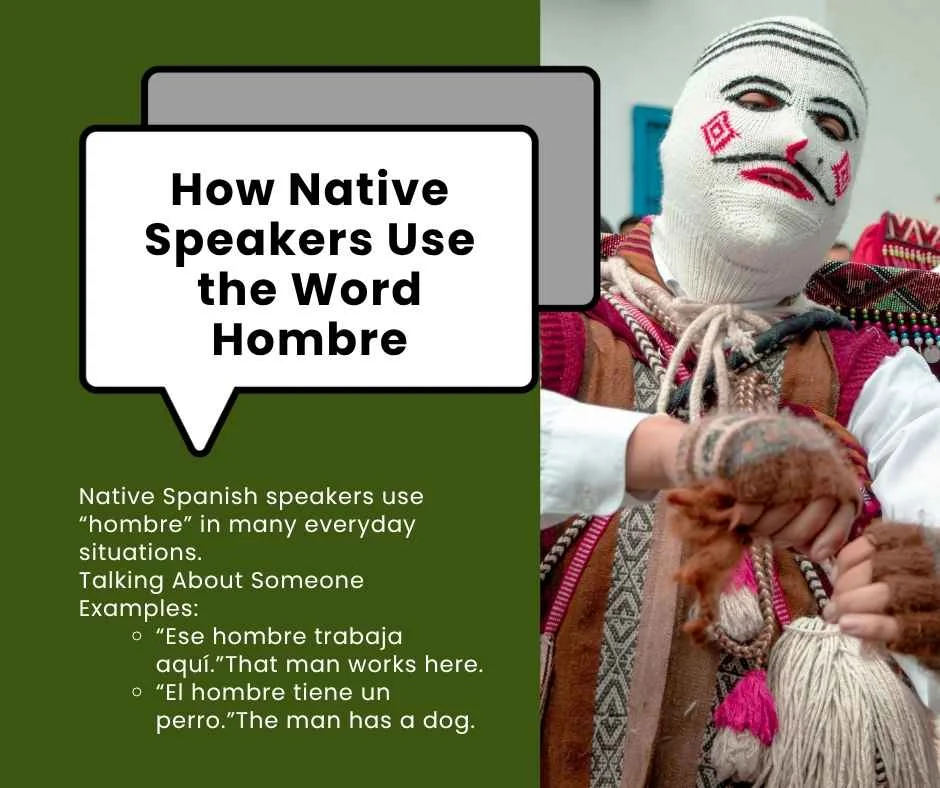
Native Spanish speakers use “hombre” in many everyday situations.
Talking About Someone
Examples:
- “Ese hombre trabaja aquí.”
- That man works here.
- “El hombre tiene un perro.”
- The man has a dog.
Expressing Emotion
Sometimes “hombre” is used casually in conversation, similar to saying:
- “man”
- “dude”
- “come on”
For example:
- “¡Hombre, claro que sí!”
- Of course, man!
This usage depends on region and tone.
Regional Differences Across Spanish-Speaking Countries
Spanish changes slightly depending on the country. While “hombre” is universally understood, some regions use different casual words for “man” or “guy.”
Spain
In Spain, people may say:
- Hombre
- Tío
“Tío” can mean:
- guy
- dude
Example:
- “Ese tío es muy simpático.”
- That guy is very friendly.
Mexico
In Mexico, common informal words include:
- Hombre
- Chico
- Tipo
“Tipo” can mean:
- guy
- fellow
Argentina
In Argentina, people sometimes say:
- Hombre
- Pibe
“Pibe” usually refers to a young guy or boy.
Understanding regional vocabulary helps learners sound more natural during conversations.
Singular and Plural Forms
When speaking Spanish, singular and plural forms are important.
Singular Form
- Hombre = man
Example:
- “El hombre está feliz.”
- The man is happy.
Plural Form
- Hombres = men
Example:
- “Los hombres están hablando.”
- The men are talking.
Notice that adding “s” creates the plural form, similar to many English nouns.
Masculine and Feminine Language in Spanish
Spanish nouns usually have masculine or feminine gender forms.
Masculine Form
- Hombre = man
Feminine Form
- Mujer = woman
Mujer is the common Spanish word for woman.
Examples:
- “La mujer sonríe.”
- The woman smiles.
Learning masculine and feminine vocabulary together helps students understand sentence structure more easily.
Common Phrases Using Hombre
Spanish learners often remember vocabulary faster when they learn complete phrases.
Everyday Examples
- “Buen hombre”
- Good man
- “Hombre trabajador”
- Hardworking man
- “Ese hombre”
- That man
- “Un hombre fuerte”
- A strong man
Using phrases improves speaking flow and listening skills.
How to Use Man in Conversations
Real conversations help vocabulary become practical and memorable.
At a Restaurant
Example:
- “El hombre quiere café.”
- The man wants coffee.
At School
Example:
- “Ese hombre es profesor.”
- That man is a teacher.
During Travel
Example:
- “El hombre ayuda a los turistas.”
- The man helps tourists.
Daily practice with realistic examples builds confidence quickly.
Formal and Informal Usage
Understanding tone is important when speaking Spanish.
Formal Situations
Use:
- Hombre
- Señor
- Caballero
Examples:
- business meetings
- customer service
- respectful conversations
Informal Situations
Use:
- Chico
- Tipo
- Tío
Examples:
- friends
- casual chats
- relaxed conversations
Choosing the right word depends on the situation and relationship.
Grammar Tips for Using Hombre Correctly
Spanish grammar may feel challenging at first, but simple patterns make learning easier.
Articles Before Hombre
Spanish often uses articles before nouns.
Examples:
- El hombre = the man
- Un hombre = a man
“El” means “the.”
“Un” means “a.”
Adjectives After the Noun
In Spanish, adjectives often come after the noun.
Examples:
- Hombre inteligente
- Intelligent man
- Hombre amable
- Kind man
This structure differs from English, where adjectives usually come first.
Easy Ways to Remember the Word Hombre
Memory techniques can help beginners learn faster.
Connect It With Familiar Sounds
“Hombre” sounds a little like:
- OHM-breh
Repeating the sound aloud helps pronunciation become natural.
Use Flashcards
Write:
- Hombre = man
Practice daily for a few minutes.
Create Simple Sentences
Examples:
- “El hombre corre.”
- “Ese hombre canta.”
Short sentences improve memory and grammar together.
Mistakes Beginners Often Make
Language learners commonly make small pronunciation or grammar errors.
Pronouncing the H
Incorrect:
- “Hum-breh”
Correct:
- “OHM-breh”
Remember:
- The “h” is silent.
Using Wrong Gender Articles
Incorrect:
- “La hombre”
Correct:
- “El hombre”
“Hombre” is masculine, so it uses masculine articles.
Translating Too Literally
Some learners try translating English slang directly into Spanish, which may sound unnatural.
Focus first on standard words like:
- Hombre
- Señor
- Chico
These are safer and easier for beginners.
How Spanish Learners Can Practice Faster
Consistency is more important than perfection.
Watch Spanish Videos
Listen to how native speakers pronounce words naturally.
Pay attention to:
- sentence rhythm
- pronunciation
- tone
Speak Daily
Even five minutes of speaking practice helps improve confidence.
Try:
- reading aloud
- repeating sentences
- practicing with friends
Label Everyday Objects
Vocabulary practice becomes easier when connected to daily life.
Example:
- hombre = man
- mujer = woman
- niño = boy
Visual repetition strengthens memory.
Cultural Importance of Respectful Language
Spanish-speaking cultures often value polite and respectful communication.
Using words like:
- señor
- caballero
can show respect, especially with older adults or strangers.
Choosing respectful language improves social interactions and helps conversations feel warmer and friendlier.
Fun Facts About the Word Hombre
Language learning becomes more interesting with cultural details.
Hombre Appears in Music and Movies
The word “hombre” is common in:
- songs
- films
- books
- television shows
You may hear phrases like:
- “Buen hombre”
- “Ese hombre”
frequently in Spanish entertainment.
Some English Speakers Already Know the Word
Because of movies and popular culture, many English speakers recognize “hombre” even before studying Spanish.
However, learning correct pronunciation and usage makes communication more accurate.
Building More Spanish Vocabulary From Hombre
Once you learn one useful word, you can expand your vocabulary naturally.
Related words include:
- Hombre joven
- Young man
- Hombre mayor
- Older man
- Hombre feliz
- Happy man
- Hombre inteligente
- Smart man
Combining nouns and adjectives helps learners create many new sentences quickly.
Frequently Asked Questions
How do you say man in Spanish?
The most common Spanish word for man is “hombre.”
How is hombre pronounced?
“Hombre” is pronounced as “OHM-breh,” with a silent “h.”
Is hombre formal or informal?
“Hombre” works in both formal and informal conversations.
What is the plural of hombre?
The plural form is “hombres,” which means “men.”
Can chico also mean man in Spanish?
Yes, “chico” can sometimes mean a young man or guy in casual conversation.
What is the Spanish slang for men?
Spanish slang for men depends on the country and region. Common words include tío (Spain), vato (Mexico), tipo (many Latin American countries), and güey (Mexico, informal). These terms are casual and should be used only in the right social context.
What is the Spanish word for man?
The standard Spanish word for man is hombre. It is the most common and widely accepted term used in everyday conversations, formal writing, and dictionaries across Spanish-speaking countries.
What is the Spanish word for male?
The Spanish word for male is masculino when describing gender or characteristics. When referring to a male person or animal, macho is also commonly used, depending on the context.
What do I call my man in Spanish?
You can call your man with affectionate Spanish nicknames such as mi amor (my love), mi vida (my life), cariño (darling), or mi rey (my king). These romantic terms are popular in many Spanish-speaking cultures.
What is slang for guy in Spanish?
Popular Spanish slang for guy includes tío, güey, chavo, tipo, and vato, depending on the country. Because slang varies by region, it’s best to choose the term that fits the local culture.
What do Spanish call their lover?
Spanish speakers often call their lover mi amor, cariño, cielo, corazón, or mi vida. These affectionate expressions are commonly used to show love, warmth, and closeness in romantic relationships.
Conclusion
Learning how to say man in Spanish is an important step for beginners studying the language.
The word “hombre” is easy to use, widely understood, and helpful in everyday conversations.
By practicing pronunciation, understanding grammar, and learning common phrases, you can communicate more naturally and confidently in Spanish.
Regular practice and simple conversations will continue improving your language skills over time.
Also Check These Posts:
- How to Say Good Evening in Italian | Easy Greetings for Beginners
- How to Say Your Welcome in Japanese | Easy Phrases for Everyday Conversations
- How to Say 19 in Spanish | Meaning, Pronunciation and Easy Examples

Blake Kinslee
Hi! I’m Blake, a passionate writer who loves exploring the beauty of different languages and cultures through storytelling. Ever since I was young, I’ve been fascinated by how words can connect people across the world. Writing, for me, is not just a hobby—it’s a way to share ideas, emotions, and dreams with readers everywhere. When I’m not crafting stories, you’ll usually find me reading, traveling, or discovering new words in languages I’ve never spoken before. Every book I write is a journey, and I hope my readers feel that magic too.
Books:
-
Whispers Across Borders
-
The Language of Dreams