

Wondering how to say your in Spanish and feeling confused by different meanings?
You’re not alone; Spanish uses more than one word for “your,” and each one depends on the situation.
This quick guide breaks it down in the simplest way possible, even if you’re a complete beginner.
By the end, you’ll know exactly which word to use and when; without second-guessing yourself.
Understanding Why “Your” Changes in Spanish
Spanish changes the word for “your” based on who you are talking to, how many things you are describing, and sometimes the level of formality.
This may feel confusing at first, but once you see the patterns, it becomes much easier.
Spanish focuses on:
- Who owns the object
- Whether the noun is singular or plural
- The formality of the situation
English stays the same with “your,” but Spanish adapts to context.
The Most Common Ways to Say Your
Spanish uses possessive adjectives to express ownership.
These words come before the noun and must match the noun, not the owner.
Tu for Informal Singular Situations
Tu is the most common informal way to say “your” in Spanish. You use it when talking to one person you know well.
Use tu when speaking to:
- Friends
- Family members
- Children
- People your age in casual settings
Examples:
- Tu libro está aquí.
Your book is here. - Me gusta tu camisa.
I like your shirt.
Key points:
- Informal
- Used with one person
- Noun is singular
Tus for Informal Plural Objects
Tus is used when the noun is plural, but the relationship stays informal.
Examples:
- Tus zapatos son nuevos.
Your shoes are new. - ¿Dónde están tus llaves?
Where are your keys?
Remember:
- Tu and tus depend on the noun, not the person
- Tus is simply the plural form
Formal Ways to Say Your in Spanish
Spanish uses formal language to show respect. This is very important in professional or polite settings.
Su for Formal or Respectful Situations
Su is used to say “your” when speaking formally to one person or addressing someone with respect.
Use su when talking to:
- Elders
- Teachers
- Bosses
- Strangers
Examples:
- Su nombre, por favor.
Your name, please. - Aquí está su café.
Here is your coffee.
Important note:
- Su can mean his, her, or your
- Context usually makes the meaning clear
Sus for Formal Plural Objects
Sus is the plural form of su and is used when the noun is plural.
Examples:
- Sus documentos están listos.
Your documents are ready. - ¿Dónde están sus hijos?
Where are your children?
This form is very common in polite conversations.
Saying Your When Talking to More Than One Person
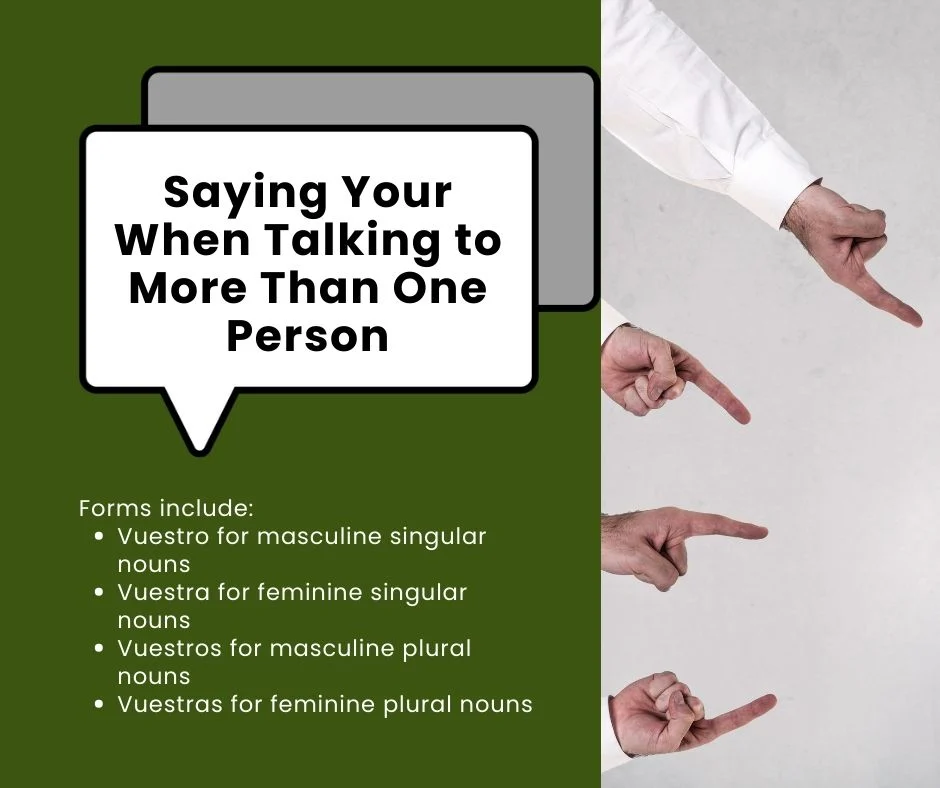
When addressing multiple people informally or formally, Spanish uses different forms.
Vuestro and Vuestra for Informal Groups
In some Spanish-speaking regions, especially Spain, vuestro and vuestra are used when talking to more than one person informally.
Forms include:
- Vuestro for masculine singular nouns
- Vuestra for feminine singular nouns
- Vuestros for masculine plural nouns
- Vuestras for feminine plural nouns
Examples:
- Vuestra casa es hermosa.
Your house is beautiful. - Vuestros amigos llegaron.
Your friends arrived.
These forms are less common in Latin America.
Su and Sus for Formal or Neutral Groups
In most Spanish-speaking countries, su and sus are used when talking to a group.
Examples:
- Su mesa está lista.
Your table is ready. - Sus ideas son interesantes.
Your ideas are interesting.
This usage works in both formal and informal plural situations.
Possessive Pronouns for Your
Spanish also uses possessive pronouns, which replace the noun instead of coming before it.
Common forms:
- El tuyo / la tuya
- Los tuyos / las tuyas
- El suyo / la suya
Examples:
- Este libro es el tuyo.
This book is yours. - Las llaves son tuyas.
The keys are yours.
These forms agree with the noun they replace.
Avoiding Confusion with Su
Because su can mean his, her, your, or their, Spanish speakers sometimes clarify.
Common clarification phrases:
- El libro de usted
- La casa de ella
Example:
- Su coche de usted está afuera.
Your car is outside.
This helps avoid misunderstandings.
Real-Life Examples Using Your in Spanish
Seeing phrases in context helps learning stick.
Daily conversations:
- ¿Es tu teléfono?
Is it your phone? - Su pedido llegará mañana.
Your order will arrive tomorrow.
At work:
- Tu informe está bien hecho.
Your report is well done. - Sus archivos están completos.
Your files are complete.
With friends:
- Me gusta tu estilo.
I like your style. - Tus planes suenan bien.
Your plans sound good.
Common Mistakes Learners Make
Beginners often struggle with these areas.
Common errors:
- Mixing tu and su incorrectly
- Forgetting plural agreement
- Translating directly from English
Incorrect:
- Tu libros
Correct: - Tus libros
Pay attention to noun number and context.
Cultural Tips for Using Your Correctly
Spanish-speaking cultures value politeness and respect.
Helpful tips:
- When unsure, use formal forms
- Observe how native speakers speak
- Politeness is appreciated in service situations
Choosing the right form shows respect and cultural awareness.
Practice Tips to Master Your in Spanish
Practice makes patterns feel natural.
Try these methods:
- Write short sentences daily
- Replace nouns with pronouns
- Practice switching between formal and informal
- Speak aloud to improve confidence
Repetition builds accuracy over time.
Frequently Asked Questions
What is the most common way to say your in Spanish?
The most common informal form is tu, used with people you know well.
When should I use su instead of tu?
Use su in formal situations or when speaking respectfully.
Does your change based on gender?
It changes based on the noun’s gender and number, not the person.
Is vuestro used in all Spanish-speaking countries?
Vuestro is mostly used in Spain and less common elsewhere.
How do I avoid confusion with su?
You can clarify by adding de usted or using context.
Conclusion
Learning how to say your in Spanish helps you speak clearly, politely, and naturally.
From tu and tus in casual settings to su and sus in formal conversations, each form has a purpose.
With practice and attention to context, you will choose the right word confidently and communicate more effectively in Spanish.
Also Check These Posts:
How to Say Hello in Norwegian Like a Native Speaker in 2026
How to Say Excuse Me in Japanese | Formal & Casual Ways in 2026
How to Say Acai | Master the Correct Pronunciation in 2026
How to Say Happy Valentine’s Day in Spanish and Other Popular Languages

Darcy Lynn
Darcy Lynn has always been fascinated by the colors and stories of life. Her journey with writing began in childhood, and today she takes readers into new worlds through her stories. For her, every word is a way to explore new experiences and emotions. Darcy loves exploring stories across different cultures and languages, which also reflects in her unique writing style. She believes that a good story touches every heart and sparks deeper thinking. Alongside writing, she enjoys connecting directly with her readers and understanding their feelings.
Books:
-
Whispers Across Worlds
-
Echoes of Tomorrow