

Want to know how to say excuse me in Japanese and sound polite in any situation?
Japanese has different phrases depending on whether you’re getting someone’s attention, apologizing, or passing by.
This guide will make it simple and easy to remember.
By the end, you’ll know exactly what to say to stay polite and respectful in Japan.
Common Japanese Words for Excuse Me
Japanese does not use just one phrase for “excuse me.” Instead, different expressions are used depending on context.
Understanding these differences is key to sounding natural.
Sumimasen and When to Use It
Sumimasen (すみません) is the most common and versatile way to say excuse me in Japanese.
Beginners often learn this first because it works in many situations.
You can use sumimasen when:
- Getting someone’s attention
- Making a small apology
- Saying “excuse me” while passing by
- Politely asking for help
Examples:
- Sumimasen, eki wa doko desu ka?
(Excuse me, where is the station?) - Sumimasen, chotto ii desu ka?
(Excuse me, may I have a moment?)
Why it works so well:
- Polite and safe in most situations
- Accepted in both casual and formal settings
- Shows respect without sounding too stiff
For beginners, sumimasen is the best all-purpose choice when learning how to say excuse me in Japanese.
Excuse me in Japanese casual
- Like a friendly wave that opens a conversation, casual “excuse me” helps you speak politely with friends.
- Like tapping a friend on the shoulder, ごめん (gomen) gets someone’s attention in an easygoing way.
- Like a gentle smile, it keeps conversations relaxed and natural.
- Like stepping lightly onto a path, it shows respect without sounding formal.
- Like a soft knock on a door, it lets others know you want to speak.
- Like sharing a laugh, it fits comfortable and familiar situations.
- Like a quiet breeze, it keeps interactions smooth and pleasant.
- Like offering a small nod, it shows simple courtesy.
- Like a friendly hello, it starts conversations naturally.
- Like an open hand, it creates a warm and welcoming feeling.
How to say excuse me in japanese formal
- Like wearing neat clothes to an important meeting, 失礼します (shitsurei shimasu) shows respect.
- Like bowing before speaking, it expresses good manners.
- Like opening a door carefully, it enters conversations politely.
- Like a professional handshake, it leaves a respectful impression.
- Like speaking with kindness, it suits business and formal settings.
- Like following good etiquette, it makes communication smoother.
- Like showing appreciation, it reflects thoughtful behavior.
- Like a calm voice, it helps avoid sounding rude.
- Like a respectful greeting, it fits official situations well.
- Like a polished introduction, it shows courtesy from the beginning.
How to say excuse me in japanese pronunciation
- Like learning the notes of a song, correct pronunciation makes Japanese sound natural.
- Like following a map, clear pronunciation helps others understand you.
- Like practicing a new dance step, repeating the words builds confidence.
- Like tuning a guitar, small improvements create better results.
- Like listening to a native speaker, your pronunciation becomes smoother.
- Like reading aloud every day, practice strengthens your speaking skills.
- Like matching a rhythm, proper pronunciation feels more natural.
- Like placing puzzle pieces together, every sound matters.
- Like walking one step at a time, progress comes through practice.
- Like speaking with confidence, clear pronunciation improves communication.
How to say excuse me in japanese anime
- Like a dramatic movie scene, anime often makes expressions sound more emotional.
- Like an energetic performance, characters may say ごめん (gomen) with strong feelings.
- Like a playful conversation, anime uses casual language between friends.
- Like an exciting story, the tone changes with the situation.
- Like acting on a stage, voice expression adds meaning.
- Like showing emotion through music, anime highlights feelings clearly.
- Like a colorful painting, each scene gives words a different mood.
- Like reading a comic, context changes how expressions sound.
- Like a lively conversation, anime speech feels expressive.
- Like watching real emotions unfold, the words match the character’s feelings.
Excuse me in Japanese hiragana
- Like learning the alphabet, hiragana helps beginners read Japanese.
- Like building a strong foundation, hiragana supports language learning.
- Like tracing simple shapes, it becomes easier with practice.
- Like reading children’s books, hiragana improves confidence.
- Like taking the first step, it starts your Japanese journey.
- Like connecting puzzle pieces, each character forms complete words.
- Like writing neatly, practice improves accuracy.
- Like learning a familiar tune, repeated reading feels natural.
- Like opening a new book, hiragana makes Japanese more approachable.
- Like planting a seed, steady practice brings lasting progress.
Excuse me in Japanese anime

- Like hearing a favorite catchphrase, anime expressions stay memorable.
- Like watching friends interact, casual language feels natural.
- Like following a character’s emotions, every expression has purpose.
- Like a scene full of excitement, tone changes the meaning.
- Like reading between the lines, context explains the words.
- Like watching a live performance, voice acting adds emotion.
- Like sharing an adventure, anime language feels engaging.
- Like a fast-moving story, conversations stay expressive.
- Like a smile during dialogue, the expression feels genuine.
- Like stepping into another world, anime makes language fun to learn.
Excuse me when entering a room in japanese
- Like knocking before opening a door, saying 失礼します (shitsurei shimasu) shows respect.
- Like asking permission politely, it reflects good manners.
- Like greeting people with kindness, it creates a positive impression.
- Like removing your shoes before entering a home, it follows cultural etiquette.
- Like speaking softly in a quiet place, it shows consideration.
- Like offering a respectful bow, it expresses courtesy.
- Like entering carefully, it respects everyone in the room.
- Like following good habits, it makes social situations comfortable.
- Like starting with kindness, it encourages positive interactions.
- Like showing gratitude through actions, it reflects respect for others.
Excuse me in japanese kanji
- Like unlocking a new level of learning, kanji adds deeper understanding.
- Like recognizing familiar landmarks, kanji helps identify common words.
- Like solving a meaningful puzzle, each character has purpose.
- Like reading a detailed map, kanji provides clear meaning.
- Like building strong language skills, learning kanji improves fluency.
- Like adding color to a drawing, kanji enriches written Japanese.
- Like practicing every day, recognition becomes easier.
- Like discovering hidden details, kanji reveals deeper meanings.
- Like climbing one step at a time, learning grows steadily.
- Like completing a picture, kanji strengthens overall Japanese reading skills.
Shitsurei Shimasu for Formal Situations
Shitsurei shimasu (失礼します) is a more formal expression. It literally means “I will be rude,” but in a polite and respectful way.
This phrase is commonly used:
- In offices or schools
- When entering or leaving a room
- During formal conversations
- In professional emails or phone calls
Examples:
- Shitsurei shimasu (when entering a meeting room)
- Shitsurei shimashita (after interrupting someone)
Important tips:
- Use it in professional or respectful environments
- Not common in casual daily conversations
- Shows awareness of social etiquette
If you work or study in Japan, knowing this form is essential.
Gomen Nasai for Apologetic Excuse Me
Gomen nasai (ごめんなさい) is used when “excuse me” is closer to “I’m sorry.” It expresses apology rather than attention or interruption.
You can use gomen nasai when:
- You make a mistake
- You accidentally bump into someone
- You hurt someone’s feelings
Examples:
- Gomen nasai, machigaemashita
(Excuse me, I made a mistake.) - Gomen nasai, okuremashita
(Sorry, I’m late.)
Things to remember:
- More emotional than sumimasen
- Not ideal for asking questions
- Best for genuine apologies
Understanding this difference helps you use the correct phrase naturally.
Chotto for Casual Excuse Me
Chotto (ちょっと) means “a little,” but in conversation, it can function as a casual “excuse me.”
Common uses include:
- Getting attention informally
- Interrupting friends
- Softening requests
Examples:
- Chotto matte
(Excuse me, wait a moment.) - Chotto kikasete
(Excuse me, let me ask you something.)
Notes for learners:
- Casual and informal
- Avoid using with strangers or elders
- Best with friends or people your age
This word appears often in daily Japanese speech.
Using Excuse Me in Crowded Places
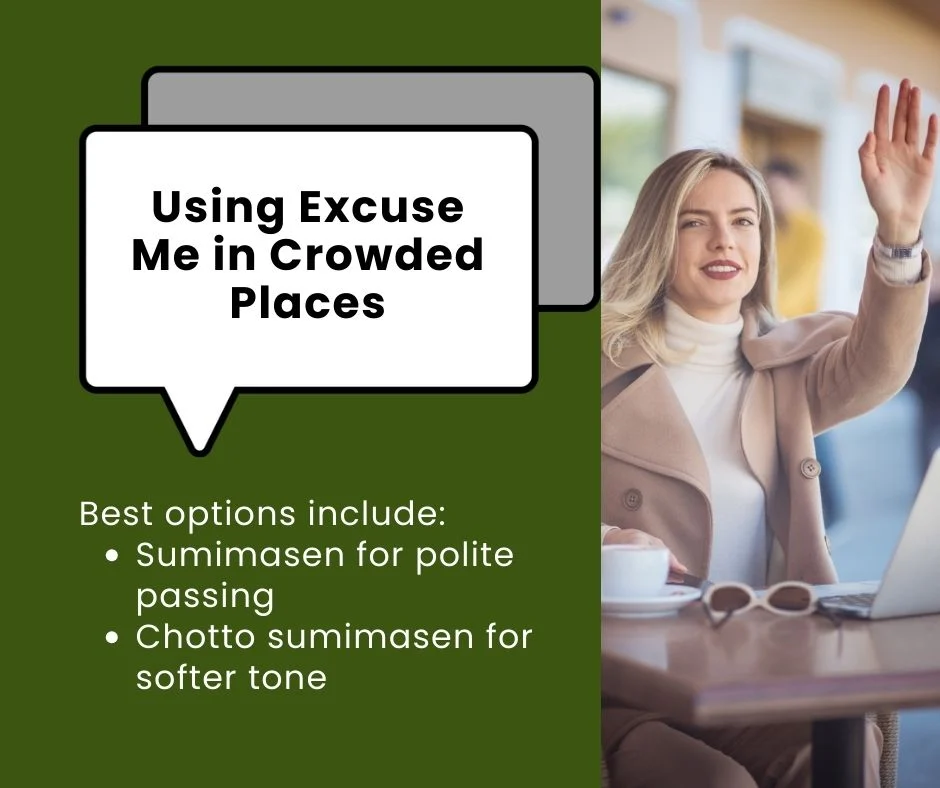
In crowded places like trains, shops, or streets, saying excuse me politely is very important.
Best options include:
- Sumimasen for polite passing
- Chotto sumimasen for softer tone
Examples:
- Sumimasen, toorimasu
(Excuse me, I’m passing through.) - Chotto sumimasen
(Excuse me, just a moment.)
Japanese people appreciate gentle and respectful expressions, especially in public spaces.
Excuse Me When Asking for Help
When asking for directions, information, or assistance, sumimasen is the most natural choice.
Useful patterns:
- Sumimasen, onegaishimasu
- Sumimasen, wakarimasen
Example conversations:
- Sumimasen, kono basu wa eki ni ikimasu ka?
(Excuse me, does this bus go to the station?) - Sumimasen, tetsudatte kudasai
(Excuse me, please help me.)
This usage sounds polite and friendly, even to strangers.
Excuse Me on the Phone or Email
In phone calls and emails, Japanese uses polite expressions that match social expectations.
Common phrases include:
- Shitsurei shimasu for starting or ending calls
- Sumimasen for interruptions
Examples:
- Shitsurei shimasu, Tanaka-san wa irasshaimasu ka?
- Sumimasen, ima yoroshii desu ka?
Using the right phrase shows professionalism and cultural understanding.
Differences Between Polite and Casual Usage
Knowing the level of politeness is crucial when learning how to say excuse me in Japanese.
Polite expressions:
- Sumimasen
- Shitsurei shimasu
Casual expressions:
- Chotto
- Gomen
General rule:
- Use polite forms with strangers
- Use casual forms with friends
- When unsure, choose polite
This rule helps avoid awkward situations.
Body Language and Tone Matter
In Japanese culture, how you say something matters just as much as what you say.
Helpful tips:
- Slight bow when saying excuse me
- Soft tone shows respect
- Avoid loud or aggressive voice
Even simple words sound more polite with calm body language.
Common Mistakes Beginners Make
Many learners misuse Japanese expressions for excuse me.
Avoid these mistakes:
- Using gomen nasai for asking questions
- Using chotto with elders
- Forgetting politeness in public
Correcting these habits improves your confidence and fluency.
Practicing Excuse Me in Daily Life
Practice helps you remember and use phrases naturally.
Ideas to practice:
- Repeat example sentences aloud
- Watch Japanese shows and listen carefully
- Role-play simple situations
The more you practice, the more natural it feels.
Frequently Asked Questions
What is the most common way to say excuse me in Japanese?
Sumimasen is the most common and safest option for beginners.
Can I use sumimasen to say sorry?
Yes, sumimasen can mean excuse me or a light apology depending on context.
Is gomen nasai polite enough for strangers?
It is polite but more emotional. Sumimasen is better for strangers.
How do you say excuse me in a formal workplace?
Use shitsurei shimasu in professional or formal settings.
Is chotto rude to use?
Chotto is not rude but very casual. Use it only with friends.
How do you say excuse me in Japanese politely?
The most polite and commonly used way to say “excuse me” in Japanese is Sumimasen (soo-mee-mah-sen). It is appropriate when getting someone’s attention, passing through a crowd, or making a polite request. In formal and everyday situations, sumimasen is the safest and most natural choice.
Is Sumimasen sorry or excuse me?
Sumimasen can mean both “sorry” and “excuse me,” depending on the situation. It is often used as a polite apology for small inconveniences or to get someone’s attention respectfully. The intended meaning is understood from the context of the conversation.
How do I say “excuse me politely”?
To say “excuse me” politely, use Sumimasen (soo-mee-mah-sen). It is the standard polite expression in Japanese and is suitable for speaking with strangers, staff, coworkers, or anyone you want to address respectfully.
How do you say “pardon me”?
In Japanese, Sumimasen (soo-mee-mah-sen) is also commonly used to mean “pardon me.” It is appropriate when asking someone to repeat themselves, moving past people, or politely interrupting a conversation.
How do I say “excuse me” in a funny way?
A playful way to say “excuse me” is to use Sumimasen (soo-mee-mah-sen) with an exaggerated or cheerful tone among friends. However, the word itself remains polite, and the humor comes from the delivery rather than changing the expression.
Should you say “excuse me” or “pardon me”?
Use “excuse me” when you want to get someone’s attention, pass by politely, or interrupt briefly. Use “pardon me” when asking someone to repeat what they said or after not hearing them clearly. Both expressions are polite, but the best choice depends on the situation.
Conclusion
Learning how to say excuse me in Japanese helps you communicate politely and confidently in many real-life situations.
From sumimasen for daily use to shitsurei shimasu in formal settings, each expression has a unique role.
Practice these phrases, understand their context, and you will sound more natural and respectful in Japanese conversations.
Also Check These Posts:
How to Say Acai | Master the Correct Pronunciation in 2026
How to Say Happy Valentine’s Day in Spanish and Other Popular Languages
How to Say Wednesday in Spanish and Improve Your Spanish Vocabulary in 2026
How to Say Hi in Ukrainian and Make a Great First Impression

Blake Kinslee
Hi! I’m Blake, a passionate writer who loves exploring the beauty of different languages and cultures through storytelling. Ever since I was young, I’ve been fascinated by how words can connect people across the world. Writing, for me, is not just a hobby—it’s a way to share ideas, emotions, and dreams with readers everywhere. When I’m not crafting stories, you’ll usually find me reading, traveling, or discovering new words in languages I’ve never spoken before. Every book I write is a journey, and I hope my readers feel that magic too.
Books:
-
Whispers Across Borders
-
The Language of Dreams