

You’re not alone if you’ve ever felt stuck or confused during a Korean conversation and wanted to say “what?” the right way.
This guide on how to say what in Korean is written just for you, especially if you’re a beginner feeling unsure.
In this article, you’ll learn the natural, polite, and everyday Korean words people actually use in real life.
Why Learning “What” in Korean Is Important
Understanding how to ask “what” helps you survive daily conversations.
You use it when you don’t understand something, when you need clarification, or when you are curious.
In Korean, the word for “what” changes depending on the situation.
This may feel confusing at first, but once you see clear examples, it becomes easy.
Learning this early will help you:
- Ask questions politely
- Understand native speakers better
- Sound more natural when speaking Korean
The Basic Way to Say “What” in Korean
The most common word used
The most common and basic way to say “what” in Korean is:
뭐 (mwo)
This word is used in casual and neutral situations. You will hear it very often in daily Korean speech.
Examples:
- 뭐야?
What is it? - 너 뭐 해?
What are you doing? - 이거 뭐야?
What is this?
This form is friendly and informal, so it’s perfect for talking with friends, classmates, or people younger than you.
When to use this form
You can use 뭐 when:
- Talking casually
- Asking simple questions
- Speaking with friends or family
Avoid using it alone in very formal situations, like speaking to a teacher or stranger.
How to say what in korean slang
In Korean slang, people often say “뭐 (mwo)” or shorten it to “머?” when they casually ask “what?” among friends. It sounds relaxed and fits everyday conversations. Native speakers use this expression in text messages, online chats, and informal face-to-face conversations. You should only use it with people you know well because it can sound rude in formal situations.
Key points:
- 뭐 (mwo) is the most common slang form.
- Friends use it in casual conversations.
- It appears often in Korean texting.
- Avoid using it with teachers, elders, or strangers.
- It creates a natural and friendly tone.
- It works well in everyday speech.
- Korean dramas often use this expression.
- The pronunciation stays short and quick.
- It helps you sound more like a native speaker.
- Choose formal expressions in respectful situations.
How to say what in korean informal
The informal Korean word for “what” is 뭐 (mwo). Korean speakers use it every day when talking with close friends, siblings, classmates, or younger people. It sounds natural and easy to remember. You can hear it in daily conversations, social media videos, and Korean entertainment.
Key points:
- 뭐 (mwo) means “what.”
- Use it with close friends.
- It fits casual conversations.
- Many Korean learners hear it first.
- It appears in everyday Korean.
- The word sounds short and simple.
- It works in spoken Korean.
- It also appears in text messages.
- Do not use it in formal situations.
- Respectful speech requires different wording.
How to say what in korean pronunciation
The Korean word 뭐 is usually pronounced “mwo.” Some learners also hear it as “muh” because native speakers speak quickly. Both pronunciations help beginners recognize the word in conversations. Listening to native speakers improves your pronunciation naturally over time.
Key points:
- The spelling is 뭐.
- The common pronunciation is “mwo.”
- Fast speech may sound like “muh.”
- Native speakers pronounce it smoothly.
- Practice by listening carefully.
- Repeat the word aloud often.
- Watch Korean videos for examples.
- Focus on natural rhythm.
- Do not pronounce each letter separately.
- Regular practice improves accuracy.
What in korean casual

In casual Korean, 뭐 (mwo) is the normal way to say “what.” Friends, classmates, and family members use it naturally throughout the day. It keeps conversations relaxed and comfortable. Korean speakers often combine it with other words to ask simple questions.
Key points:
- 뭐 (mwo) is the casual form.
- Friends use it daily.
- It creates a relaxed tone.
- It appears in spoken Korean.
- Many Korean shows include it.
- It fits everyday situations.
- It sounds friendly.
- It helps conversations flow naturally.
- Avoid it in respectful settings.
- Learn formal alternatives too.
How to say what in korean funny
Korean speakers sometimes stretch the word “뭐?” into “뭐어어?” to sound surprised, playful, or funny. Friends often use this style during jokes or lighthearted conversations. The meaning stays the same, but the longer pronunciation adds humor and emotion.
Key points:
- Funny speech stretches the sound.
- “뭐어어?” sounds playful.
- Friends use it while joking.
- It adds surprise.
- It creates a humorous tone.
- Korean content creators use it often.
- It fits casual conversations.
- It should not appear in formal speech.
- Context makes it funny.
- Native speakers understand the playful style.
What” in Korean formal
In formal Korean, people usually avoid saying only “what.” Instead, they use respectful expressions like “무엇 (mueot)” or complete polite questions such as “무엇이라고요?” or “뭐라고요?” These expressions show respect and fit conversations with elders, teachers, customers, or professionals.
Key points:
- 무엇 (mueot) is the formal word.
- Formal speech shows respect.
- Use it with elders.
- It fits business situations.
- Teachers expect polite language.
- Respect matters in Korean culture.
- Complete polite questions sound natural.
- Formal Korean differs from casual Korean.
- Choose respectful wording carefully.
- Practice both casual and formal forms.
How to say huh in Korean

Korean speakers often say “어?” (eo?) or “응?” (eung?) to express “huh?” when they do not hear something clearly. Friends use these expressions in casual conversations. Polite situations usually require a more respectful response instead of these informal words.
Key points:
- 어? (eo?) means “huh?”
- 응? (eung?) also shows confusion.
- Friends use them casually.
- They express surprise.
- They ask for clarification.
- They sound natural in speech.
- Korean dramas use them often.
- They fit informal conversations.
- Avoid them in formal settings.
- Respectful speech uses polite alternatives.
What did you say in Korean
The common Korean expression for “What did you say?” is “뭐라고 했어?” (mworago haesseo?) in informal speech. In polite conversations, people usually say “뭐라고 하셨어요?” or “뭐라고요?” These expressions help you ask someone to repeat what they said politely or casually, depending on the situation.
Key points:
- 뭐라고 했어? is informal.
- 뭐라고 하셨어요? is polite.
- 뭐라고요? politely asks for repetition.
- Choose the correct level of politeness.
- Friends use informal expressions.
- Respectful situations need polite speech.
- Korean culture values polite language.
- These phrases appear in daily conversations.
- Practice both versions.
- Context decides which expression sounds natural.
A More Polite Way to Say “What”
The polite form
When you want to sound polite, Korean uses a slightly different form:
뭐요? (mwoyo?)
This is simply 뭐 with a polite ending.
Examples:
- 이게 뭐요?
What is this? - 지금 뭐요?
What is it now?
This version is useful when:
- Talking to strangers
- Speaking with elders
- Being respectful but still friendly
It’s common in shops, casual workplaces, and daily polite conversations.
Formal Way to Say “What” in Korean
The formal expression
In formal or professional settings, Koreans use:
무엇 (mueot)
This is the dictionary and formal form of “what.” You’ll often see it in writing, news, books, or formal speech.
Examples:
- 이것은 무엇입니까?
What is this? - 질문이 무엇입니까?
What is the question?
You may not hear 무엇 often in casual speech, but it’s important to recognize and understand it.
When to use this form
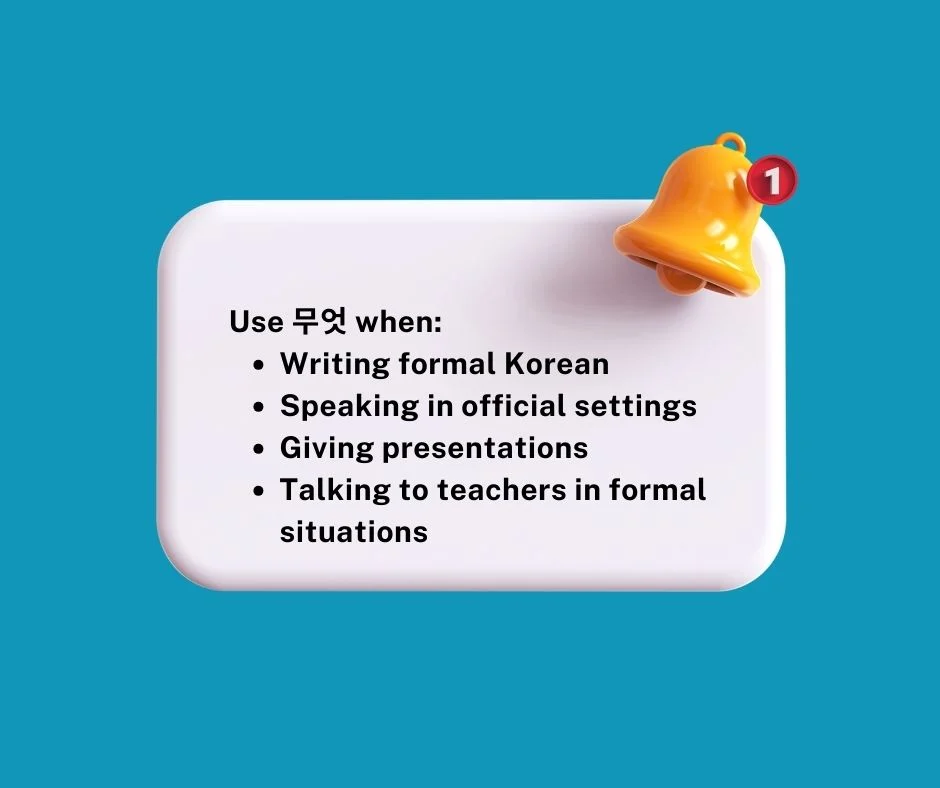
Use 무엇 when:
- Writing formal Korean
- Speaking in official settings
- Giving presentations
- Talking to teachers in formal situations
Shortened Spoken Forms You Will Hear
Natural spoken Korean
Korean speakers often shorten words when speaking. 무엇 becomes:
뭣 (mwot)
This form sounds strong or surprised and is used in speech.
Examples:
- 뭣이 문제야?
What is the problem? - 방금 뭐라고? / 뭣?
What did you say?
This is common in dramas, movies, and emotional conversations.
Using “What” in Common Daily Questions
Asking what someone is doing
- 뭐 해?
What are you doing? - 지금 뭐 해요?
What are you doing now?
Asking about objects
- 이거 뭐야?
What is this? - 가방 안에 뭐 있어요?
What is in the bag?
Asking about food
- 이 음식 뭐예요?
What is this food? - 뭐 먹을래요?
What do you want to eat?
These questions are extremely useful for daily life in Korea.
Using “What” With Particles
Adding particles for clarity
Korean often uses particles to show grammar roles. With “what,” the most common ones are:
- 뭐를 / 뭘
What (object form) - 뭐가
What (subject form)
Examples:
- 뭐를 좋아해요?
What do you like? - 뭐가 필요해요?
What is needed?
These particles help make sentences clearer and more natural.
Asking “What” in Indirect Questions
Polite and soft questions
Sometimes you don’t ask directly. Korean allows indirect questions using “what.”
Examples:
- 뭐 하는지 모르겠어요.
I don’t know what you are doing. - 그게 뭐인지 알아요?
Do you know what that is?
This style sounds gentle and polite, especially in conversations with adults.
Using “What” to Show Surprise or Confusion
Expressing emotions
“What” in Korean is often used to show surprise, shock, or confusion.
Examples:
- 뭐라고요?
What did you say? - 뭐야 이게?
What is this?
Tone of voice is very important here. The same word can sound friendly or angry depending on how you say it.
Common Mistakes Beginners Make
Using the wrong level of politeness
Many beginners use 뭐야? in formal situations. This can sound rude.
Tip:
- Use 뭐예요? or 무엇입니까? when unsure
Confusing pronunciation
Some learners mix up 뭐 and 무엇. Remember:
- 뭐 is spoken and casual
- 무엇 is formal and written
Practice listening to native speakers to hear the difference.
Real-Life Practice Examples
At a restaurant
- 이 메뉴 뭐예요?
What is this menu item? - 뭐 추천해요?
What do you recommend?
At school
- 숙제 뭐예요?
What is the homework? - 이 단어 뭐 뜻이에요?
What does this word mean?
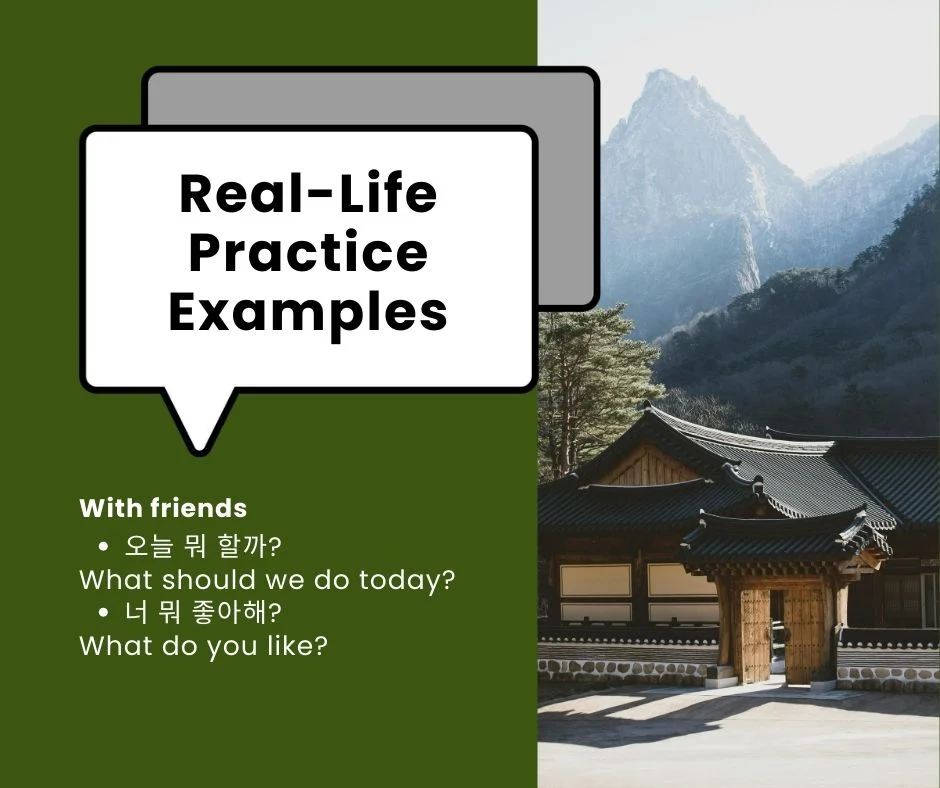
With friends
- 오늘 뭐 할까?
What should we do today? - 너 뭐 좋아해?
What do you like?
These examples show how natural and useful the word is.
Frequently Asked Questions
How to say what in Korean casually?
The casual way to say what in Korean is 뭐 (mwo). It’s used with friends and people you know well.
Is “무엇” always formal?
Yes, 무엇 is formal and mostly used in writing, presentations, or very polite speech.
Can I use “뭐요” with strangers?
Yes, 뭐요? is polite and suitable for daily conversations with strangers.
Why does “what” sound different in Korean dramas?
Korean dramas often use shortened or emotional forms like 뭣 to show surprise or anger.
Is pronunciation important when saying what in Korean?
Yes, pronunciation and tone matter a lot. The same word can sound polite, rude, or surprised depending on tone.
What’s the Korean word for what?
The Korean word for “what” is 뭐 (mwo) in casual speech and 무엇 (mueot) in formal writing or speech. Koreans also commonly use 뭘 (mwol) and 뭔 (mwon) depending on the sentence, making “what” one of the most frequently used Korean question words.
What is MWO in Korean?
MWO (뭐) is the Romanized spelling of the Korean word 뭐, which means “what.” It is used in casual conversations to ask about things, actions, or information, and is one of the first Korean words beginners learn.
How do you say “what politely” in Korean?
To say “what” politely in Korean, people usually use 무엇 (mueot) or 뭐예요? (mwoyeyo?) depending on the situation. These polite forms show respect and are commonly used when speaking with strangers, elders, or in formal conversations.
Why do Koreans say “imnida”?
Imnida (입니다) is a polite Korean expression that means “is,” “am,” or “are.” It is commonly used in formal introductions, presentations, and respectful conversations to sound polite and professional.
How do Koreans say “sorry”?
Koreans say 미안해 (mianhae) in casual situations, 미안해요 (mianhaeyo) politely, and 죄송합니다 (joesonghamnida) in formal or respectful situations. The correct expression depends on the relationship and level of politeness.
Why do Koreans say Sumida?
People often hear “Sumida,” but the correct Korean ending is “seumnida” (습니다/습니다). It is a formal sentence ending used to show politeness and respect, especially in speeches, customer service, news broadcasts, and official conversations.
Conclusion
Learning how to say what in Korean is a small step that makes a big difference in communication.
From casual 뭐 to formal 무엇, each form helps you sound natural in different situations.
Practice using them daily, listen carefully to native speakers, and soon asking questions in Korean will feel easy and confident.

Daniel Carter
Hi, I’m Daniel Carter, a passionate storyteller and lifelong explorer of languages and cultures. Writing has always been my way of connecting with the world, sharing stories that inspire, educate, and entertain. I love diving into the nuances of communication and finding beauty in the words we use every day. Over the years, I’ve dedicated myself to crafting stories that resonate across borders and languages. When I’m not writing, you’ll usually find me exploring new places or learning something new about the world around me. My goal is to create stories that make readers think, smile, and sometimes even dream.
Books:
-
Whispers Across Borders
-
The Language of Hearts