
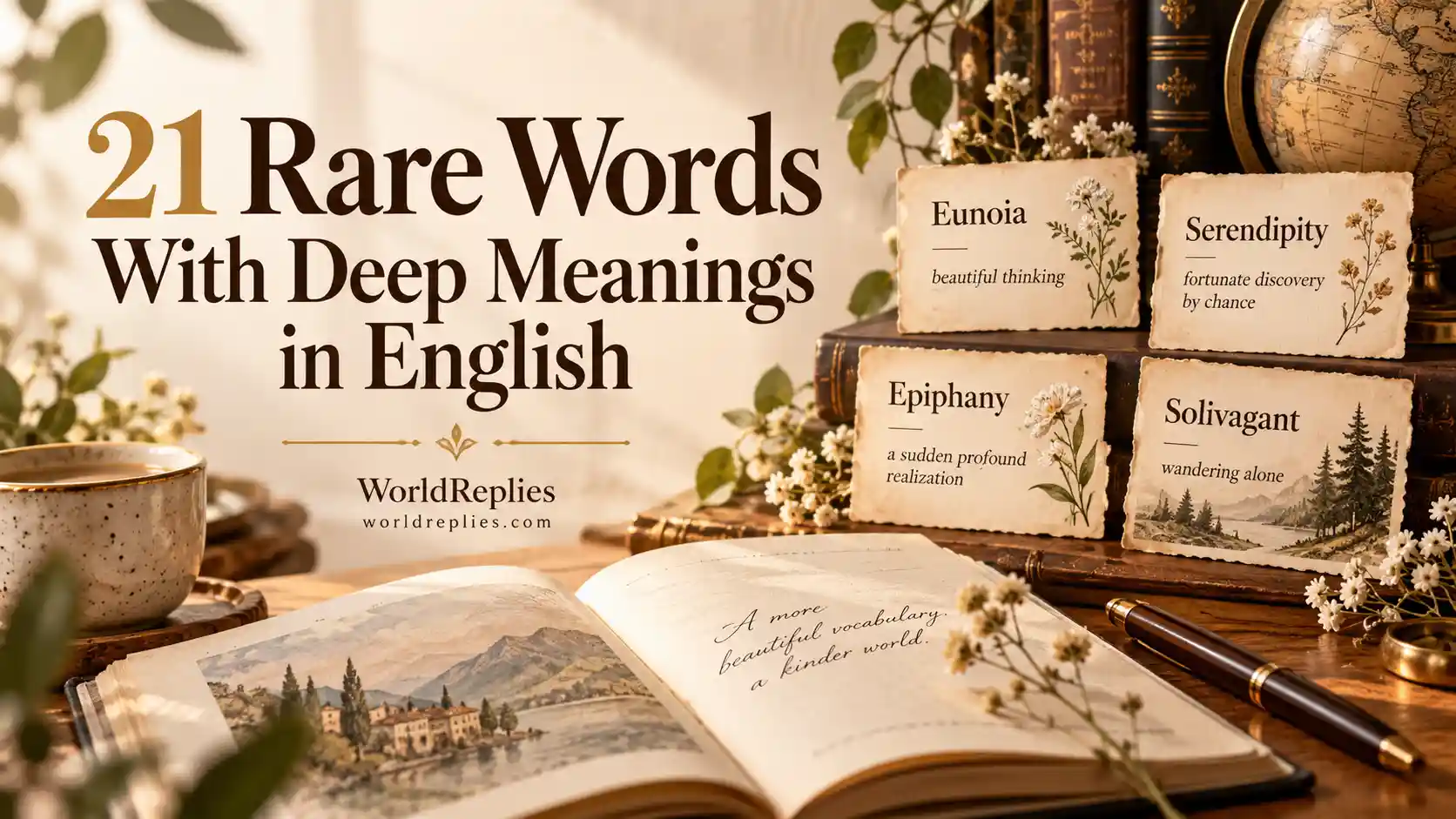
Language is a living, breathing tool that often fails to capture the intricate tapestry of human experience. Sometimes, a simple ‘happy’ or ‘sad’ just doesn’t suffice to describe the depth of our inner lives. Exploring rare words with deep meanings allows us to articulate nuanced emotions, find clarity in the chaotic, and appreciate the elegance of English. Whether you are a writer, a poet, or a curious linguist, incorporating these uncommon terms can transform your communication from mundane to profound. Let us dive into a collection of words that describe feelings and states of being you likely never knew had a name.
21 Rare Words for Your Lexicon
This list explores words that encapsulate complex human experiences, from the melancholy of time passing to the joy of discovering something new.
1. Sonder
The profound realization that every passerby is living a life as vivid and complex as your own, filled with their own ambitions, routines, and heartaches.
2. Petrichor
The pleasant, earthy scent that accompanies the first rain after a long period of warm, dry weather.
3. Nefelibata
Derived from Spanish and Portuguese, it literally means ‘cloud-walker’—a person who lives in the clouds of their own imagination or dreams.
4. Vellichor
The strange wistfulness of used bookstores, filled with thousands of books you will never have time to read, each representing a forgotten life.
5. Ethereal
Extremely delicate and light in a way that seems too perfect for this world; often used to describe beauty that is almost haunting.
6. Ephemeral
Lasting for a very short time; a reminder that beauty often lies in the transience of a moment.
7. Serendipity
The occurrence of events by chance in a happy or beneficial way; finding something beautiful while looking for something else entirely.
8. Mellifluous
A sound that is sweet and smooth, pleasing to hear, often used to describe a voice or musical notes.
9. Limerence
The state of being infatuated or obsessed with another person, typically experienced involuntarily.
10. Epoch
A particular period of time in history or a person’s life, typically marked by notable events or particular characteristics.
11. Solitude
The state of being alone without being lonely; a positive and constructive state of engagement with oneself.
12. Ineffable
Too great or extreme to be expressed or described in words; something that transcends language itself.
13. Iridescent
Showing luminous colors that seem to change when seen from different angles; a beautiful visual phenomenon.
14. Halcyon
Denoting a period of time in the past that was idyllically happy and peaceful.
15. Syzygy
The alignment of three celestial bodies in a gravitational system; a rare moment of cosmic perfection.
16. Eloquence
Fluent or persuasive speaking or writing; the art of using language to move others.
17. Fernweh
A German term often borrowed, describing a longing for far-off places; a craving for travel.
18. Ameliorate
To make something bad or unsatisfactory better; the act of improvement.
19. Nefarious
Wicked or criminal; often used to describe actions or intentions that are inherently dark.
20. Pulchritudinous
A surprisingly ugly-sounding word that actually means beautiful or physically attractive.
21. Quintessential
Representing the most perfect or typical example of a quality or class.
Tools to Elevate Your Writing
To truly master these words, you need the right tools to journal, study, and document your thoughts. Here are some highly recommended products for word lovers.
Leather Bound Journal for Creative Writing

Best For: Aspiring writers and vocabulary enthusiasts
A high-quality journal is essential for keeping track of new vocabulary and drafting your own creative prose.
Practical Tips: Write down one new word each day and try to use it in a sentence to ensure retention.
Recommended: Vintage Leather Writing Journal
Oxford English Dictionary

Best For: Serious students and language researchers
The definitive resource for understanding the etymology and historical usage of the English language.
Practical Tips: Use the dictionary to find related words and expand your study session into a deep dive of linguistic history.
Recommended: Concise Oxford English Dictionary
How to Integrate Rare Words into Daily Life
Integrating sophisticated vocabulary isn’t about showing off; it’s about precision. Start by keeping a ‘word bank’ in a dedicated notebook. When you feel an emotion that you struggle to name, look for an ‘ineffable’ word that fits. Read literature from different eras to see how authors utilized these terms. Practice using them in casual conversation, but ensure the context is appropriate so your meaning remains clear to your audience.
Frequently Asked Questions
Why should I learn rare words?
Learning rare words allows you to express complex emotions with precision, enhancing both your writing and your ability to articulate your feelings.
Is it pretentious to use big words?
Not at all, as long as the word is used correctly to add clarity rather than just to sound impressive. Aim for meaningful communication.
Final Thoughts
Language is a gift, and the more nuanced our vocabulary, the more vivid our experience of the world becomes. By integrating these rare words into your daily life, you aren’t just learning definitions; you are gaining new perspectives on the human condition. Start small, stay curious, and let these words help you tell your own unique story more effectively.
