
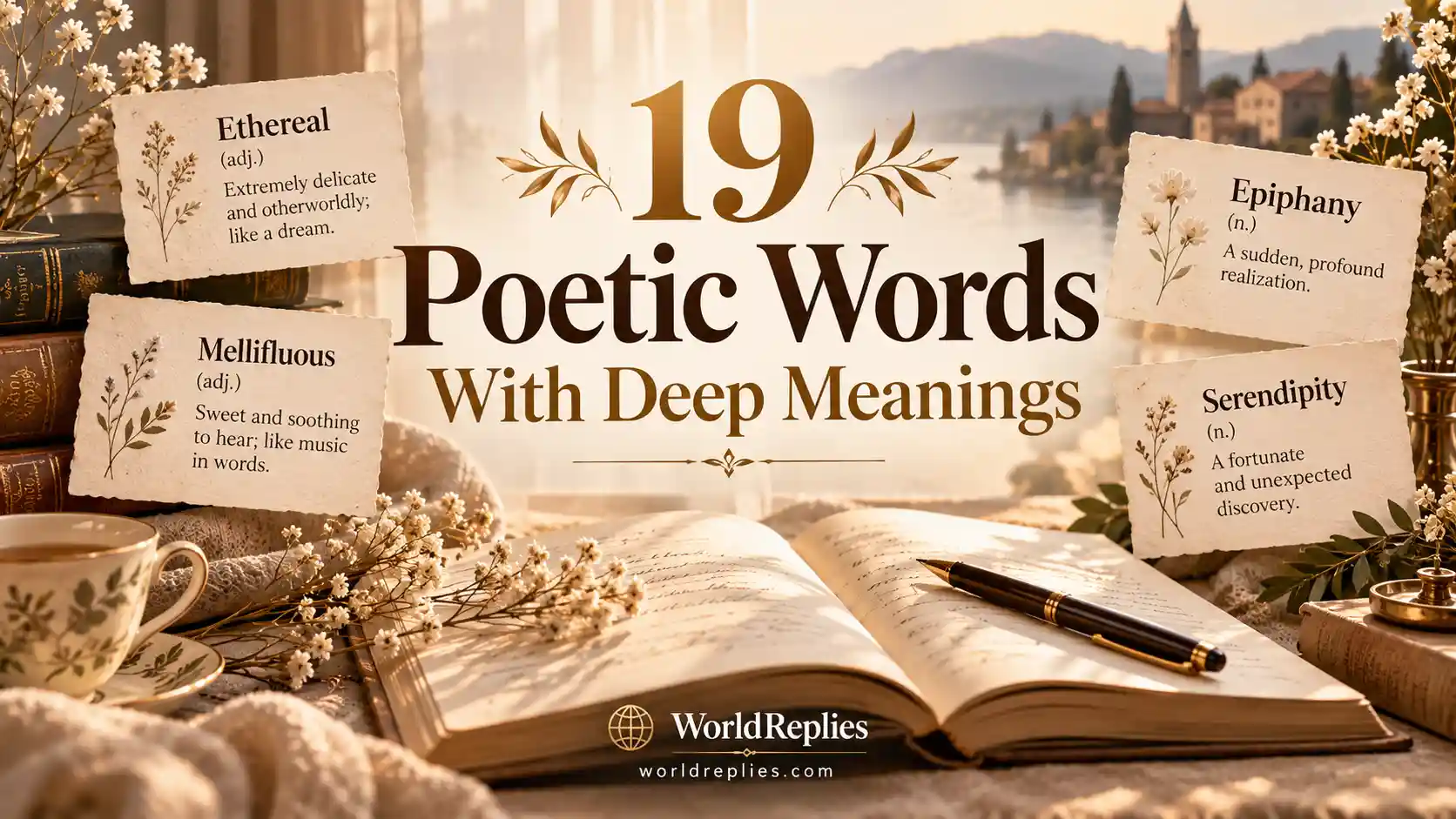
Language is the architecture of our thoughts, yet sometimes everyday English fails to capture the nuance of our deepest emotions. Poetic words, often borrowed from other languages or unearthed from archaic roots, offer a bridge between the intangible and the spoken word. Exploring these terms does more than just expand your vocabulary; it shifts your perspective on the world. Whether you are a writer seeking the perfect descriptor or a soulful reader looking to articulate complex feelings, these 19 poetic words with deep meanings will help you name the unnamed parts of your life.
19 Beautiful Words That Capture the Human Experience
A quick look at words that define longing, joy, sorrow, and the subtle connections we share in life.
1. Petrichor
This is the earthy scent produced when rain falls on dry soil. It evokes a sense of renewal and connection to the earth.
2. Vellichor
The strange wistfulness of used bookstores, where the smell of old paper and dust suggests thousands of stories you will never know.
3. Saudade
A Portuguese term for a deep emotional state of nostalgic longing for an absent something or someone that one cares for and loves.
4. Ethereal
Something extremely delicate and light in a way that seems too perfect for this world.
5. Ephemeral
Lasting for a very short time; it serves as a poetic reminder of the fleeting nature of sunsets and moments of joy.
6. Serendipity
The occurrence of events by chance in a happy or beneficial way; a lucky find.
7. Solitude
The state of being alone without being lonely; a powerful, restorative experience.
8. Mellifluous
A sound that is sweet and smooth, pleasant to hear like honey to the ears.
9. Limerence
The state of being infatuated or obsessed with another person, typically experienced involuntarily.
10. Nefarious
Wicked or criminal, often used to describe dark, poetic intentions.
11. Halcyon
Denoting a period of time in the past that was idyllically happy and peaceful.
12. Sehnsucht
A German word for an intense, inconsolable longing for a far-off place or a different life.
13. Incandescent
Emitting light as a result of being heated; or full of strong, passionate emotion.
14. Evanescent
Soon passing out of sight, memory, or existence; quickly fading or disappearing.
15. Luminescence
The emission of light by a substance not resulting from heat; it implies a soft, internal glow.
16. Quixotic
Exceedingly idealistic; unrealistic and impractical, yet charmingly romantic.
17. Ineffable
Too great or extreme to be expressed or described in words.
18. Sonder
The profound realization that every random passerby is living a life as vivid and complex as your own.
19. Fernweh
An ache for distant places; the craving for travel and the unknown.
Bring Poetry Into Your Daily Life
If these words have inspired you to explore the depths of language and human storytelling, these curated books are the perfect next step.
Towards Understanding: A Poetic Journey Of Valiant Survival

Best For: Readers seeking catharsis through poetic narrative.
This collection serves as a testament to the power of words to heal, capturing intense emotional experiences with raw beauty.
Practical Tips: Read one poem a day to practice finding the right words for your own daily struggles.
Recommended: Playing With Words Series
Poetic Injustice: A True Story of Forbidden Love

Best For: Lovers of true stories told with a lyrical heart.
A powerful narrative that proves how deep, complex words can describe the most forbidden and complicated human emotions.
Practical Tips: Use this book to study how the author embeds emotion into prose, transforming standard sentences into poetic revelations.
Recommended: Non-Fiction Poetry/Memoir
The Iliad: A New Translation by Caroline Alexander

Best For: Those who want to master the foundation of Western poetic language.
The ultimate source of poetic language. This translation brings the ancient epic to life with modern clarity.
Practical Tips: Focus on the descriptors used for the characters to expand your own descriptive abilities.
Recommended: Classic Literature Collection
How to Use Poetic Words in Your Writing
To integrate these words naturally, start by replacing generic adjectives with specific ones. Instead of saying a sound was ‘nice’, use ‘mellifluous’. Instead of saying you missed someone, use the weight of ‘saudade’. Keep a small notebook to jot down these words when you find them, and try using at least one in your journal entries each week. This practice creates a habit of mindfulness where you are always searching for the most accurate way to describe your inner world.
Frequently Asked Questions
Why should I use poetic words in conversation?
Using poetic words helps you articulate complex emotions more accurately, allowing for deeper connections with those around you.
Are these words too pretentious?
Not if used correctly. The key is to ensure the word fits the context perfectly rather than just trying to sound sophisticated.
Final Thoughts
Poetic words are more than just linguistic curiosities; they are vessels for the experiences that make us human. By identifying the ‘saudade’ or the ‘petrichor’ in our daily lives, we reclaim our ability to feel deeply and communicate authentically. Incorporate these terms into your writing and conversation, and watch how your world begins to reflect the beauty of your vocabulary.
