
You’re not alone if military time has ever made you pause and second-guess yourself.
If you’ve been wondering how to say military time with confidence, this guide is here just for you.
Maybe you’ve seen it on schedules, in movies, or during travel, and felt a little unsure; that’s completely normal.
Together, we’ll make it simple, clear, and even a little fun, so you can use it in real life without any hesitation.
What Is Military Time and Why It Matters
Military time is a 24-hour clock system. Instead of using AM and PM, it counts hours from 00 to 23.
Why People Use Military Time
- Avoids confusion between AM and PM
- Used in hospitals, aviation, and the military
- Helps in international communication
- Makes scheduling more accurate
Simple Example
- 2:00 PM → 14:00
- 9:00 AM → 09:00
This format removes guesswork and makes time clear.
Understanding the 24-Hour Clock System
To learn how to say military time, you first need to understand how the 24-hour clock works.
Basic Structure
- Midnight → 00:00
- Noon → 12:00
- Evening → 18:00 (6 PM)
- Night → 23:00 (11 PM)
Easy Comparison Table
| Standard Time | Military Time |
| 1:00 AM | 01:00 |
| 6:00 AM | 06:00 |
| 12:00 PM | 12:00 |
| 3:00 PM | 15:00 |
| 8:00 PM | 20:00 |
| 11:00 PM | 23:00 |
Key Tip
After 12 PM, just add 12 to the hour.
- 4 PM → 16:00
- 7 PM → 19:00
How to Say Military Time Correctly
Now let’s learn how to say military time out loud.
Saying Hours
- 00:00 → “zero hundred hours”
- 06:00 → “zero six hundred hours”
- 14:00 → “fourteen hundred hours”
Saying Minutes
If minutes are included:
- 14:30 → “fourteen thirty”
- 09:15 → “zero nine fifteen”
Important Rules
- Always say numbers clearly
- Use “hundred” for exact hours
- Skip “hours” in casual speech
Practice Examples
- 16:00 → “sixteen hundred”
- 21:45 → “twenty-one forty-five”
Step-by-Step Method to Convert Time
Converting standard time into military time is easier than it looks.
Morning Times (AM)
- Keep the same number
- Add a zero if needed
👉 Examples:
- 7:00 AM → 07:00
- 9:30 AM → 09:30
Afternoon and Evening (PM)
- Add 12 to the hour
👉 Examples:
- 1:00 PM → 13:00
- 6:45 PM → 18:45
Special Cases
- 12:00 AM → 00:00
- 12:00 PM → 12:00
How to Read Military Time Easily
Reading military time becomes simple with practice.
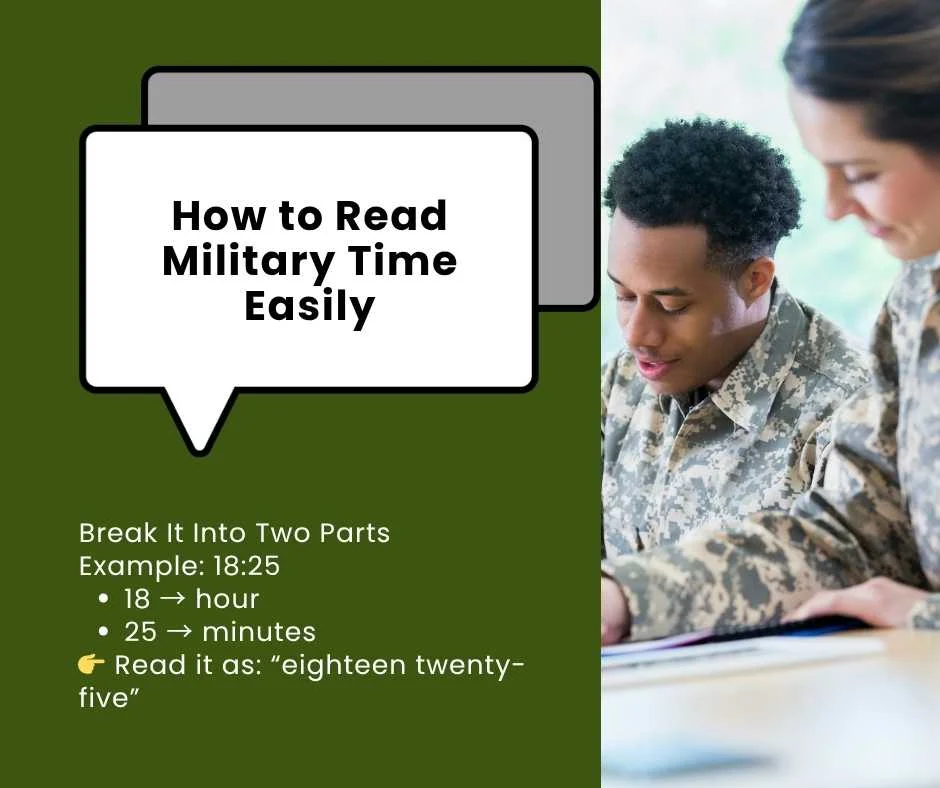
Break It Into Two Parts
Example: 18:25
- 18 → hour
- 25 → minutes
👉 Read it as: “eighteen twenty-five”
Quick Reading Tips
- Don’t convert in your head at first
- Read numbers directly
- Practice daily with a clock
Common Mistakes Beginners Make
When learning how to say military time, beginners often make small errors.
Forgetting Leading Zeros
- Wrong: “six hundred” for 06:00
- Correct: “zero six hundred”
Mixing AM/PM Thinking
- Military time does not use AM or PM
- Always rely on the 24-hour format
Misreading Numbers
- 13:00 is “thirteen hundred,” not “one hundred”
Real-Life Situations Where Military Time Is Used
Understanding how to say military time is useful in many real-world situations.
Travel and Flights
Airlines often use 24-hour time:
- Flight at 21:00 → 9 PM
Hospitals and Healthcare
Doctors and nurses use it to avoid confusion:
- Medication at 08:00 and 20:00
Military and Security Jobs
Precise timing is critical, so military time is standard.
Digital Devices
Many phones and computers allow 24-hour format settings.
Easy Practice Exercises
Practice helps you remember faster and speak confidently.
Exercise 1: Convert Time
- 3:00 PM → ?
👉 Answer: 15:00 - 10:00 AM → ?
👉 Answer: 10:00
Exercise 2: Say It Aloud
- 07:30 → “zero seven thirty”
- 22:15 → “twenty-two fifteen”
Exercise 3: Daily Practice
- Look at your phone clock
- Convert time throughout the day
- Say it out loud
Tips to Master Military Time Quickly
Learning how to say military time becomes easier with smart strategies.
Use Patterns
- Morning = same numbers
- Afternoon = add 12
Practice Daily
- Set your phone to 24-hour format
- Read time regularly
Use Flashcards
Write standard time on one side and military time on the other.
Think in Military Time
Try to stop converting and start thinking directly in 24-hour format.
Advanced Understanding for Better Fluency
Once you understand basics, you can improve your fluency.
Speaking Naturally
- In formal settings: say “hours”
- In casual speech: skip “hours”
Listening Skills
- Pay attention to number clarity
- Practice with real audio examples
Speed Practice
- Try reading time quickly
- Build confidence in conversations
Frequently Asked Questions (FAQs)
What is the easiest way to learn how to say military time?
The easiest way is to practice daily and remember that afternoon times are 12 hours ahead.
How do you say 1400 in military time?
You say it as “fourteen hundred.”
Is military time hard for beginners?
No, it becomes easy with practice and simple rules.
Why is military time important?
It avoids confusion and is used in professional and global settings.
Can I use military time in everyday life?
Yes, many people use it on phones, schedules, and while traveling.
Conclusion
Learning how to say military time is a valuable skill that improves your communication and time management.
By understanding the 24-hour system, practicing pronunciation, and using it in daily life, you can master it quickly.
Keep practicing regularly, and soon reading and saying military time will feel completely natural.
Also Check These Posts:
How to Say Hi in Swedish Correctly Every Time
How to Say Goodnight to Your Crush with Simple and Sweet Messages
How to Say Happy Birthday in Hawaiian | Fun and Easy Guide in 2026

Darcy Lynn
Darcy Lynn has always been fascinated by the colors and stories of life. Her journey with writing began in childhood, and today she takes readers into new worlds through her stories. For her, every word is a way to explore new experiences and emotions. Darcy loves exploring stories across different cultures and languages, which also reflects in her unique writing style. She believes that a good story touches every heart and sparks deeper thinking. Alongside writing, she enjoys connecting directly with her readers and understanding their feelings.
Books:
-
Whispers Across Worlds
-
Echoes of Tomorrow