

Curious about how to say go in Spanish and use it the right way in conversation?
If you’re giving directions, learning verbs, or traveling in a Spanish-speaking country, the correct word makes all the difference.
This guide will teach you the exact term, its variations, and practical examples so you can say go in Spanish confidently every time.
The most common way to say go in Spanish
The most common verb for “go” in Spanish is ir. It is an irregular verb, which means it does not follow normal conjugation rules.
Even though that may sound difficult, it becomes easy with practice.
It is used when talking about movement from one place to another.
Examples in English:
- I go to school.
- They go to work.
- We go home.
In Spanish, all of these use the verb ir, but the form changes depending on the subject.
Present tense forms of ir
To use how to say go in Spanish correctly in daily conversation, you must learn the present tense of ir.
Here are the present tense forms:
- Yo voy – I go
- Tú vas – You go (informal)
- Él / Ella va – He / She goes
- Usted va – You go (formal)
- Nosotros vamos – We go
- Ellos / Ellas van – They go
- Ustedes van – You all go
These forms may look very different from the verb ir, but they are used constantly in spoken Spanish.
Examples:
- Yo voy al trabajo. (I go to work.)
- Ella va a la tienda. (She goes to the store.)
- Nosotros vamos a casa. (We go home.)
Using “ir a” to talk about the future
One of the most useful structures related to how to say go in Spanish is ir a + verb.
This structure is used to talk about future plans, similar to “going to” in English.
Formula:
- Subject + form of ir + a + verb
Examples:
- Voy a estudiar. (I am going to study.)
- Van a viajar mañana. (They are going to travel tomorrow.)
- Vamos a comer. (We are going to eat.)
This is extremely common in everyday Spanish and is perfect for beginners because it avoids complex future tense forms.
Past tense ways to say go in Spanish
Spanish has more than one past tense, and how to say go in Spanish changes depending on meaning.
Preterite tense for completed actions
Use the preterite tense when the action of going is finished.
Preterite forms of ir:
- Fui – I went
- Fuiste – You went
- Fue – He / She went
- Fuimos – We went
- Fueron – They went
Examples:
- Fui al mercado ayer. (I went to the market yesterday.)
- Ellos fueron al cine. (They went to the cinema.)
This tense focuses on a specific moment in the past.
Imperfect tense for habitual going
Use the imperfect tense when talking about repeated or habitual actions in the past.
Imperfect forms of ir:
- Iba – I used to go / I was going
- Ibas – You used to go
- Iba – He / She used to go
- Íbamos – We used to go
- Iban – They used to go
Examples:
- Iba a la escuela caminando. (I used to go to school walking.)
- Íbamos al parque cada domingo. (We used to go to the park every Sunday.)
This tense adds background information rather than focusing on a single event.
Commands using go in Spanish
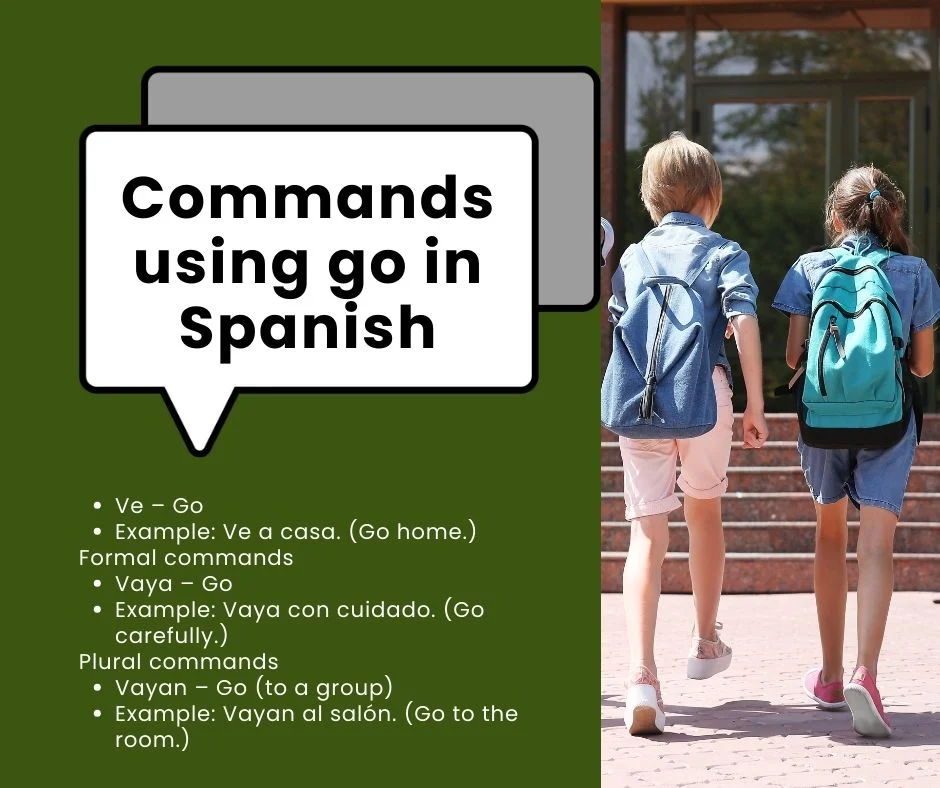
Another important part of how to say go in Spanish is giving commands.
Informal commands
- Ve – Go
Example: Ve a casa. (Go home.)
Formal commands
- Vaya – Go
Example: Vaya con cuidado. (Go carefully.)
Plural commands
- Vayan – Go (to a group)
Example: Vayan al salón. (Go to the room.)
Commands are often used in daily conversation, instructions, and polite requests.
Saying go with places and destinations
When talking about where someone is going, Spanish uses a to mean “to.”
Examples:
- Voy a España. (I go to Spain.)
- Van al trabajo. (They go to work.)
- Vamos a la playa. (We go to the beach.)
Notice:
- a + el = al
- a + la stays the same
This rule is essential for speaking correctly.
Other Spanish verbs that can mean go
Although ir is the main verb, Spanish sometimes uses other verbs to express “go,” depending on context.
Salir
Used when leaving a place.
- Salgo de casa. (I leave the house.)
Venir
Means “to come,” but often replaces “go” from the listener’s perspective.
- Vengo a ayudarte. (I come to help you.)
Pasar
Used for going somewhere briefly.
- Paso por tu casa. (I’ll stop by your house.)
Understanding these verbs helps you sound more natural and fluent.
Common expressions with ir
Learning common expressions helps reinforce how to say go in Spanish naturally.
- Ir bien – To go well
- Todo va bien. (Everything is going well.)
- Todo va bien. (Everything is going well.)
- Ir mal – To go badly
- El día va mal. (The day is going badly.)
- El día va mal. (The day is going badly.)
- Irse – To leave
- Me voy ahora. (I’m leaving now.)
- Me voy ahora. (I’m leaving now.)
These expressions appear frequently in conversations.
Everyday sentences using go in Spanish
Here are practical examples you can use immediately:
- Voy al baño. (I’m going to the bathroom.)
- Vamos al restaurante. (Let’s go to the restaurant.)
- Ella va tarde. (She is running late.)
- ¿Adónde vas? (Where are you going?)
Practicing sentences like these helps build confidence.
Common mistakes learners make
When learning how to say go in Spanish, beginners often make a few mistakes.
Common errors:
- Using ir like a regular verb
- Forgetting to change the verb form
- Mixing ir and venir incorrectly
- Forgetting a before destinations
Correct example:
- ❌ Yo ir a casa
- ✅ Yo voy a casa
Small corrections make a big difference in fluency.
Tips to remember how to say go in Spanish
- Practice voy, vas, va daily
- Use ir a for future plans
- Listen to native speakers
- Speak out loud while practicing
- Use real-life examples
Consistency is more important than speed when learning a new verb.
Frequently Asked Questions
What is the basic way to say go in Spanish
The basic way is the verb ir, which means “to go” and changes form depending on the subject.
How do you say I go in Spanish
You say yo voy, which is the present tense form of ir for “I go.”
How to say go in Spanish for future plans
Use ir a + verb, such as voy a estudiar, meaning “I am going to study.”
Is ir a regular or irregular verb
Ir is an irregular verb, so its forms do not follow standard patterns.
Can go in Spanish mean leave
Yes, irse is often used to mean “to leave,” which comes from the verb ir.
Conclusion
Learning how to say go in Spanish opens the door to clear and confident communication.
The verb ir is essential for talking about movement, plans, and daily activities.
By practicing its forms, tenses, and common expressions, you will understand Spanish conversations more easily and express yourself naturally.
Keep practicing, and using “go” in Spanish will soon feel effortless.
Also Check These Posts:
How to Say Your in Spanish | Formal vs Informal Use in 2026
How to Say Sleep in Spanish the Right Way in 2026
How to Say Hello in Norwegian Like a Native Speaker in 2026

Blake Kinslee
Hi! I’m Blake, a passionate writer who loves exploring the beauty of different languages and cultures through storytelling. Ever since I was young, I’ve been fascinated by how words can connect people across the world. Writing, for me, is not just a hobby—it’s a way to share ideas, emotions, and dreams with readers everywhere. When I’m not crafting stories, you’ll usually find me reading, traveling, or discovering new words in languages I’ve never spoken before. Every book I write is a journey, and I hope my readers feel that magic too.
Books:
-
Whispers Across Borders
-
The Language of Dreams