
Family is one of the most important parts of life, and learning how to say family in Spanish can help you communicate more naturally with Spanish speakers.
If you are studying Spanish for school, travel, work, or personal interest, knowing family-related vocabulary is essential. This guide explains the meaning, pronunciation, usage, and common family terms in simple and easy English.
How to Say Family in Spanish
The Spanish word for family is familia.
Family = Familia
The word looks very similar to the English word “family,” making it easy for beginners to remember.
Pronunciation of Familia
The pronunciation of familia is:
fa-MEE-lee-ah
You can break it into three parts:
- Fa
- Mee
- Lee-ah
Listening to native speakers and practicing aloud can help improve your pronunciation.
Example Sentences
Here are some simple examples:
- Mi familia es muy grande.
- My family is very big.
- Amo a mi familia.
- I love my family.
- Mi familia vive en España.
- My family lives in Spain.
- Paso tiempo con mi familia.
- I spend time with my family.
These examples show how commonly the word is used in daily conversations.
Understanding the Meaning of Familia
In Spanish-speaking cultures, family often plays a central role in everyday life. The word familia refers to a group of people related by blood, marriage, or adoption.
It can include:
- Parents
- Children
- Grandparents
- Brothers and sisters
- Aunts and uncles
- Cousins
- Extended relatives
Just like in English, the word can refer to both immediate and extended family members.
Why Familia Is an Important Word
When learning Spanish, family vocabulary is among the first topics taught because it helps people:
- Introduce themselves
- Talk about relatives
- Describe relationships
- Share personal information
- Build conversations
Knowing family-related words makes communication easier and more natural.
Common Family Members in Spanish
After learning how to say family in Spanish, the next step is understanding common family terms.
Parents
- Mother = Madre
- Mom = Mamá
- Father = Padre
- Dad = Papá
Examples:
- Mi madre es amable.
- My mother is kind.
- Mi padre trabaja mucho.
- My father works hard.
Brothers and Sisters
- Brother = Hermano
- Sister = Hermana
Examples:
- Tengo un hermano.
- I have a brother.
- Tengo dos hermanas.
- I have two sisters.
Children
- Son = Hijo
- Daughter = Hija
Examples:
- Mi hijo estudia español.
- My son studies Spanish.
- Mi hija canta muy bien.
- My daughter sings very well.
Grandparents
- Grandfather = Abuelo
- Grandmother = Abuela
Examples:
- Mi abuelo vive cerca.
- My grandfather lives nearby.
- Mi abuela cocina muy bien.
- My grandmother cooks very well.
Extended Family
- Uncle = Tío
- Aunt = Tía
- Cousin = Primo (male)
- Prima (female)
- Nephew = Sobrino
- Niece = Sobrina
These words are frequently used in everyday Spanish conversations.
How to Talk About Your Family in Spanish
Once you know the word familia, you can start creating simple sentences.
Saying “My Family”
The phrase for “my family” is:
Mi familia
Examples:
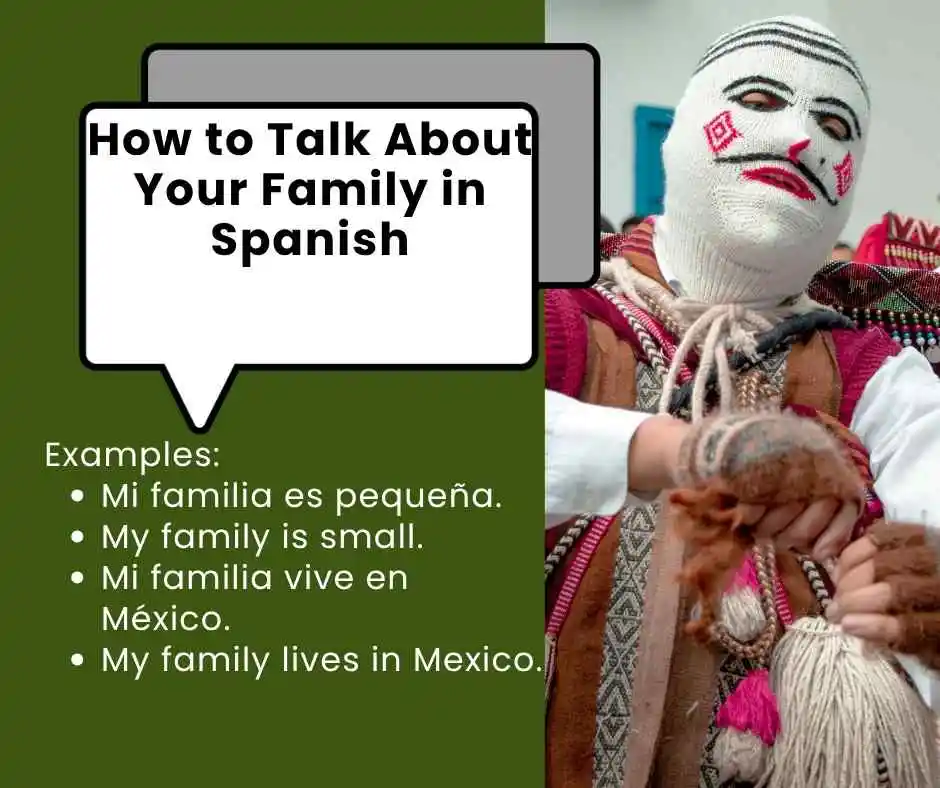
- Mi familia es pequeña.
- My family is small.
- Mi familia vive en México.
- My family lives in Mexico.
Saying “Our Family”
The phrase for “our family” is:
Nuestra familia
Examples:
- Nuestra familia es unida.
- Our family is close.
- Nuestra familia celebra juntos.
- Our family celebrates together.
Saying “Your Family”
The phrase for “your family” is:
Tu familia
Examples:
- Tu familia parece muy amable.
- Your family seems very kind.
- ¿Cómo está tu familia?
- How is your family?
These expressions are useful in everyday conversations.
Useful Family Phrases in Spanish
Learning complete phrases helps you speak more naturally.
Talking About Family Size
- Tengo una familia grande.
- I have a big family.
- Tengo una familia pequeña.
- I have a small family.
Asking About Someone’s Family
- ¿Cómo está tu familia?
- How is your family?
- ¿Cuántos hermanos tienes?
- How many siblings do you have?
- ¿Tienes hijos?
- Do you have children?
Speaking About Relatives
- Mi hermano vive en otra ciudad.
- My brother lives in another city.
- Mi abuela tiene ochenta años.
- My grandmother is eighty years old.
These phrases are common in both formal and informal conversations.
Family Vocabulary for Beginners
Beginners often find it helpful to learn vocabulary in categories.
Immediate Family
- Familia = Family
- Madre = Mother
- Padre = Father
- Hermano = Brother
- Hermana = Sister
- Hijo = Son
- Hija = Daughter
Grandparents
- Abuelo = Grandfather
- Abuela = Grandmother
Extended Family
- Tío = Uncle
- Tía = Aunt
- Primo = Cousin
- Prima = Cousin
- Sobrino = Nephew
- Sobrina = Niece
Marriage-Related Family
- Esposo = Husband
- Esposa = Wife
- Suegro = Father-in-law
- Suegra = Mother-in-law
- Cuñado = Brother-in-law
- Cuñada = Sister-in-law
Learning these words can significantly improve your Spanish vocabulary.
Differences Between English and Spanish Family Terms
Although many family relationships exist in both languages, Spanish sometimes uses more specific terms.
For example:
- Cousin has one common word in English.
- Spanish uses primo for a male cousin and prima for a female cousin.
Similarly:
- Brother = Hermano
- Sister = Hermana
The ending often changes based on gender.
Gender in Spanish Family Words
Spanish nouns usually have masculine and feminine forms.
Examples:
| Masculine | Feminine |
| Hermano | Hermana |
| Abuelo | Abuela |
| Tío | Tía |
| Primo | Prima |
| Hijo | Hija |
Recognizing these patterns makes learning Spanish easier.
How Family Is Viewed in Spanish-Speaking Cultures
Family is highly valued in many Spanish-speaking countries. Family gatherings, celebrations, and traditions often bring relatives together.
Importance of Family Relationships
Many Spanish-speaking communities emphasize:
- Respect for elders
- Strong family connections
- Regular family gatherings
- Support among relatives
- Shared traditions
Because family is such an important topic, learning family vocabulary helps you better understand the culture as well as the language.
Family Celebrations
Families often gather for:
- Birthdays
- Weddings
- Holidays
- Religious celebrations
- Family reunions
These events provide opportunities to use family-related Spanish vocabulary in real situations.
Practical Conversation Examples
Here are examples you might hear in everyday Spanish.
Introducing Your Family
Spanish:
- Esta es mi familia.
English:
- This is my family.
Talking About Siblings
Spanish:
- Tengo dos hermanos y una hermana.
English:
- I have two brothers and one sister.
Talking About Parents
Spanish:
- Mis padres viven en Madrid.
English:
- My parents live in Madrid.
Talking About Grandparents
Spanish:
- Visito a mis abuelos los fines de semana.
English:
- I visit my grandparents on weekends.
Practicing these examples can help improve both speaking and comprehension skills.
Common Mistakes When Learning Family Vocabulary
Many learners make similar mistakes when studying family words.
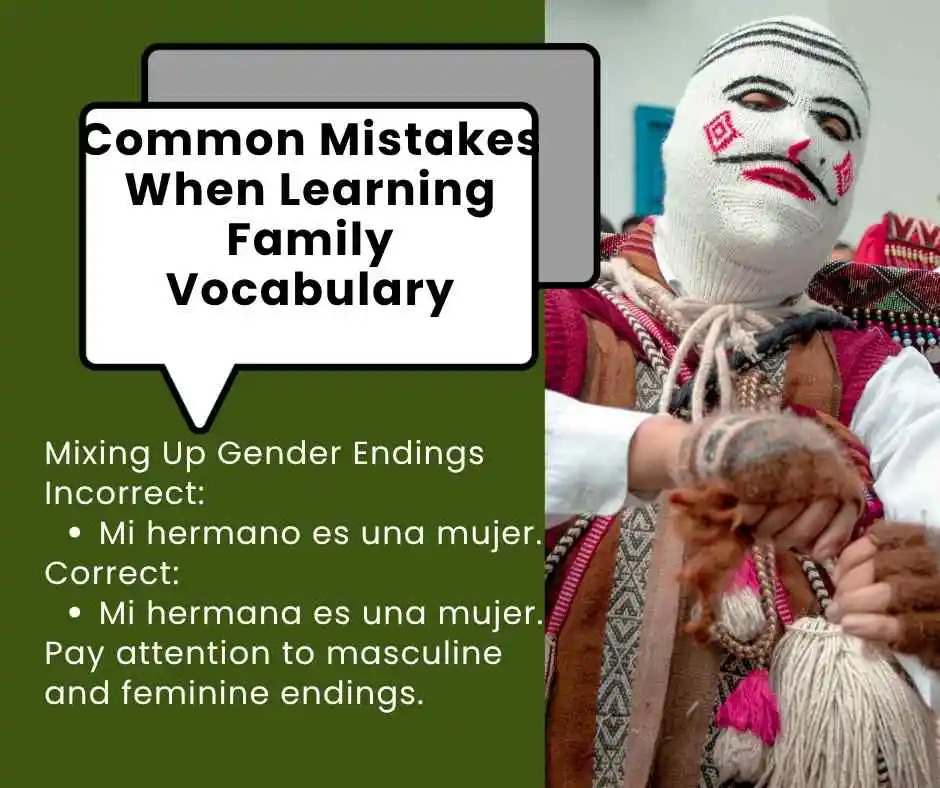
Mixing Up Gender Endings
Incorrect:
- Mi hermano es una mujer.
Correct:
- Mi hermana es una mujer.
Pay attention to masculine and feminine endings.
Forgetting Accent Marks
Some family words include accent marks.
Examples:
- Tío
- Tía
Using proper spelling helps improve writing accuracy.
Using English Word Order
Spanish sentence structure can differ slightly from English.
Practice reading and listening to native Spanish content to become familiar with natural patterns.
Tips for Remembering Family Words in Spanish
Memorizing vocabulary becomes easier with practice.
Create Family Charts
Write your relatives’ names and label each person in Spanish.
For example:
- Madre
- Padre
- Hermano
- Hermana
Practice Daily
Spend a few minutes each day reviewing family vocabulary.
Use Flashcards
Flashcards can help reinforce memory and pronunciation.
Speak Out Loud
Saying words aloud improves speaking confidence and retention.
Write Simple Sentences
Examples:
- Mi familia es amable.
- Tengo una hermana.
Writing helps strengthen vocabulary recall.
Frequently Asked Questions
What is the Spanish word for family?
The Spanish word for family is familia.
How do you pronounce family in Spanish?
Familia is pronounced approximately as fa-MEE-lee-ah.
Is familia masculine or feminine in Spanish?
Familia is generally treated as a feminine noun in Spanish.
How do you say my family in Spanish?
You say mi familia, which means “my family.”
Why is learning family vocabulary important in Spanish?
Family vocabulary helps you introduce relatives, describe relationships, and participate in everyday conversations.
Conclusion
Learning how to say family in Spanish is an important step for anyone studying the language. The word familia is easy to remember and is used frequently in daily conversations. By learning related family terms, practicing pronunciation, and using simple examples, you can communicate more confidently and build a stronger Spanish vocabulary over time.
Also Check These Posts:
How to Say Happy Thanksgiving with Heart in 2026
How to Say 17 in Spanish Without Mistakes
Learn How to Say You’re Welcome in Italian and Impress Everyone

Daniel Carter
Hi, I’m Daniel Carter, a passionate storyteller and lifelong explorer of languages and cultures. Writing has always been my way of connecting with the world, sharing stories that inspire, educate, and entertain. I love diving into the nuances of communication and finding beauty in the words we use every day. Over the years, I’ve dedicated myself to crafting stories that resonate across borders and languages. When I’m not writing, you’ll usually find me exploring new places or learning something new about the world around me. My goal is to create stories that make readers think, smile, and sometimes even dream.
Books:
-
Whispers Across Borders
-
The Language of Hearts