
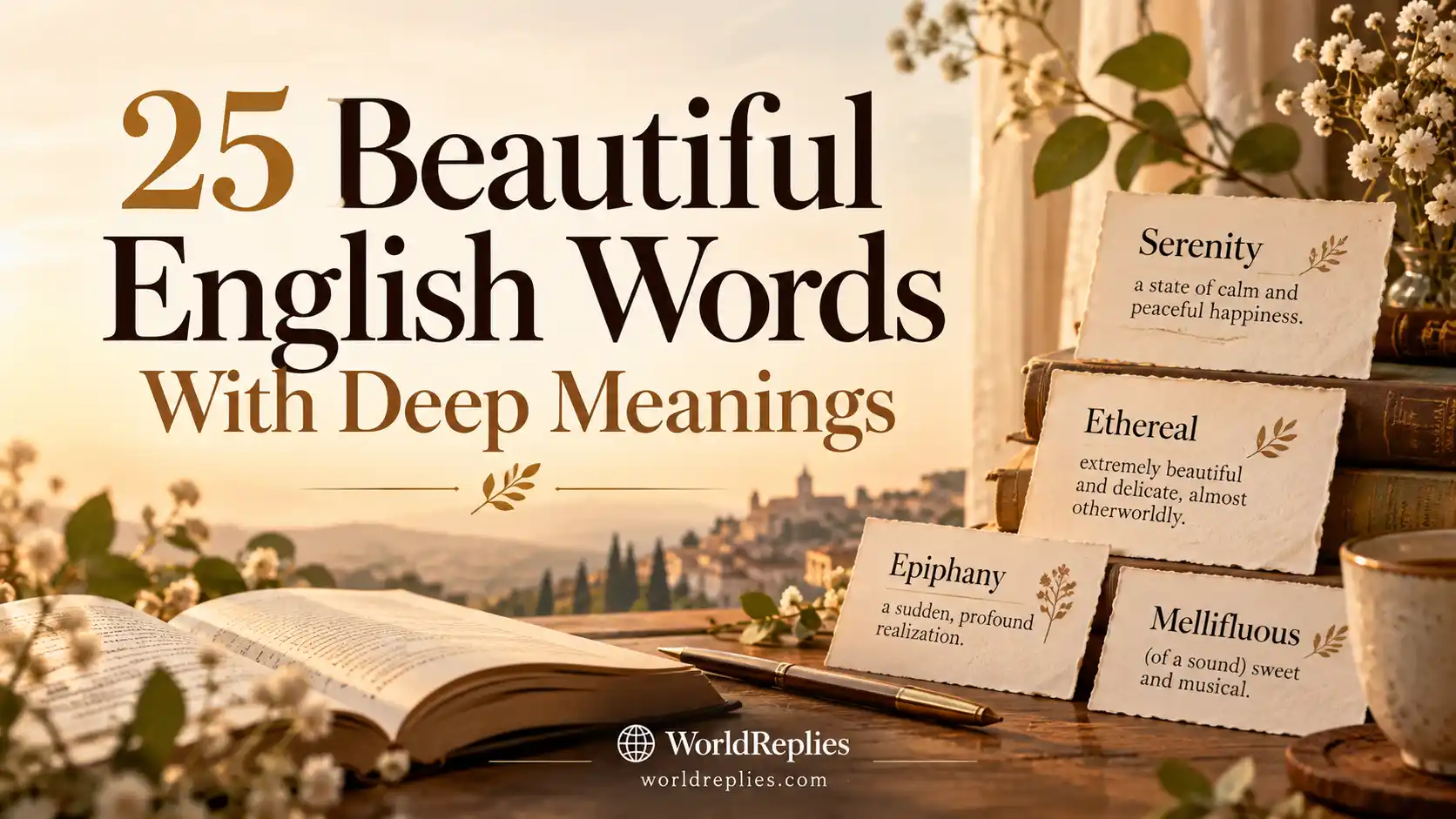
The English language is a vast, ever-evolving tapestry of emotion, history, and culture. Sometimes, a single word can capture a feeling that takes a whole paragraph to describe. Whether you are a writer, a poet, or simply a lover of language, integrating more beautiful English words with deep meanings into your daily life can add profound nuance to your expression. In this guide, we explore 25 words that go beyond the ordinary, offering a glimpse into the complexity of the human experience through the art of vocabulary.
25 Profound English Words You Should Know
This list covers a mix of classic, poetic, and nuanced words that define complex emotional states and observations of the world.
1. Ephemeral
Lasting for a very short time. It reminds us that beauty is often found in the fleeting nature of life, like a sunset or a passing breeze.
2. Mellifluous
Having a smooth, rich flow; sweet or musical to hear. Use this to describe a voice that sounds like honey.
3. Petrichor
The pleasant, earthy smell that accompanies the first rain after a long period of warm, dry weather.
4. Serendipity
The occurrence of events by chance in a happy or beneficial way. A beautiful word for those unexpected moments of luck.
5. Ethereal
Extremely delicate and light in a way that seems too perfect for this world. Often used to describe beauty that feels otherworldly.
6. Limerence
The state of being infatuated or obsessed with another person, characterized by a dream-like state of intense desire.
7. Solitude
The state of being alone without being lonely; a positive, peaceful choice to spend time with one’s own thoughts.
8. Aurora
The dawn, or a natural electrical phenomenon characterized by the appearance of streamers of reddish or greenish light in the sky.
9. Incandescent
Emitting light as a result of being heated; passionate or brilliant in quality.
10. Halcyon
Denoting a period of time in the past that was idylically happy and peaceful.
11. Eloquence
Fluent or persuasive speaking or writing; the ability to express complex ideas with clarity and grace.
12. Nefarious
Wicked or criminal. A word that carries a heavy, dark weight in literature.
13. Iridescent
Showing luminous colors that seem to change when seen from different angles.
14. Effervescent
Vivacious and enthusiastic; literally, giving off bubbles of gas. Perfect for a bubbly personality.
15. Panacea
A solution or remedy for all difficulties or diseases; a cure-all.
16. Quixotic
Exceedingly idealistic; unrealistic and impractical, yet charming in its ambition.
17. Resilience
The capacity to recover quickly from difficulties; toughness in the face of adversity.
18. Vellichor
The strange wistfulness of used bookstores, where you are surrounded by thousands of old books you will never have time to read.
19. Sonder
The profound realization that each random passerby is living a life as vivid and complex as your own.
20. Epoch
A particular period of time in history or a person’s life, typically marked by notable events.
21. Gossamer
Used to refer to something very light, thin, and insubstantial or delicate.
22. Clarion
Loud and clear. Often used to describe a powerful, unmistakable call or sound.
23. Taciturn
Reserved or uncommunicative in speech; saying little. The power of silence.
24. Idyllic
Extremely happy, peaceful, or picturesque, especially in a natural setting.
25. Zenith
The time at which something is most powerful or successful; the peak or highest point.
Literature That Embodies Deep Language
If you are captivated by these beautiful words, the following books are perfect for further immersion into expressive and thoughtful prose.
Walden: Or, Life in the Woods

Best For: Readers who love reflective and descriptive prose.
Henry David Thoreau’s classic is a masterclass in using language to describe the nuances of nature and solitude.
Practical Tips: Use this book to study how the author uses vocabulary like ‘solitude’ and ‘ethereal’ to paint a picture of simple living.
Recommended: Nature Philosophy Classics
Beautiful Chaos

Best For: Those looking for contemporary expressions of deep feelings.
A collection of poetry that utilizes a modern vocabulary to describe the complex emotional states of love, loss, and growth.
Practical Tips: Read this to see how modern poets inject raw emotion into their word choices.
Recommended: Modern Poetry
The Christian’s Secret of a Happy Life

Best For: Readers seeking meaningful, calm, and persuasive language.
A timeless exploration of peace and contentment, written with clarity and eloquent conviction.
Practical Tips: Observe how the author defines ‘resilience’ and ‘peace’ without relying on overly complex jargon.
Recommended: Inspirational Literature
How to Integrate Advanced Vocabulary
To truly own these words, start by picking one or two to use in your daily writing or conversation. Don’t force them; wait for the natural context to appear. Keeping a vocabulary journal where you jot down the word and a sentence you have written yourself can significantly improve your retention. Reading literature, as suggested in our product section, is the fastest way to see these words in their natural habitat.
Frequently Asked Questions
Why is it important to learn words with deep meanings?
It allows for more precise communication and helps you articulate complex emotions that standard vocabulary might miss.
How can I improve my vocabulary daily?
Read consistently, play word games, and challenge yourself to write a journal entry using at least one new word every day.
Final Thoughts
Expanding your vocabulary is more than just an academic exercise; it is a way to deepen your connection to the world around you. By choosing words that carry weight, history, and beauty, you change the way you think and express your inner self. Start small, pick your favorite word from this list today, and watch how it adds a new layer of color to your daily life.
