

Asking questions is a key part of learning any language, and knowing the right words makes conversations easier.
If you’ve ever wondered how to say who in Spanish, you’re in the right place.
This guide will teach you the exact word, its pronunciation, and how to use it naturally in everyday questions.
Soon, you’ll be asking “who” in Spanish confidently and like a native speaker.
Understanding the Word Who in Spanish
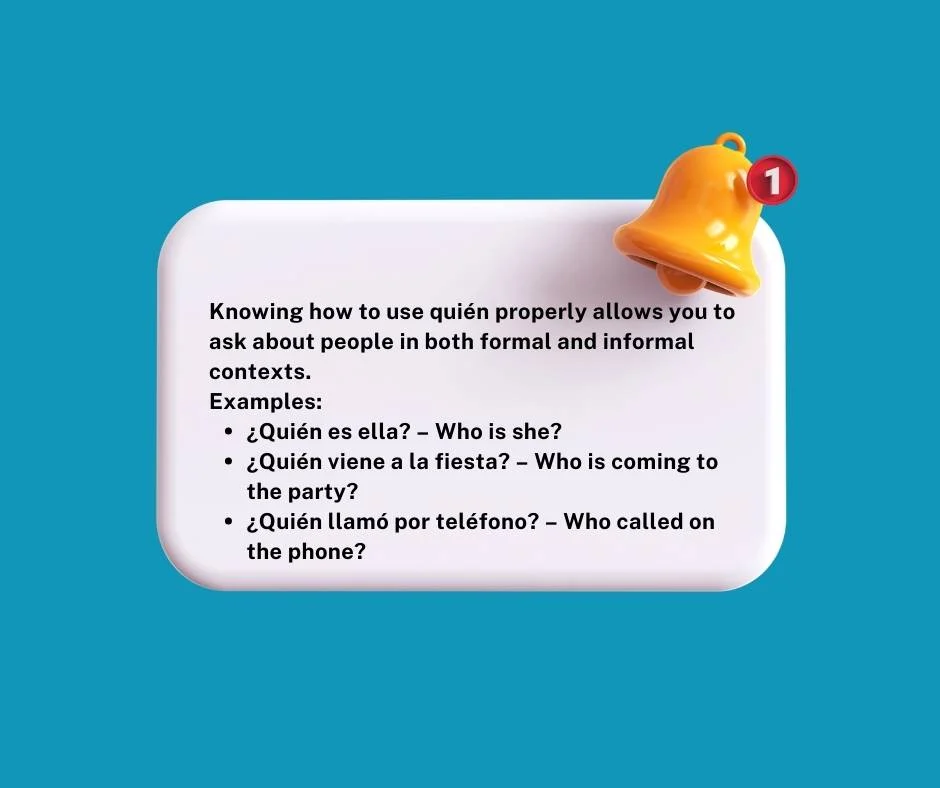
The Spanish word for “who” is quién. It’s simple but versatile and appears in many types of questions.
Knowing how to use quién properly allows you to ask about people in both formal and informal contexts.
Examples:
- ¿Quién es ella? – Who is she?
- ¿Quién viene a la fiesta? – Who is coming to the party?
- ¿Quién llamó por teléfono? – Who called on the phone?
Notice that quién often carries an accent mark, which is important to differentiate it from other words.
Using it correctly ensures that your questions are understood.
Using Quién in Different Contexts
Learning how to say who in Spanish goes beyond basic questions. It can be used in formal, informal, and conversational situations.
Asking About People
The most common use of quién is asking about the identity of a person. Combine it with the verb ser (to be) for straightforward identification.
Examples:
- ¿Quién es tu profesor? – Who is your teacher?
- ¿Quién es el dueño de este coche? – Who is the owner of this car?
- ¿Quién es responsable de esto? – Who is responsible for this?
These examples show how quién helps identify individuals in daily interactions.
Asking About Actions
You can also use quién to ask who performed an action. Pair it with action verbs in different tenses.
Examples:
- ¿Quién compró estos boletos? – Who bought these tickets?
- ¿Quién preparó la cena? – Who prepared dinner?
- ¿Quién terminó el proyecto? – Who finished the project?
Using quién in this way allows you to inquire about responsibility, contributions, or events naturally.
Using Quién in Formal and Informal Situations
Spanish distinguishes between formal and informal contexts. While quién itself doesn’t change, the verbs and pronouns you pair with it may differ.
Informal Examples:
- ¿Quién es tu amigo? – Who is your friend?
- ¿Quién viene contigo? – Who is coming with you?
Formal Examples:
- ¿Quién es usted? – Who are you? (formal “you”)
- ¿Quién estará a cargo de la reunión? – Who will be in charge of the meeting?
Understanding these nuances ensures your questions are appropriate in any situation.
Asking About Multiple People
Sometimes, you want to ask about several people at once. In these cases, Spanish uses quiénes, the plural form of quién.
Examples:
- ¿Quiénes son tus amigos? – Who are your friends?
- ¿Quiénes asistirán a la reunión? – Who will attend the meeting?
- ¿Quiénes participaron en el evento? – Who participated in the event?
Plural forms are important to remember because they make your questions precise and clear.
Combining Quién with Prepositions
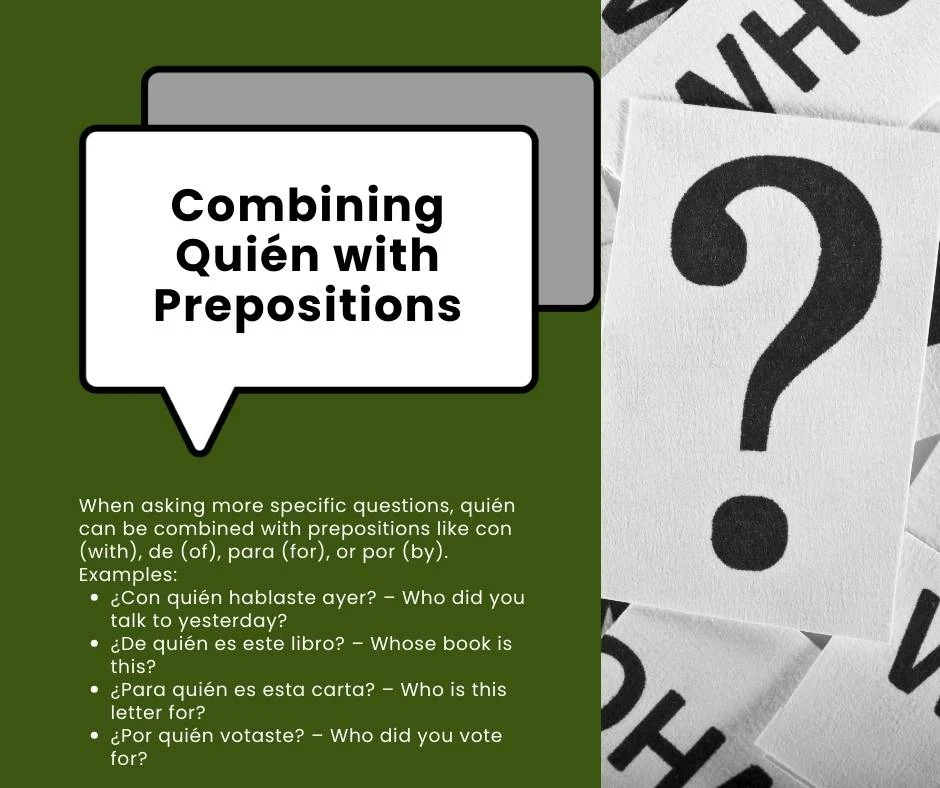
When asking more specific questions, quién can be combined with prepositions like con (with), de (of), para (for), or por (by).
Examples:
- ¿Con quién hablaste ayer? – Who did you talk to yesterday?
- ¿De quién es este libro? – Whose book is this?
- ¿Para quién es esta carta? – Who is this letter for?
- ¿Por quién votaste? – Who did you vote for?
Using quién with prepositions is a key skill for forming natural, detailed questions in real-life conversations.
Asking Questions in Different Tenses
Quién can be used with verbs in past, present, and future tenses to ask about actions in different times.
Present Tense Examples:
- ¿Quién trabaja en esta oficina? – Who works in this office?
- ¿Quién vive aquí? – Who lives here?
Past Tense Examples:
- ¿Quién llegó primero? – Who arrived first?
- ¿Quién escribió esta carta? – Who wrote this letter?
Future Tense Examples:
- ¿Quién vendrá mañana? – Who will come tomorrow?
- ¿Quién ayudará en la fiesta? – Who will help at the party?
Mastering these patterns allows you to ask about people in any context.
Using Quién in Indirect Questions
Indirect questions are common in conversation and often require a slightly different structure. You don’t always start the sentence with quién directly.
Examples:
- No sé quién viene a la reunión. – I don’t know who is coming to the meeting.
- Me pregunto quién ganó el concurso. – I wonder who won the contest.
- Dime quién necesita ayuda. – Tell me who needs help.
Indirect questions help you sound more advanced and polite in Spanish.
Common Mistakes to Avoid
Beginners often make mistakes when using quién. Here are some tips to avoid them:
- Forgetting the accent: quien without an accent does not mean “who.” Always use quién for questions.
- Plural confusion: Use quiénes for multiple people, not quién.
- Incorrect verb agreement: Make sure the verb matches the subject in number.
- Wrong preposition placement: Prepositions like con or de should come before quién in the question.
- Mixing formal and informal: Ensure verbs and pronouns match the context.
Real-Life Examples of Using Quién
Here are practical situations where quién is used daily:
- At work:
- ¿Quién envió este correo electrónico? – Who sent this email?
- ¿Quién asistirá a la reunión? – Who will attend the meeting?
- ¿Quién envió este correo electrónico? – Who sent this email?
- With friends:
- ¿Quién viene a la fiesta esta noche? – Who is coming to the party tonight?
- ¿Con quién fuiste al cine? – Who did you go to the movies with?
- ¿Quién viene a la fiesta esta noche? – Who is coming to the party tonight?
- In school:
- ¿Quién sabe la respuesta? – Who knows the answer?
- ¿Quién entregó la tarea primero? – Who submitted the homework first?
- ¿Quién sabe la respuesta? – Who knows the answer?
Practicing these examples will help you use quién confidently in everyday conversations.
Advanced Tips for Using Quién Naturally
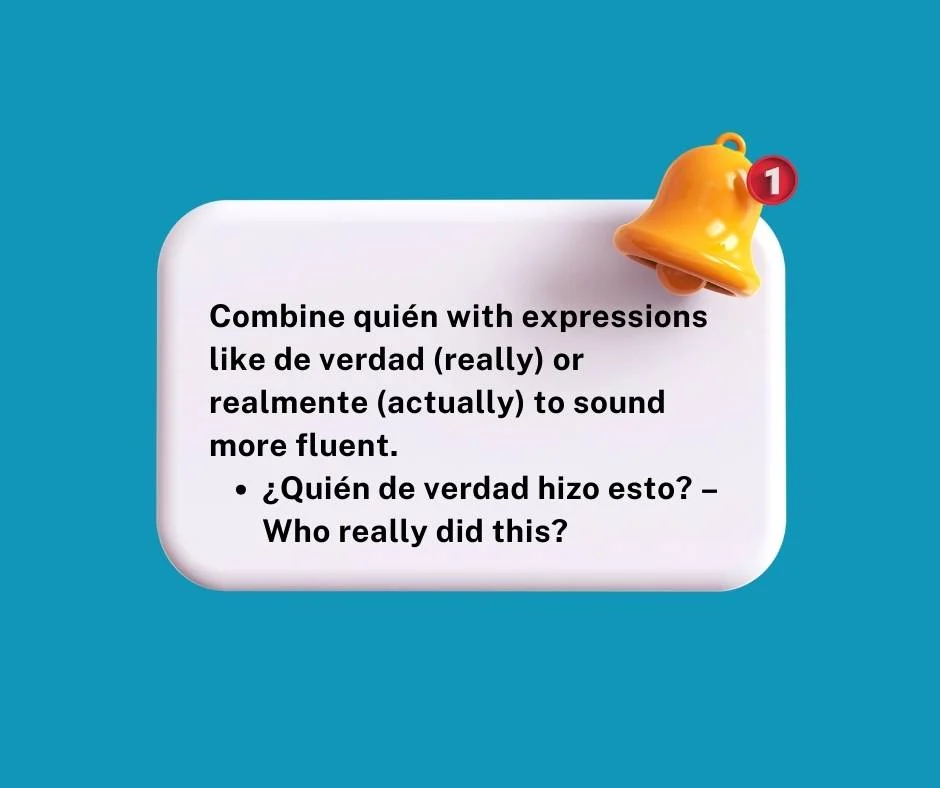
- Combine quién with expressions like de verdad (really) or realmente (actually) to sound more fluent.
- ¿Quién de verdad hizo esto? – Who really did this?
- ¿Quién de verdad hizo esto? – Who really did this?
- Use quién in rhetorical questions for emphasis.
- ¿Quién no quiere ser feliz? – Who doesn’t want to be happy?
- ¿Quién no quiere ser feliz? – Who doesn’t want to be happy?
- Pair quién with commands politely.
- Dime quién necesita ayuda. – Tell me who needs help.
- Dime quién necesita ayuda. – Tell me who needs help.
These tips make your Spanish sound more natural and advanced.
Frequently Asked Questions (FAQs)
1. What is the word for “who” in Spanish?
The word is quién for singular and quiénes for plural.
2. How do you ask “who is coming?” in Spanish?
You say ¿Quién viene?
3. Can “quién” be used with prepositions?
Yes, examples include ¿Con quién hablaste? (Who did you talk to?) and ¿De quién es esto? (Whose is this?).
4. How do I ask about multiple people?
Use quiénes, for example: ¿Quiénes asistirán a la reunión? – Who will attend the meeting?
5. Is there a difference between formal and informal use of “who”?
The word quién stays the same, but verb forms and pronouns should match the formality of the situation.
Conclusion
Learning how to say who in Spanish is essential for asking questions, identifying people, and engaging in conversations naturally.
Whether you use quién in casual chats, formal settings, or indirect questions, mastering it opens doors to clearer communication.
Practice the examples, pay attention to accents, and use the plural forms correctly, and you’ll gain confidence speaking Spanish in any context.

Ethan Moore
Ethan Moore is a passionate storyteller and language enthusiast who believes that words have the power to bridge cultures. Ever since he was young, Ethan has been fascinated by how languages shape our thoughts and connect people from different corners of the world. Through his writing, he explores the beauty of communication and the subtle nuances that make each language unique. When he’s not writing, Ethan enjoys traveling, learning new languages, and diving into different cultures. His goal is to inspire readers to embrace diversity and appreciate the richness of global expression.
Books:
-
Whispers Across Tongues
-
The Language of Dreams