
Knowing how to say Good Evening in French helps you greet others politely and warmly at the end of the day.
If you’re chatting with friends, meeting colleagues, or traveling, the right phrase makes a great impression.
This guide will show you simple ways to use it naturally in everyday conversation.
By the end, you’ll feel confident saying “Good Evening” in French like a native speaker.
Basic Ways to Say Good Evening
The most common and widely used phrase is “Bonsoir.”
This word is suitable for both formal and informal contexts and is the standard way to greet someone in the evening.
Pronunciation Tips
- Bonsoir → bohn-swahr
- Stress the second syllable lightly for natural pronunciation.
- Start slowly, then practice using it in full sentences.
Simple Examples
- “Good evening, everyone.” → Bonsoir à tous.
- “Good evening, how are you?” → Bonsoir, comment ça va ?
- “I wish you a good evening.” → Je vous souhaite une bonne soirée.
Using Bonsoir correctly helps you greet others politely and naturally.
How to Say Good Evening in French
The most common way to say good evening in French is:
Bonsoir
Pronunciation: bohn-swahr
Meaning: Good evening
This greeting is used after the afternoon, usually from around 6 PM until night. It can also be used when meeting someone or entering a place like a restaurant or shop.
Example Sentences
- Bonsoir! Comment allez-vous ?
Good evening! How are you? - Bonsoir tout le monde.
Good evening everyone.
It is simple, polite, and widely used in everyday conversations.
How to Say Good Evening in French to a Guy
When greeting a man in the evening, you still use Bonsoir. French greetings usually stay the same regardless of gender.
Example phrases include:
- Bonsoir, monsieur. – Good evening, sir.
- Bonsoir, Pierre. – Good evening, Pierre.
Adding monsieur makes the greeting more polite.
Practical Example
Imagine entering a restaurant:
“Bonsoir, monsieur. Une table pour deux, s’il vous plaît.“
Meaning:
“Good evening, sir. A table for two, please.”
This greeting sounds respectful and natural.
How to Say Good Evening in French to a Friend
When speaking to friends, you can still say Bonsoir, but the tone becomes more relaxed.
Examples:
- Bonsoir mon ami ! – Good evening my friend
- Bonsoir Marie ! – Good evening Marie
- Bonsoir les amis ! – Good evening friends
Friendly Conversation Example
Friend arrives at your house:
You: Bonsoir !
Friend: Bonsoir, ça va ?
Meaning:
You: Good evening!
Friend: Good evening, how are you?
French greetings often start casual conversations like this.
How to Say Good Evening in French Informal
In informal situations, people still commonly use Bonsoir, but they may shorten conversations or add casual phrases.
Examples include:
- Bonsoir ! Ça va ? – Good evening! How are you?
- Salut ! Bonsoir ! – Hi! Good evening!
Informal Situations
Informal greetings are common in:
- meeting friends
- chatting with family
- casual social gatherings
- texting or messaging
The greeting remains polite but feels relaxed.
How to Pronounce Good Evening in French
Correct pronunciation helps you sound more natural.
Bonsoir Pronunciation
Bonsoir
Pronounced as:
bohn-swahr
Breakdown:
- Bon sounds like “bohn”
- Soir sounds like “swahr”
Pronunciation Tips
- The n in bon is nasal and soft
- The r in soir is pronounced from the throat
- Speak smoothly without stressing syllables too strongly
Practice saying the word slowly:
bohn… swahr
With practice, it becomes very natural.
How to Say Good Evening in French Formal
In formal situations, Bonsoir is also used, but it is often combined with polite titles.
Examples:
- Bonsoir, monsieur. – Good evening, sir
- Bonsoir, madame. – Good evening, ma’am
- Bonsoir, madame et monsieur. – Good evening, ma’am and sir
When to Use Formal Greetings
Formal greetings are used in situations such as:
- business meetings
- hotels and restaurants
- speaking to elders
- official events
French culture values politeness, so using titles shows respect.
Good Night in French
When someone is going to sleep or leaving late at night, the phrase changes.
Bonne nuit
Pronunciation: bun nwee
Meaning: Good night
Example
Before going to bed:
Bonne nuit ! Dormez bien.
Meaning:
Good night! Sleep well.
Difference Between Bonsoir and Bonne Nuit
| Phrase | Meaning | When to Use |
| Bonsoir | Good evening | Greeting someone in the evening |
| Bonne nuit | Good night | When someone is going to sleep |
Understanding this difference helps avoid common mistakes.
Good Evening in French to a Woman
When greeting a woman politely, you can say:
Bonsoir, madame
Meaning: Good evening, ma’am
If the woman is younger or unmarried, you may hear:
Bonsoir, mademoiselle
Meaning: Good evening, miss
Example
Entering a hotel reception:
“Bonsoir, madame. J’ai une réservation.“
Meaning:
“Good evening, ma’am. I have a reservation.”
This sounds polite and professional.
Good Morning in French
Another important greeting to know is good morning in French.
The phrase is:
Bonjour
Pronunciation: bohn-zhoor
Meaning: Good morning / Hello
When to Use Bonjour
It is used during the daytime, usually from morning until late afternoon.
Examples:
- Bonjour ! Comment ça va ? – Good morning! How are you?
- Bonjour monsieur. – Good morning sir.
Greeting Timeline in French
Here is a simple guide:
| Time | Greeting |
| Morning | Bonjour |
| Evening | Bonsoir |
| Night | Bonne nuit |
Learning these greetings helps you communicate politely at any time of day.
Informal Expressions for Friends and Family
In casual settings, you can pair Bonsoir with informal phrases or shorten it slightly for friendly conversations.
Common Informal Expressions
- Salut, bonsoir ! – Hi, good evening!
- Coucou, bonsoir – Hey there, good evening (very informal, playful).
- Bonne soirée – Have a good evening (used when parting).
- Bonsoir tout le monde – Good evening, everyone.
- À ce soir – See you this evening.
Examples in Sentences
- “Good evening, friends!” → Bonsoir, les amis !
- “Have a nice evening at the party.” → Bonne soirée à la fête.
- “See you this evening at the café.” → À ce soir au café.
Informal greetings help you connect naturally with friends and family.
Formal and Polite Ways
When speaking to colleagues, elders, or unfamiliar people, it’s best to use polite or formal expressions.
Recommended Formal Phrases
- Bonsoir, Monsieur / Madame – Good evening, Sir / Madam.
- Je vous souhaite une excellente soirée – I wish you an excellent evening.
- Bonsoir à vous tous – Good evening to all of you.
- Je vous souhaite une bonne fin de journée – I wish you a good end of the day.
- Que votre soirée soit agréable – May your evening be pleasant.
Usage Examples
- “Good evening, Mr. Dupont.” → Bonsoir, Monsieur Dupont.
- “I wish you a pleasant evening.” → Je vous souhaite une soirée agréable.
- “Good evening, everyone at the meeting.” → Bonsoir à tous à la réunion.
Formal expressions show respect and professionalism in social and business contexts.
Talking About Evening Activities
You can use good evening greetings to introduce or talk about evening plans, routines, and events.
Common Phrases
- “We are going out tonight.” → Nous sortons ce soir.
- “I will read a book this evening.” → Je vais lire un livre ce soir.
- “Dinner starts at 7 p.m.” → Le dîner commence à 19 heures.
- “We are having a small gathering tonight.” → Nous avons un petit rassemblement ce soir.
- “The party will be fun this evening.” → La fête sera amusante ce soir.
Practical Tips
- Pair Bonsoir with these phrases to start conversations naturally.
- For invitations, follow Bonsoir with friendly expressions:
Example: “Good evening, would you like to join us?” → Bonsoir, voulez-vous vous joindre à nous ?
Talking about evening activities makes greetings more engaging and context-specific.
Expressing Good Wishes in the Evening
French speakers often extend their greetings to include wishes for a pleasant evening, especially when parting.
Common Phrases
- Bonne soirée – Have a good evening.
- Passez une bonne soirée – Have a good evening (formal/polite).
- Que votre soirée soit agréable – May your evening be pleasant.
- Profitez de votre soirée – Enjoy your evening.
- Je vous souhaite une soirée merveilleuse – I wish you a wonderful evening.
Examples in Sentences
- “Have a good evening at the theater.” → Passez une bonne soirée au théâtre.
- “Enjoy your evening with friends.” → Profitez de votre soirée avec des amis.
- “I wish you a wonderful evening at the event.” → Je vous souhaite une soirée merveilleuse à l’événement.
Adding good wishes shows thoughtfulness and cultural awareness.
Talking About Evening Routines
Learning how to say good evening in French also helps you discuss routines or daily activities during the evening.
Examples of Evening Routines
- “I usually watch TV in the evening.” → Je regarde la télévision le soir.
- “We take a walk every evening.” → Nous faisons une promenade chaque soir.
- “I like to drink tea in the evening.” → J’aime boire du thé le soir.
- “She reads before going to bed.” → Elle lit avant de se coucher.
- “We have dinner together every evening.” → Nous dînons ensemble chaque soir.
Discussing routines using evening phrases integrates your learning into daily life.
Combining Good Evening With Other Greetings
In French, you can combine Bonsoir with other expressions for more nuanced greetings.
Romantic or Friendly Additions
- Bonsoir, mon amour – Good evening, my love.
- Bonsoir, ma chère amie – Good evening, my dear friend.
- Bonsoir, tout le monde, comment allez-vous ? – Good evening, everyone, how are you?
- Bonsoir, j’espère que vous avez passé une bonne journée – Good evening, I hope you had a nice day.
- Bonsoir et bienvenue – Good evening and welcome.
Examples in Context
- “Good evening, my love, how was your day?” → Bonsoir, mon amour, comment s’est passée ta journée ?
- “Good evening everyone, I’m glad to see you.” → Bonsoir tout le monde, je suis content(e) de vous voir.
Combining phrases adds personality and makes greetings more engaging.
Advanced Expressions and Idioms
For learners seeking more advanced ways to greet someone in the evening, French offers idiomatic expressions.
Examples
- À la tombée de la nuit, bonsoir – As night falls, good evening.
- Que cette soirée vous apporte joie et détente – May this evening bring you joy and relaxation.
- Je vous souhaite une soirée paisible – I wish you a peaceful evening.
- Passez une agréable soirée en famille – Have a pleasant evening with your family.
- Que votre soirée soit remplie de bonheur – May your evening be filled with happiness.
Practical Usage
- Use these phrases for letters, formal emails, or special occasions.
- Pair advanced expressions with Bonsoir for elegance:
Example: Bonsoir, je vous souhaite une soirée paisible.
These advanced greetings convey thoughtfulness and cultural fluency.
Writing Good Evening Messages
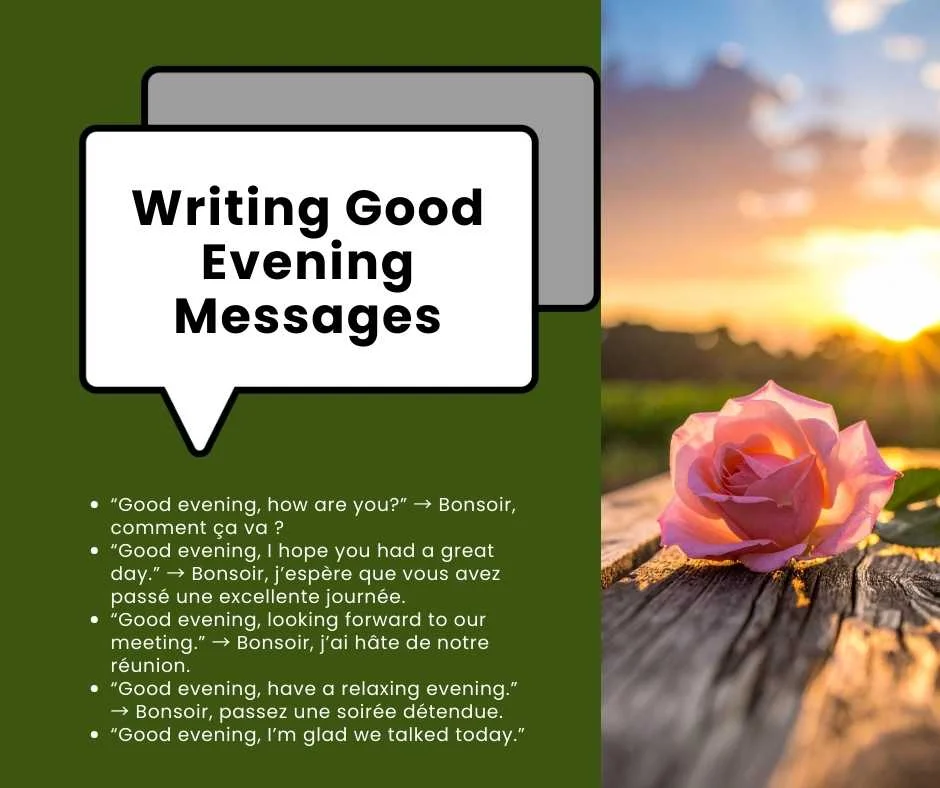
In texting or emails, good evening greetings are often used at the start of messages.
Examples
- “Good evening, how are you?” → Bonsoir, comment ça va ?
- “Good evening, I hope you had a great day.” → Bonsoir, j’espère que vous avez passé une excellente journée.
- “Good evening, looking forward to our meeting.” → Bonsoir, j’ai hâte de notre réunion.
- “Good evening, have a relaxing evening.” → Bonsoir, passez une soirée détendue.
- “Good evening, I’m glad we talked today.” → Bonsoir, je suis content(e) que nous ayons parlé aujourd’hui.
Tips for Messaging
- Use polite expressions in professional contexts.
- Emojis can be added for informal texts: 🌙✨💬
- Keep it concise but thoughtful for maximum impact.
Writing greetings allows learners to practice spelling, grammar, and tone.
Frequently Asked Questions
1. How do you say good evening in French?
The standard phrase is Bonsoir, used from late afternoon until bedtime.
2. Can I use Bonsoir informally?
Yes, it’s suitable for friends, family, or casual settings, sometimes combined with Salut or playful words.
3. How do I wish someone a good evening when leaving?
You can say Bonne soirée or Passez une bonne soirée.
4. Is there a formal way to say good evening?
Yes, formal phrases include Je vous souhaite une excellente soirée or Que votre soirée soit agréable.
5. Can I combine Bonsoir with other greetings?
Absolutely! You can add phrases like Bonsoir, mon amour or Bonsoir tout le monde, comment ça va ?
Conclusion
Knowing how to say good evening in French is essential for polite, friendly, and professional interactions.
From casual greetings with friends to formal wishes in social or business settings, using Bonsoir and related expressions allows you to communicate effectively and culturally appropriately.
Practicing pronunciation, pairing with additional phrases, and understanding context ensures your greetings are natural, warm, and engaging.
Also Check These Posts:
How to Say Good Night in German | Essential Words for Every Night in 2026
How to Say Lunch in Spanish | Easy Phrases to Use Every Day in 2026
How to Say Happy New Year | Greetings Everyone Will Remember in 2026

Daniel Carter
Hi, I’m Daniel Carter, a passionate storyteller and lifelong explorer of languages and cultures. Writing has always been my way of connecting with the world, sharing stories that inspire, educate, and entertain. I love diving into the nuances of communication and finding beauty in the words we use every day. Over the years, I’ve dedicated myself to crafting stories that resonate across borders and languages. When I’m not writing, you’ll usually find me exploring new places or learning something new about the world around me. My goal is to create stories that make readers think, smile, and sometimes even dream.
Books:
-
Whispers Across Borders
-
The Language of Hearts