

Want to greet someone politely during the day but don’t know how to say good afternoon in Italian?
Whether you’re traveling, learning Italian, or chatting with native speakers, using the right phrase matters.
A simple greeting can make your conversation feel warm and respectful.
This guide will show you the correct and easy way to say good afternoon in Italian with confidence.
The most common way Italians say good afternoon
The standard and most widely used way to say good afternoon in Italian is:
Buon pomeriggio
This phrase is polite, neutral, and suitable for almost every situation. You can use it with strangers, coworkers, shopkeepers, teachers, or anyone you don’t know well.
Buon means “good”
Pomeriggio means “afternoon”
Together, they form a respectful greeting that works perfectly during the afternoon hours.
When to use buon pomeriggio
Italians are very specific about time-related greetings. Using the correct one shows cultural awareness.
You should say buon pomeriggio:
- From around 12:00 PM to early evening
- After lunch when the day moves past morning
- In formal and informal settings
- When entering shops, offices, or meetings in the afternoon
Example:
- Buon pomeriggio, come sta?
Good afternoon, how are you?
Difference between buon pomeriggio and buongiorno
Many beginners get confused between these two greetings.
Understanding the difference is important when learning how to say good afternoon in Italian correctly.
Buongiorno meaning and usage
Buongiorno means “good morning” or “good day.”
It is commonly used:
- From early morning
- Until around lunchtime
- Sometimes slightly after lunch in casual situations
In some regions, people may still say buongiorno until 1 or 2 PM.
However, to be safe and correct, switching to buon pomeriggio after noon is recommended.
Why buon pomeriggio matters
Using buon pomeriggio instead of buongiorno:
- Sounds more natural in formal Italian
- Shows respect for Italian customs
- Helps you avoid sounding like a beginner
Formal and informal ways to say good afternoon
Italian greetings change depending on who you are speaking to. Let’s look at how to adapt your greeting.
Formal situations
In formal contexts, buon pomeriggio is perfect on its own or paired with polite phrases.
Examples:
- Buon pomeriggio, signore.
- Buon pomeriggio, piacere di conoscerla.
- Buon pomeriggio, come sta?
These are ideal for:
- Business meetings
- Talking to elders
- Speaking with professionals
- Official settings
Informal situations
Among friends or people you know well, Italians may still say buon pomeriggio, but often keep it simple.
Examples:
- Buon pomeriggio!
- Ciao, buon pomeriggio!
In casual chats, some Italians even skip the greeting if they already met earlier in the day. Still, using it is always polite.
Pronunciation tips for beginners
Correct pronunciation helps you sound confident when saying good afternoon in Italian.
Buon pomeriggio is pronounced as:
- bwohn poh-meh-REE-joh
Helpful tips:
- The “gn” sound in pomeriggio is soft, similar to “ny” in “canyon”
- Stress the “REE” syllable
- Don’t rush the words
Practicing slowly will improve clarity and confidence.
Regional habits and cultural notes
Italy has strong regional cultures, and greetings can slightly vary.
Northern Italy
In northern regions, people tend to be more formal. You will hear buon pomeriggio used more consistently after lunchtime, especially in professional environments.
Central Italy
In cities like Rome or Florence, both buongiorno and buon pomeriggio are used, but locals are flexible. Context matters more than strict timing.
Southern Italy
In the south, people may continue saying buongiorno longer into the day. However, buon pomeriggio is still correct and polite everywhere.
Knowing this helps you understand conversations even if you hear different greetings.
Common mistakes learners make
When learning how to say good afternoon in Italian, beginners often make small mistakes. Avoiding them will help you sound more natural.
Using buona pomeriggio
This is incorrect.
Pomeriggio is masculine, so you must say buon, not buona.
Correct:
- Buon pomeriggio
Incorrect:
- Buona pomeriggio
Using buona sera too early
Buona sera means “good evening.”
It is usually used:
- After sunset
- Or later in the evening
Using buona sera at 2 PM sounds strange. Stick with buon pomeriggio until early evening.
Mixing languages
Saying “good pomeriggio” or combining English and Italian sounds unnatural. Always use the full Italian phrase.
Using good afternoon in real conversations
Learning greetings is not just about memorizing words. Let’s see how buon pomeriggio fits into real-life situations.
At a café or restaurant
When entering in the afternoon:
- Buon pomeriggio!
When speaking to staff:
- Buon pomeriggio, posso ordinare?
Good afternoon, may I order?
At work or school
Greeting colleagues or teachers:
- Buon pomeriggio a tutti.
- Buon pomeriggio, professore.
On the phone or in emails
Italians often use buon pomeriggio in afternoon calls and messages.
Email example:
- Buon pomeriggio,
La contatto per…
Phone example:
- Buon pomeriggio, parlo con Marco?
Polite responses to buon pomeriggio
When someone greets you with buon pomeriggio, responding correctly is easy.
Common replies:
- Buon pomeriggio!
- Buon pomeriggio anche a lei.
Good afternoon to you too
This keeps the conversation polite and natural.
Comparison with English usage
In English, “good afternoon” is often skipped or sounds formal. In Italian, it is used much more frequently.
Key differences:
- Italians greet more often
- Greetings are expected in shops and offices
- Skipping a greeting can seem rude
Understanding this cultural difference helps you communicate better.
Learning greetings as part of Italian etiquette
Mastering how to say good afternoon in Italian is part of a larger cultural habit.
Italians value:
- Respectful greetings
- Eye contact
- A friendly tone
A simple buon pomeriggio can:
- Start conversations smoothly
- Show respect
- Create a positive impression
Practice examples for learners
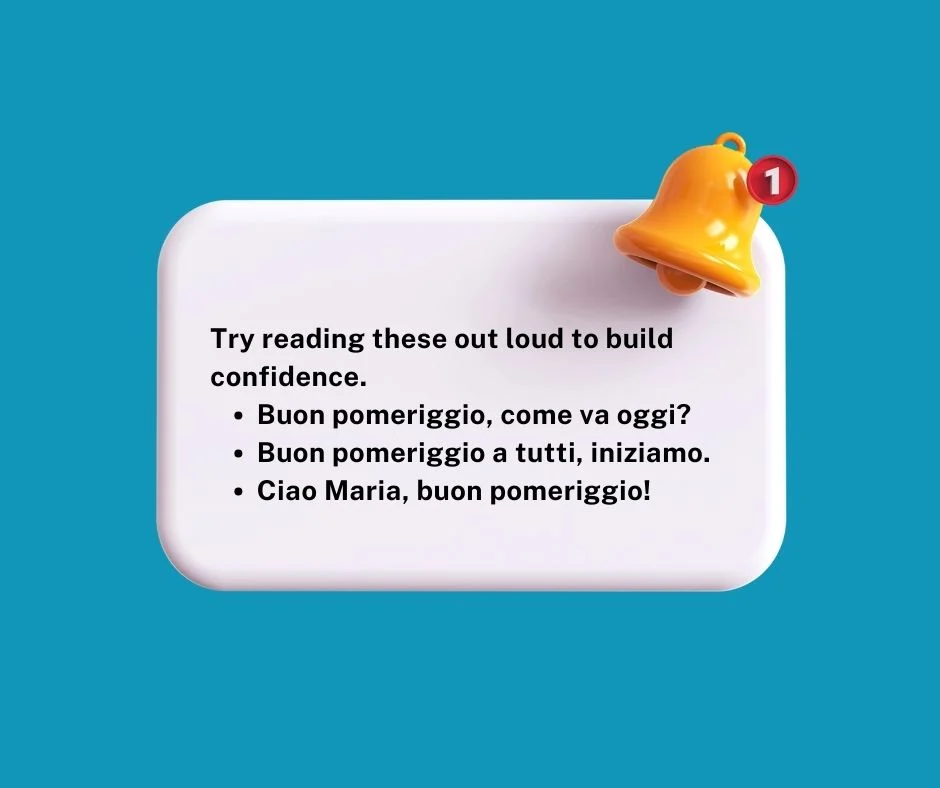
Try reading these out loud to build confidence.
- Buon pomeriggio, come va oggi?
- Buon pomeriggio a tutti, iniziamo.
- Ciao Maria, buon pomeriggio!
Repeating these helps improve fluency and comfort.
Frequently Asked Questions
What is the correct way to say good afternoon in Italian
The correct and most common way is buon pomeriggio. It is polite and suitable for formal and informal situations.
At what time do Italians say buon pomeriggio
Italians usually say buon pomeriggio from around 12 PM until early evening, before switching to buona sera.
Can I use buongiorno instead of buon pomeriggio
You can use buongiorno earlier in the day, but after lunch, buon pomeriggio is more accurate and polite.
Is buon pomeriggio formal or informal
Buon pomeriggio works in both formal and informal settings, making it very versatile for learners.
Do Italians really use good afternoon often
Yes, Italians commonly greet people with buon pomeriggio, especially in shops, offices, and social interactions.
Conclusion
Learning how to say good afternoon in Italian is a simple yet powerful step in mastering the language.
The phrase buon pomeriggio helps you sound polite, respectful, and culturally aware.
By using it at the right time and in the right context, you build better connections and communicate more naturally.
Keep practicing, and your Italian greetings will soon feel effortless.

Ethan Moore
Ethan Moore is a passionate storyteller and language enthusiast who believes that words have the power to bridge cultures. Ever since he was young, Ethan has been fascinated by how languages shape our thoughts and connect people from different corners of the world. Through his writing, he explores the beauty of communication and the subtle nuances that make each language unique. When he’s not writing, Ethan enjoys traveling, learning new languages, and diving into different cultures. His goal is to inspire readers to embrace diversity and appreciate the richness of global expression.
Books:
-
Whispers Across Tongues
-
The Language of Dreams