

Ever wondered how to say cousin in Spanish and make family conversations more meaningful?
Whether you’re connecting with relatives or learning Spanish for fun, knowing this simple word brings you closer to culture and conversation.
In this guide, you’ll learn the correct term, tips for using it naturally, and even a few fun ways to talk abo
Basic Translation of Cousin in Spanish
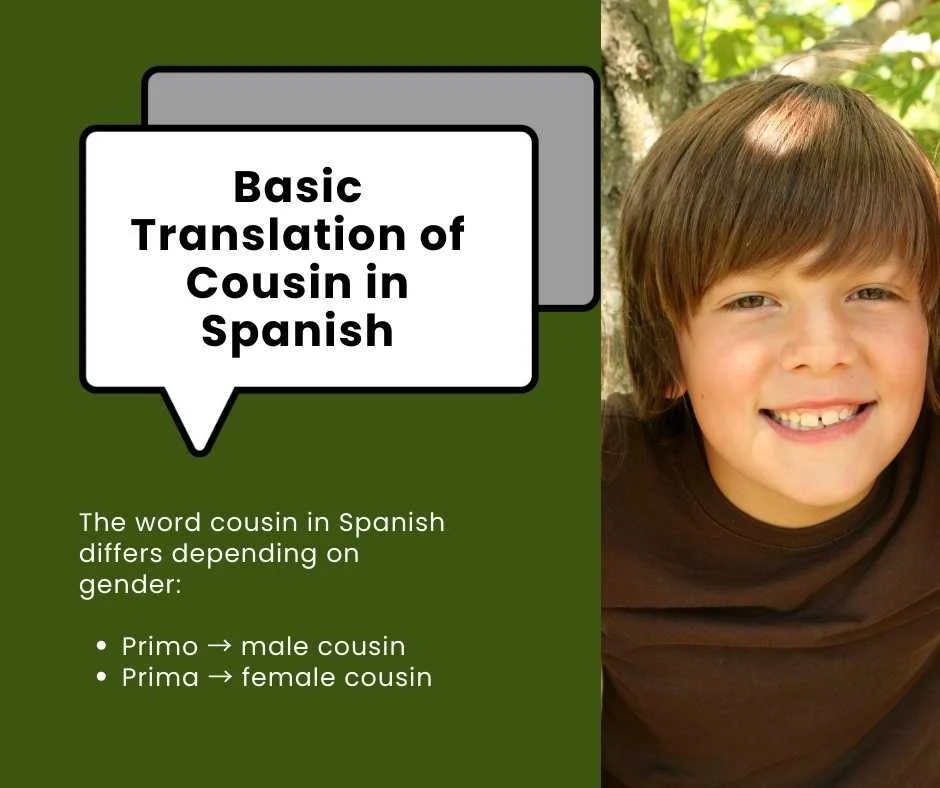
The word cousin in Spanish differs depending on gender:
- Primo → male cousin
- Prima → female cousin
Practical examples:
- “Mi primo vive en México.” → “My cousin (male) lives in Mexico.”
- “Mi prima es muy simpática.” → “My cousin (female) is very nice.”
Plural Forms
When talking about more than one cousin, Spanish uses plural endings:
- Primos → male cousins or mixed group of cousins
- Primas → female cousins
Examples:
- “Tengo tres primos y dos primas.” → “I have three male cousins and two female cousins.”
- “Mis primas son muy divertidas.” → “My female cousins are very fun.”
Pronunciation Tips for Beginners
Correct pronunciation makes your speech more understandable:
- Primo → “PREE-moh”
- Prima → “PREE-mah”
- Primos → “PREE-mos”
- Primas → “PREE-mas”
Tips:
- Emphasize the first syllable.
- The “i” is pronounced like the “ee” in “see.”
- Practice by saying simple sentences: “Mi primo es alto” (My male cousin is tall).
Cousin in Spanish Male
The word for cousin in Spanish male is:
Primo
How to Use Primo in a Sentence
Here are simple examples:
- Mi primo vive en Madrid.
(My male cousin lives in Madrid.) - Voy al cine con mi primo.
(I’m going to the movies with my cousin.)
Pronunciation
Pree-moh
The “i” sounds like “ee” and the “o” sounds like “oh.”
Important Grammar Tip
Spanish nouns have gender.
- Primo = male cousin
- Ends in -o, which usually signals masculine form.
Cousin in Spanish Female
The word for cousin in Spanish female is:
Prima
Example Sentences
- Mi prima es doctora.
(My female cousin is a doctor.) - Amo a mi prima.
(I love my cousin.)
Pronunciation
Pree-mah
The “a” sounds like “ah.”
Quick Gender Rule
- -o ending → masculine
- -a ending → feminine
So:
- Primo = male
- Prima = female
Cousins in Spanish Plural
If you want to say cousins in Spanish plural, you add -s.
- Primos = male cousins OR mixed group
- Primas = all female cousins
Examples
- Mis primos viven en México.
(My cousins live in Mexico.) - Mis primas son muy divertidas.
(My girl cousins are very fun.)
Important Rule
In Spanish:
- If the group includes even one male, use primos
- Only use primas if all cousins are female
This rule applies to most Spanish family words.
My Favorite Cousin in Spanish
To say my favorite cousin in Spanish, you need to adjust for gender.
Male Cousin
Mi primo favorito
Example:
Mi primo favorito siempre me ayuda.
(My favorite cousin always helps me.)
Female Cousin
Mi prima favorita
Example:
Mi prima favorita es muy inteligente.
(My favorite cousin is very smart.)
Why the Ending Changes
- Favorito → masculine
- Favorita → feminine
Adjectives must match the noun’s gender.
My Girl Cousins in Spanish
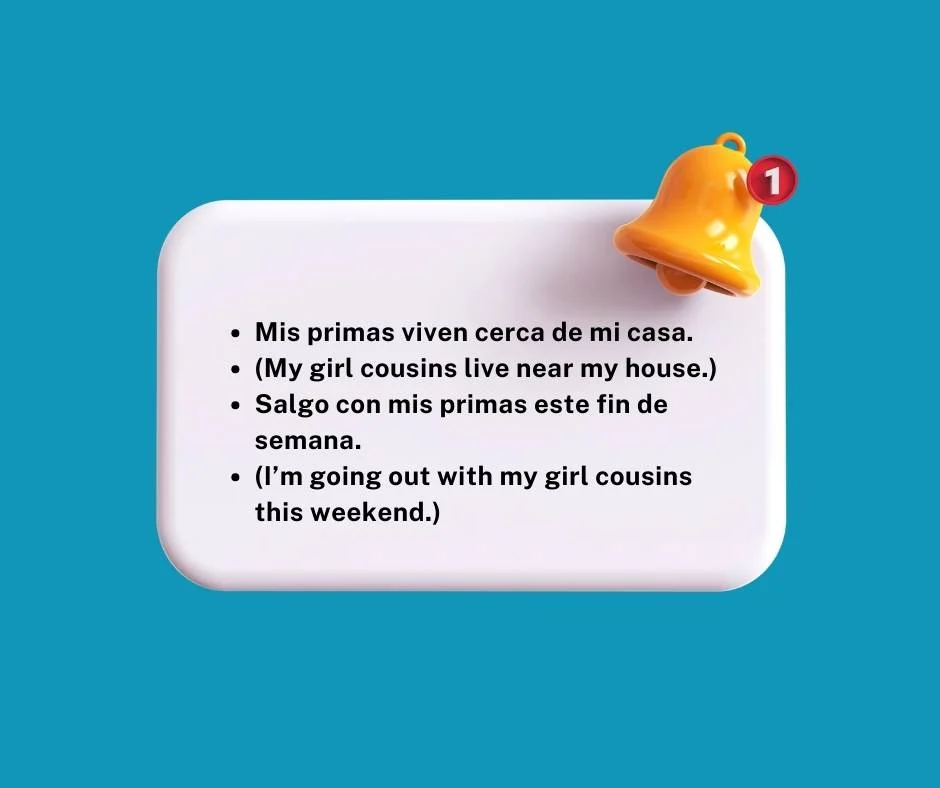
If you want to say my girl cousins in Spanish, the correct phrase is:
Mis primas
Example Sentences
- Mis primas viven cerca de mi casa.
(My girl cousins live near my house.) - Salgo con mis primas este fin de semana.
(I’m going out with my girl cousins this weekend.)
Grammar Breakdown
- Mi → singular
- Mis → plural
So:
- Mi prima = My female cousin
- Mis primas = My female cousins
Cousin in Spanish Slang
Now let’s talk about how to say cousin in Spanish slang.
In many Spanish-speaking countries, especially Mexico, people use:
Primo / Prima as slang for:
- Close friend
- Buddy
- Bro
In Mexican Spanish
In Mexican Spanish, “primo” can be used casually like:
- ¿Qué onda, primo?
(What’s up, bro?)
It doesn’t always mean real cousin. It can simply show closeness or friendliness.
Other Informal Variations
In some regions, people may shorten words casually, but primo/prima remains the most common slang-friendly word.
Cousin in Mexican Spanish
If you’re specifically asking about cousin in Mexican Spanish, the standard word is still:
Primo / Prima
However, in Mexico, it’s very common to:
- Use it casually among friends
- Say it in a friendly tone
- Use it in greetings
Example:
- Primo, vamos a comer.
(Bro, let’s go eat.)
It adds warmth and familiarity.
Cuñado Meaning in English
Now let’s clarify cuñado meaning in English.
Cuñado means:
Brother-in-law
Female Version
- Cuñada = Sister-in-law
Examples
- Mi cuñado es muy amable.
(My brother-in-law is very kind.) - Mi cuñada vive en España.
(My sister-in-law lives in Spain.)
Important Difference
Do not confuse:
- Primo = cousin
- Cuñado = brother-in-law
They are completely different family relationships.
Quick Comparison Table
| English | Spanish (Male) | Spanish (Female) | Plural |
| Cousin | Primo | Prima | Primos / Primas |
| My cousin | Mi primo | Mi prima | Mis primos |
| Favorite cousin | Primo favorito | Prima favorita | Primos favoritos |
| Brother-in-law | Cuñado | Cuñada | Cuñados |
This table helps you remember quickly.
Common Mistakes to Avoid
Mixing Primo and Cuñado
Many beginners confuse cousin and brother-in-law. Remember:
- Primo = cousin
- Cuñado = brother-in-law
Forgetting Gender Agreement
Wrong: Mi primo favorita
Correct: Mi primo favorito
Adjectives must match the noun.
Forgetting Plural Rules
Wrong: Mis primo
Correct: Mis primos
Always add -s for plural.
How to Use These Words Naturally
To sound fluent:
- Match gender correctly
- Use plural properly
- Practice pronunciation
- Listen to native speakers
You can even practice by describing your family:
- Tengo dos primos y tres primas.
(I have two male cousins and three female cousins.)
Using Cousin in Everyday Conversations
Talking About Family
You can describe your cousins in different situations:
- Basic introduction:
“Este es mi primo Juan.” → “This is my cousin Juan.”
“Ella es mi prima María.” → “She is my cousin María.” - Talking about multiple cousins:
“Mis primos van a venir a la fiesta.” → “My cousins are going to come to the party.”
Sharing Personal Stories
- “Cuando era niño, jugaba con mi primo en el parque.” → “When I was a child, I played with my cousin in the park.”
- “Mi prima me enseñó a cocinar.” → “My cousin taught me how to cook.”
These examples show how primo and prima are naturally used in conversation.
Advanced Usage and Variations
Extended Family Terms
Sometimes you may want to specify the cousin’s relationship more clearly:
- Primo hermano / Prima hermana → first cousin (literally “brother cousin” or “sister cousin”)
- Primo segundo / Prima segunda → second cousin
Example:
- “Mi primo hermano vive en España.” → “My first cousin lives in Spain.”
- “Tengo un primo segundo que vive en Argentina.” → “I have a second cousin who lives in Argentina.”
Formal or Written Use
In letters or formal communication, you may write:
- “Estimado primo” → “Dear cousin”
- “Querida prima” → “Dear cousin (female)”
These are polite and respectful ways to address cousins in writing.
Talking About Cousins’ Characteristics
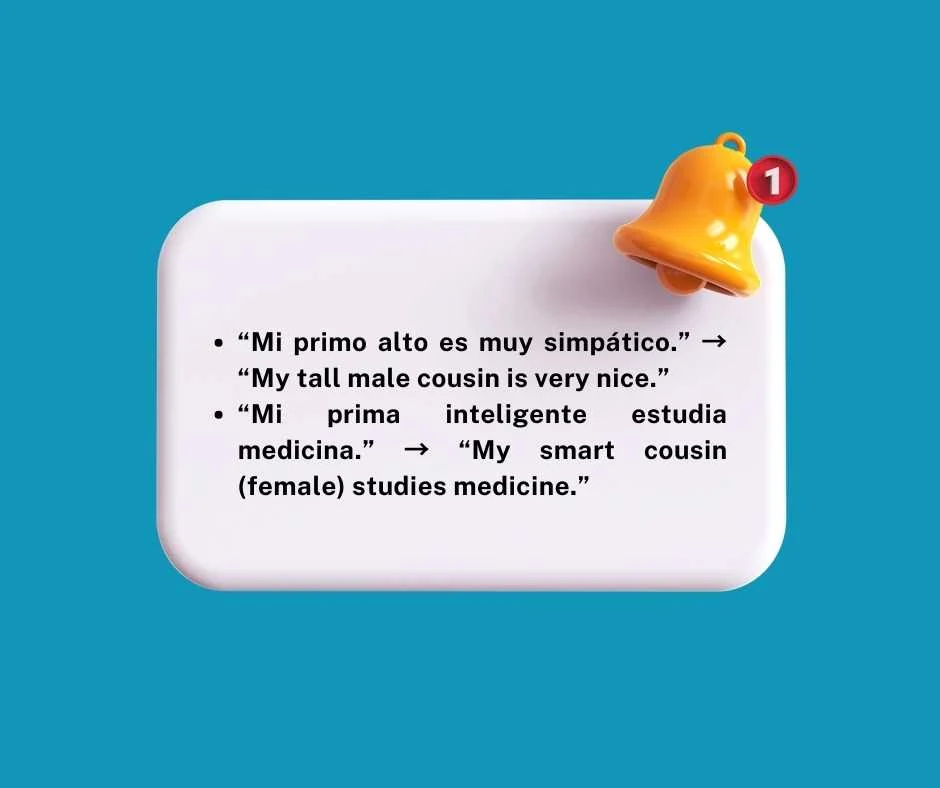
You can describe your cousins using adjectives and gender agreement:
- “Mi primo alto es muy simpático.” → “My tall male cousin is very nice.”
- “Mi prima inteligente estudia medicina.” → “My smart cousin (female) studies medicine.”
For plural cousins:
- “Mis primos divertidos juegan al fútbol.” → “My fun male cousins play soccer.”
- “Mis primas creativas dibujan muy bien.” → “My creative female cousins draw very well.”
Tip: Remember adjectives must agree in gender and number with the noun.
Cultural Notes About Cousins in Spanish-Speaking Countries
Family Importance
In many Spanish-speaking cultures, cousins are often considered almost as close as siblings. Extended family gatherings are common, and cousins are frequently part of daily life.
- Using the correct term (primo/prima) shows respect and understanding of family dynamics.
- Mentioning cousins in conversation is a natural way to share about your personal life.
Social Situations
- “Vamos a cenar con mis primos este fin de semana.” → “We are going to have dinner with my cousins this weekend.”
- Including cousins in conversation signals warmth and closeness in Spanish culture.
Practical Examples for Everyday Situations
Introducing Cousins
- “Quiero presentarte a mi prima Ana.” → “I want to introduce you to my cousin Ana.”
- “Este es mi primo Pedro, viene de Colombia.” → “This is my cousin Pedro, he comes from Colombia.”
Talking About Activities
- “Mis primos y yo vamos al cine.” → “My cousins and I are going to the movies.”
- “Mi prima y yo estudiamos juntas.” → “My cousin and I study together.”
Talking About Memories
- “Cuando éramos niños, mis primos y yo jugábamos en el jardín.” → “When we were children, my cousins and I played in the garden.”
- “Mi prima me enseñó a montar en bicicleta.” → “My cousin taught me how to ride a bicycle.”
Tips for Remembering Cousin Vocabulary
- Associate names: Link cousins’ names to primo or prima.
- Use in sentences: Practice saying sentences like “Mi primo es divertido.”
- Visual cues: Picture your cousins when learning the terms.
- Practice gender forms: Always match adjectives correctly (primo alto, prima alta).
Frequently Asked Questions (FAQs)
1. How do you say cousin in Spanish for a boy or a girl?
- Use primo for a boy and prima for a girl.
2. What if I have multiple cousins?
- Use plural forms: primos for male or mixed groups, primas for females.
3. How do I specify first or second cousins?
- First cousin: primo hermano / prima hermana
- Second cousin: primo segundo / prima segunda
4. Can I use cousin in formal letters?
- Yes, write Estimado primo or Querida prima for polite communication.
5. Do adjectives change with cousin?
- Yes, adjectives agree in gender and number: primo alto, prima alta, primos altos, primas altas.
Conclusion
Learning how to say cousin in Spanish is a foundational part of family vocabulary.
Using primo for male cousins and prima for female cousins allows you to speak naturally and accurately about your family.
By understanding plural forms, gender agreement, and cultural nuances, you can confidently talk about your cousins in conversations, stories, and written communication.
Practicing sentences and using real-life examples will help you remember and apply these terms naturally, strengthening both your Spanish skills and your connection to family in any Spanish-speaking context.
Also Check These Posts:
How to Say I Love You in ASL | Learn the Gesture That Touches Hearts
How to Say Dad in Spanish | Master the Perfect Word for Your Father in 2026
How to Say Shit in Spanish | Funny, Useful and Real-Life Expressions for 2026
How to Say Cheers in Korean | Speak Like a Local at Parties and Gatherings

Blake Kinslee
Hi! I’m Blake, a passionate writer who loves exploring the beauty of different languages and cultures through storytelling. Ever since I was young, I’ve been fascinated by how words can connect people across the world. Writing, for me, is not just a hobby—it’s a way to share ideas, emotions, and dreams with readers everywhere. When I’m not crafting stories, you’ll usually find me reading, traveling, or discovering new words in languages I’ve never spoken before. Every book I write is a journey, and I hope my readers feel that magic too.
Books:
-
Whispers Across Borders
-
The Language of Dreams