
Learning numbers in a new language can be tricky, but knowing how to say 17 in Spanish is easier than you think.
If you’re traveling, studying, or just curious, mastering this number will boost your confidence in Spanish conversations.
In this article, you’ll discover the simple and natural way to say 17 in Spanish, plus tips to remember it effortlessly.
Keep reading to make your Spanish learning journey smooth and fun!
Why learning numbers in Spanish matters
When you start learning Spanish, numbers quickly become part of your everyday practice.
You see them in books, hear them in conversations, and use them while speaking.
Knowing how to say numbers correctly helps you:
- Share your age
- Understand prices and dates
- Speak more naturally in real situations
Even one number, like seventeen, can appear in many places. That is why learning it clearly is important.
The correct way to say seventeen in Spanish
The Spanish word for seventeen
The number 17 in Spanish is diecisiete.
It is written as one word:
- diecisiete
It is pronounced slowly as:
- dee-eh-see-syeh-teh
This word is used in all Spanish-speaking countries, so you can rely on it everywhere.
Understanding how the word is formed
Spanish numbers often follow patterns, and learning them makes things easier.
Breaking the word into parts
Diecisiete comes from two smaller parts:
- diez (ten)
- siete (seven)
When combined, they form:
- dieci + siete = diecisiete
This pattern helps you understand other numbers between sixteen and nineteen.
How diecisiete fits with similar numbers
Learning one number becomes easier when you compare it with others.
Numbers from sixteen to nineteen
Here are nearby numbers to help you see the pattern:
- 16 → dieciséis
- 17 → diecisiete
- 18 → dieciocho
- 19 → diecinueve
They all start with dieci, which connects them to the number ten.
How to pronounce diecisiete correctly
Pronunciation matters, especially for beginners.
Simple pronunciation tips
- Say it slowly at first
- Break it into syllables
- Practice out loud
Helpful tips:
- Stress is gentle and natural
- Keep your vowels clear
- Do not rush the ending
With practice, it becomes smooth and natural.
Using diecisiete in everyday sentences
Learning a number is more useful when you see it in real sentences.
Talking about age
Age is one of the most common uses.
Examples:
- Tengo diecisiete años
- Mi hermana tiene diecisiete
This means “I am seventeen years old” or “My sister is seventeen.”
Using seventeen with dates and time
Dates and time are another common area.
Talking about days and events
Examples:
- El diecisiete de mayo
- La clase empieza el diecisiete
This shows how numbers are used naturally in calendars and schedules.
Using diecisiete when shopping
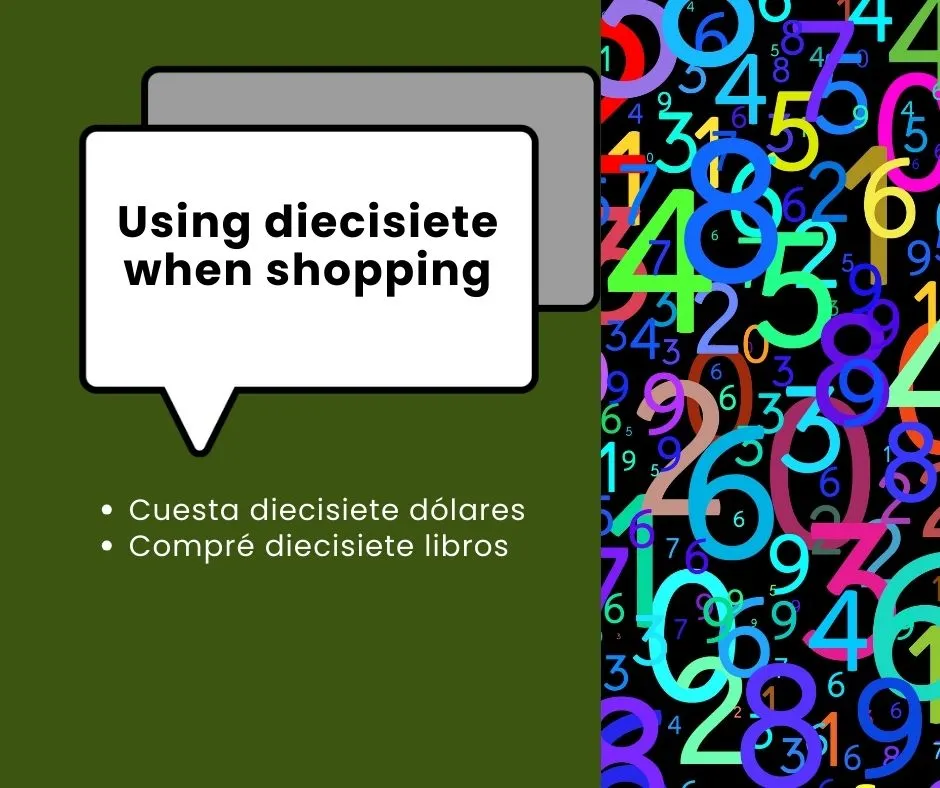
Numbers are essential while shopping or handling money.
Prices and quantities
Examples:
- Cuesta diecisiete dólares
- Compré diecisiete libros
Knowing how to say the number clearly avoids confusion.
Formal and informal use of diecisiete
Numbers do not change for formality in Spanish.
Same word in all situations
- With friends
- In school
- At work
Diecisiete stays the same everywhere, which makes it easier for learners.
Common mistakes learners make
Beginners sometimes make small errors when learning numbers.
Mixing spelling and pronunciation
Common mistakes include:
- Writing “dieci siete” as two words
- Mispronouncing the middle sound
Remember:
- It is one word
- Practice hearing it spoken
How accents affect nearby numbers
Some Spanish numbers use accent marks, which can confuse learners.
Why diecisiete has no accent
- Dieciséis has an accent
- Diecisiete does not
This is because of stress rules in Spanish. Learning this helps improve writing skills.
Comparing Spanish and English numbers
Seeing the difference helps memory.
Key differences to notice
- Spanish combines words
- English separates them
English:
- seventeen
Spanish:
- diecisiete
Understanding this difference improves reading and writing.
How children learn this number in Spanish
Spanish-speaking children learn numbers early.
Simple learning methods
- Counting aloud
- Songs and games
- Repetition
You can use the same methods as a learner.
Practice ideas for remembering diecisiete
Practice makes learning easier and faster.
Easy practice activities
- Write it five times
- Say it in a sentence
- Count from one to twenty
These small steps build confidence.
Using diecisiete in school and exams
Students often see numbers in tests.
Academic examples
- Página diecisiete
- Capítulo diecisiete
Knowing the number avoids mistakes and saves time.
Hearing diecisiete in real conversations
Listening is as important as speaking.
Where you may hear it
- Movies
- Songs
- Conversations
The more you listen, the more familiar it becomes.
Cultural notes about numbers in Spanish
Numbers are neutral but widely used.
Everyday cultural usage
- Birthdays
- Sports jerseys
- Class numbers
Diecisiete appears naturally in daily life.
Why mastering small numbers builds fluency
Small skills lead to big progress.
Confidence through basics
- Faster responses
- Better understanding
- Clear pronunciation
One number learned well helps with many others.
Frequently Asked Questions
How do you say 17 in Spanish?
You say 17 in Spanish as diecisiete.
Is diecisiete one word or two words?
Diecisiete is written as one word in Spanish.
Does diecisiete change for masculine or feminine?
No, diecisiete stays the same for all genders.
Is there an accent mark in diecisiete?
No, diecisiete does not use an accent mark.
Why is learning how to say 17 in Spanish important?
Learning how to say 17 in Spanish helps with ages, dates, prices, and daily conversations.
Conclusion
Learning how to say 17 in Spanish may seem simple, but it plays an important role in daily communication.
The word diecisiete is easy to use, sounds natural, and fits many real-life situations.
By practicing it in sentences and daily use, you build confidence step by step.
Keep learning, keep practicing, and enjoy your Spanish journey.
Also Check These Posts:
How to Say I Miss You Without Saying It | Real-Life Examples That Feel Genuine
How to Say My Condolences in Spanish | Communicate Comfort and Support
How to Say Good Evening in French | Speak Like a Native Tonight
How to Say We in Spanish | Make Your Conversations Smooth in 2026

Daniel Carter
Hi, I’m Daniel Carter, a passionate storyteller and lifelong explorer of languages and cultures. Writing has always been my way of connecting with the world, sharing stories that inspire, educate, and entertain. I love diving into the nuances of communication and finding beauty in the words we use every day. Over the years, I’ve dedicated myself to crafting stories that resonate across borders and languages. When I’m not writing, you’ll usually find me exploring new places or learning something new about the world around me. My goal is to create stories that make readers think, smile, and sometimes even dream.
Books:
-
Whispers Across Borders
-
The Language of Hearts