
Learning numbers is one of the first steps in mastering any new language.
If you’re wondering how to say 12 in Spanish, you’re in the right place.
This quick guide is made for beginners who want a clear, simple answer without confusion.
By the time you finish reading, you’ll confidently know how to say 12 in Spanish and use it naturally in everyday situations.
Understanding the Number 12 in Spanish
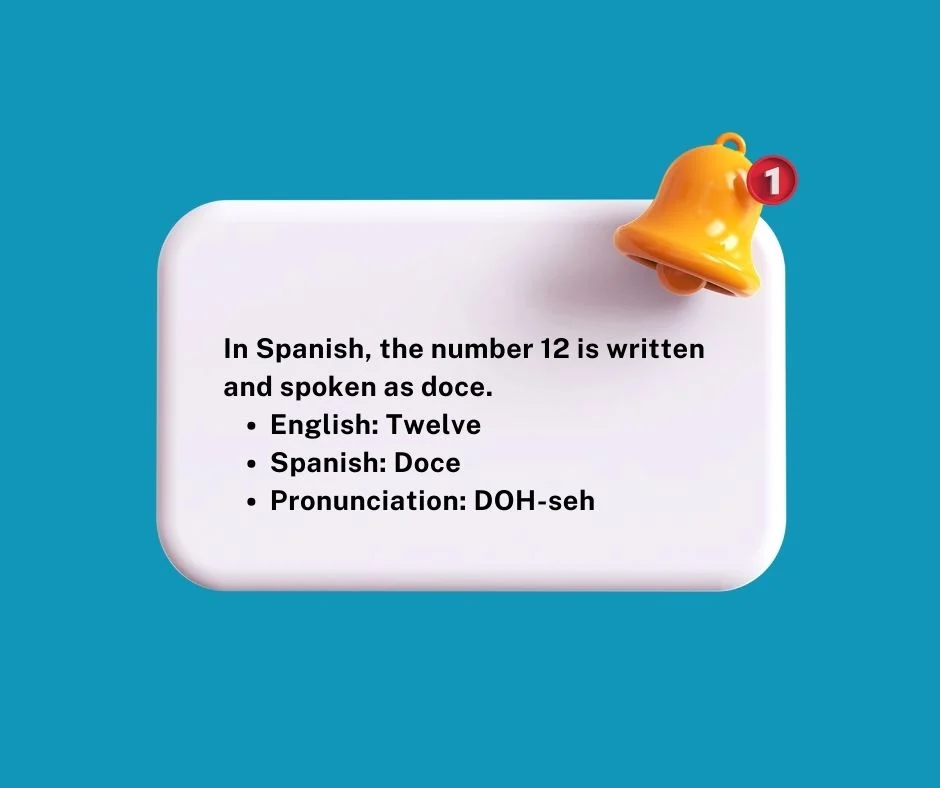
In Spanish, the number 12 is written and spoken as doce.
- English: Twelve
- Spanish: Doce
- Pronunciation: DOH-seh
This word is short, simple, and used very often. Once you learn it, you will hear it in many real-life situations, such as time, dates, ages, prices, and quantities.
Spanish numbers from 1 to 15 have unique forms, so they must be memorized. Twelve does not follow a pattern like higher numbers, which is why learning doce early is helpful.
Correct Pronunciation of Doce
Pronouncing Spanish words correctly helps you sound more confident and clear. Let’s break down doce step by step.
How Doce Sounds
- Do sounds like “doh”
- Ce sounds like “seh” (in Latin American Spanish)
Say it smoothly as DOH-seh.
Helpful Pronunciation Tips
- Stress the first syllable: DO-ce
- Keep the sound soft and clear
- Do not pronounce the “e” strongly at the end
Practicing aloud a few times a day will help fix the pronunciation in your memory.
Why Doce Is Different From Other Numbers
When learning how to say 12 in Spanish, many students wonder why it does not follow a clear pattern like other numbers.
Spanish numbers from 1 to 15 are unique words:
- One: uno
- Two: dos
- Three: tres
- Eleven: once
- Twelve: doce
After 15, Spanish numbers start following clearer patterns. That is why doce should be memorized rather than calculated.
Using Doce in Everyday Spanish
Knowing how to say 12 in Spanish is useful in many daily situations. Below are common ways doce appears in real life.
Talking About Time
Spanish often uses numbers when telling time.
Examples:
- Son las doce. (It is twelve o’clock.)
- A las doce del mediodía. (At twelve noon.)
- A las doce de la noche. (At twelve at night.)
This is one of the most common uses of doce.
Talking About Age
When speaking about age, Spanish uses the verb tener.
Examples:
- Tengo doce años. (I am twelve years old.)
- Ella tiene doce años. (She is twelve years old.)
This structure is very common in beginner Spanish.
Talking About Dates
Dates in Spanish also use numbers.
Examples:
- El doce de mayo. (The twelfth of May.)
- Hoy es doce de marzo. (Today is March twelfth.)
Here, doce acts as a date number.
Talking About Quantity
You will often use doce when counting items.
Examples:
- Doce libros. (Twelve books.)
- Doce estudiantes. (Twelve students.)
- Doce manzanas. (Twelve apples.)
Spanish nouns usually come after the number.
Writing 12 in Spanish Correctly
Writing doce is straightforward, but spelling matters.
Correct spelling:
- Doce
Common mistakes to avoid:
- Dose
- Doose
- Douse
Always remember that doce has one “o” and ends with “ce.”
Grammar Rules When Using Doce
Spanish grammar changes slightly when numbers are used with nouns.
Singular and Plural Nouns
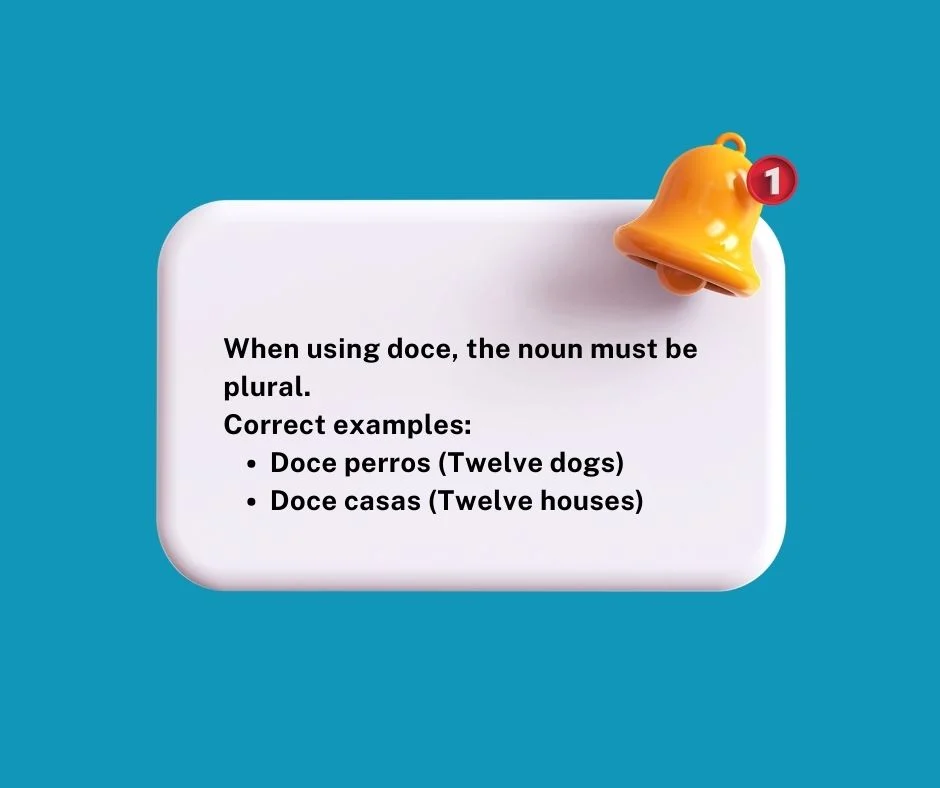
When using doce, the noun must be plural.
Correct examples:
- Doce perros (Twelve dogs)
- Doce casas (Twelve houses)
Incorrect example:
- Doce perro
This rule applies to all numbers greater than one.
Doce in Questions and Answers
Knowing how to say 12 in Spanish also helps when asking or answering questions.
Examples:
- ¿Cuántos años tienes? Tengo doce años.
- ¿Cuántos estudiantes hay? Hay doce estudiantes.
- ¿Qué día es hoy? Es doce de abril.
These examples show how naturally doce fits into conversation.
Comparing 12 With Nearby Numbers
Understanding doce becomes easier when you compare it with nearby numbers.
- 11: once
- 12: doce
- 13: trece
These numbers are often confused by beginners, so practicing them together is helpful.
Tip:
Once sounds like “on-seh”
Doce sounds like “doh-seh”
Trece sounds like “treh-seh”
Common Phrases Using Doce
Here are common phrases you may hear or use:
- Las doce en punto (Exactly twelve o’clock)
- Doce horas (Twelve hours)
- Docena (A dozen, related to doce)
The word docena comes from doce and means a group of twelve.
Cultural Use of Twelve in Spanish-Speaking Countries
The number twelve has cultural importance in many Spanish-speaking regions.
Examples:
- Las doce uvas (The twelve grapes eaten at midnight on New Year’s Eve)
- Doce meses del año (Twelve months of the year)
Knowing how to say 12 in Spanish helps you understand traditions and conversations better.
Learning Tips to Remember Doce
Memorizing doce becomes easier with practice and repetition.
Helpful tips:
- Say it aloud every day
- Write it in sentences
- Use flashcards
- Practice with real objects
Example:
- Count twelve items around you and say “doce” each time.
Common Mistakes Beginners Make
Many learners make small mistakes when learning how to say 12 in Spanish.
Mistakes to avoid:
- Mixing it with eleven (once)
- Mispronouncing the ending
- Using singular nouns after doce
Practice slowly and focus on clarity.
Practice Examples for Beginners
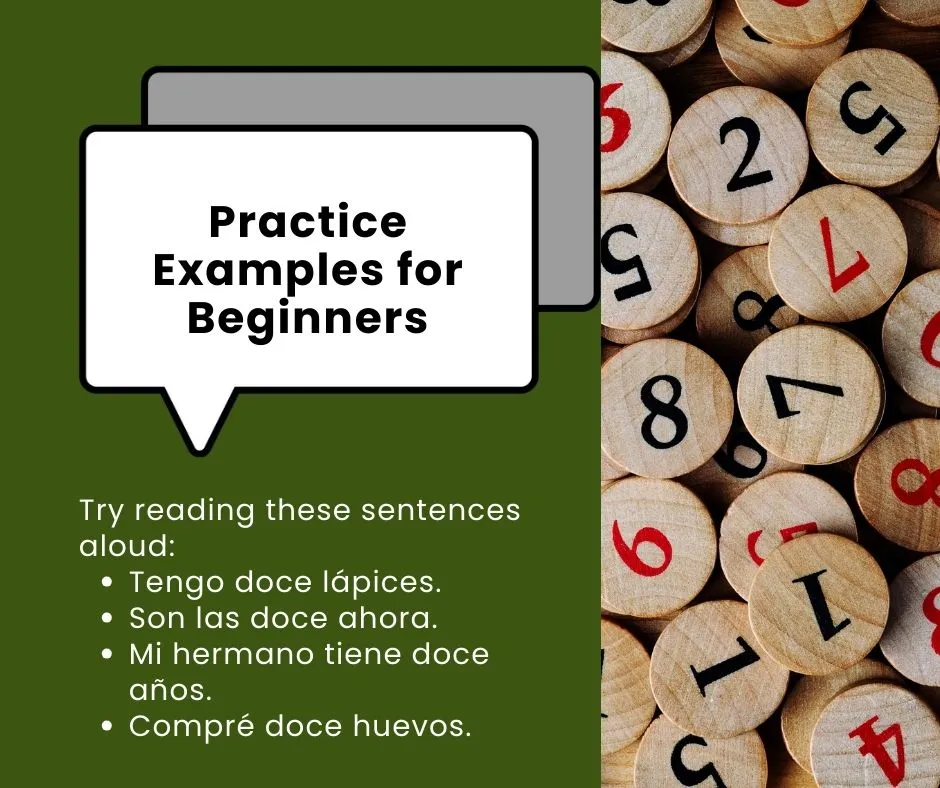
Try reading these sentences aloud:
- Tengo doce lápices.
- Son las doce ahora.
- Mi hermano tiene doce años.
- Compré doce huevos.
These simple sentences help reinforce learning naturally.
Frequently Asked Questions
What is 12 in Spanish called
The number 12 in Spanish is called doce, and it is used in counting, dates, time, and quantities.
How do you pronounce 12 in Spanish
Doce is pronounced as DOH-seh, with stress on the first syllable.
Is doce masculine or feminine
Doce itself does not change gender, but the noun after it must match gender and be plural.
How is doce used in sentences
Doce is placed before plural nouns, such as doce libros or doce años.
Is doce used the same in all Spanish-speaking countries
Yes, doce is used the same way and spelled the same across all Spanish-speaking countries.
Conclusion
Understanding how to say 12 in Spanish is a key step for beginners and students learning the language.
The word doce is simple, common, and used in many everyday situations like time, age, dates, and counting.
With correct pronunciation, proper grammar, and regular practice, you will use it confidently in real conversations.
Keep practicing, and your Spanish skills will grow steadily.
Also Check These Posts:
How to Say Happy Thanksgiving with Heart in 2026
How to Say 17 in Spanish Without Mistakes
Learn How to Say You’re Welcome in Italian and Impress Everyone

Darcy Lynn
Darcy Lynn has always been fascinated by the colors and stories of life. Her journey with writing began in childhood, and today she takes readers into new worlds through her stories. For her, every word is a way to explore new experiences and emotions. Darcy loves exploring stories across different cultures and languages, which also reflects in her unique writing style. She believes that a good story touches every heart and sparks deeper thinking. Alongside writing, she enjoys connecting directly with her readers and understanding their feelings.
Books:
-
Whispers Across Worlds
-
Echoes of Tomorrow